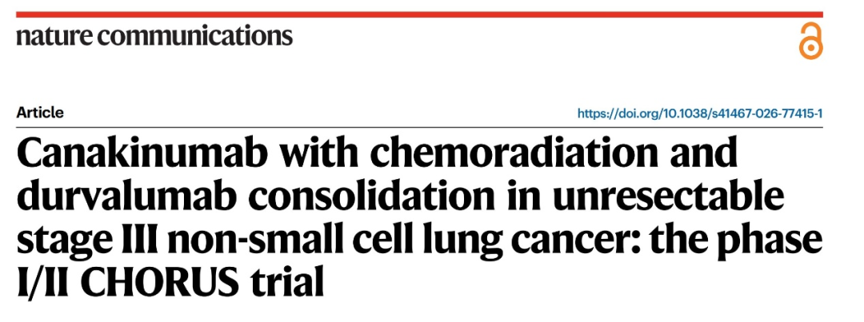
Advances in modern oncology have introduced a range of groundbreaking treatment approaches for lung cancer, making it one of the fastest-evolving solid tumors. To help clinicians gain a deeper and more comprehensive understanding of major developments in this field, Oncology Frontier has partnered with Professor Hua Zhong, Director of the Department of Pulmonary and Critical Care Medicine at Shanghai Chest Hospital, and Professor Baohui Han to launch a series of clinical updates titled “Zhong” Voice, “Hui” Insights. Through expert interpretations of high-quality clinical studies in lung cancer, the series aims to promote improvements in clinical practice and patient care.In this episode, the two professors discuss the study “Efficacy and Safety of Canakinumab Combined with Chemoradiotherapy and Durvalumab in Patients with Unresectable Stage III NSCLC: The Phase I/II CHORUS Study.” The study was recently published in Nature Communications.
Study Overview
Background and Study Design
For patients with unresectable stage III locally advanced non-small cell lung cancer (NSCLC), durvalumab is the current standard treatment option based on data from the PACIFIC study. Previous research has shown that interleukin-1β (IL-1β) contributes to immune resistance and the development of an immunosuppressive tumor microenvironment. Canakinumab is a highly selective, fully human monoclonal antibody targeting IL-1β. This study aimed to explore the efficacy and safety of canakinumab combined with durvalumab as induction and maintenance treatment for patients with unresectable stage III NSCLC.
This investigator-initiated study was a single-arm, open-label clinical trial. It enrolled patients with histologically confirmed unresectable stage III NSCLC. Patients who had not experienced disease progression after concurrent chemoradiotherapy began immunotherapy 2–8 weeks after completing their last treatment.
During concurrent chemoradiotherapy, canakinumab was administered subcutaneously at 200 mg once every 3 weeks for a maximum of three cycles. During the period of concomitant treatment with durvalumab, canakinumab was administered at 200 mg once every 4 weeks for a maximum of 12 cycles. The primary endpoint was the 2-year progression-free survival (PFS) rate.
Efficacy and Safety Results
A total of 41 patients were screened, 37 received study treatment, and 32 were included in the efficacy assessment. Adenocarcinoma accounted for 59% of cases. The proportions of patients with stage IIIA, IIIB, and IIIC disease were 31%, 44%, and 25%, respectively. The proportions of patients with programmed death-ligand 1 (PD-L1)-negative tumors, PD-L1 expression of 1–49%, and PD-L1 expression of ≥50% were 48%, 24%, and 28%, respectively.
The 24-month PFS rate was 67%, with a lower bound of the 90% confidence interval (CI) of 56.5%, exceeding the prespecified historical benchmark of 46%. The 12-month PFS rate was 75%. The overall survival (OS) rates at 12 and 24 months were 93% and 73%, respectively. Median PFS and OS had not been reached.
A total of 37 patients were included in the safety analysis. No deaths related to canakinumab treatment were observed.
During concurrent chemoradiotherapy, grade 3 or higher adverse events (AEs) potentially related to canakinumab included one case of febrile neutropenia, four cases of neutropenia, and one case of lymphopenia. One additional patient experienced grade 4 febrile neutropenia.
During combination treatment with durvalumab, grade 3 or higher AEs included one case each of pulmonary infection, fatigue, and hypertension.
Expert Commentary
Professor Baohui Han:
This study is an exploratory investigation in the treatment of unresectable stage III NSCLC. For patients with unresectable stage III NSCLC without driver gene mutations, the current standard of care is immune checkpoint inhibitor maintenance therapy following concurrent or sequential chemoradiotherapy. However, some patients still experience recurrence or rapid disease progression, indicating that unmet clinical needs remain in this setting. This exploratory study may help expand treatment options for patients with stage III lung cancer without driver gene mutations.
Several points should be considered when interpreting the findings.
First, this was a small, single-arm, open-label exploratory study without a blinded control group. Its conclusions are primarily intended to generate hypotheses for subsequent research.
Second, the baseline characteristics of the enrolled population were not entirely consistent with those of the PACIFIC study and other trials. Therefore, the results should not be directly compared with those of PACIFIC.
Third, according to the intention-to-treat (ITT) principle in clinical trials, all patients who receive study treatment should be included in efficacy and safety analyses. In this study, 37 patients received study treatment, but only 32 were included in the efficacy analysis. One patient who did not complete treatment for safety reasons and patients who dropped out early were excluded. These exclusions may have introduced additional bias into the data analysis.
Finally, the study did not report driver gene mutation status in its presentation of baseline characteristics. According to established treatment standards, patients with driver gene mutations should not be prioritized for immunotherapy-based treatment. The study flowchart indicates that one patient was excluded from subsequent analyses because they received an epidermal growth factor receptor tyrosine kinase inhibitor (EGFR-TKI). However, some patients whose mutation status was unknown were included in the analysis, potentially affecting the accuracy of the analyzed population definition.
Professor Hua Zhong:
The development of canakinumab in lung cancer has been a rather winding journey, originating with the CANTOS study. The original objective of CANTOS was to evaluate whether canakinumab could reduce the risk of cardiovascular events after myocardial infarction. Subgroup analyses suggested that canakinumab could reduce lung cancer mortality, and further analyses found that this protective effect appeared to increase with higher canakinumab doses.
Subsequently, canakinumab was investigated in several settings involving patients without driver gene mutations, including postoperative adjuvant therapy, first-line combination therapy, and second-line combination therapy. However, all three randomized controlled trials (RCTs) yielded negative results.
The CANOPY-A study enrolled patients with lung cancer who had undergone curative surgical resection, received adjuvant platinum-based doublet chemotherapy, and experienced no disease progression. Patients received canakinumab or placebo. The results showed that median disease-free survival (DFS) was 35.0 months in the canakinumab group and 29.7 months in the placebo group (hazard ratio [HR], 0.94; P=0.258).
The CANOPY-1 study focused on first-line treatment for advanced lung cancer without driver gene mutations. It used chemotherapy plus pembrolizumab as the control regimen and investigated whether adding canakinumab could provide additional benefit. Median OS was 20.8 months in the four-drug group and 20.2 months in the three-drug group (HR, 0.87; P=0.123). The respective 24-month OS rates were 46.01% and 40.01%. Median PFS was 6.8 months in both groups (HR, 0.85; P=0.102), while the objective response rates (ORRs) were 45.6% and 45.5%, respectively. None of the three efficacy endpoints demonstrated an advantage for the combination treatment.
The CANOPY-2 study enrolled patients with advanced lung cancer without driver gene mutations whose disease had become resistant to platinum-based doublet chemotherapy and immune checkpoint inhibitor treatment. Canakinumab plus docetaxel was compared with docetaxel alone, but the results were also negative. Median OS was 10.6 months in the canakinumab combination group and 11.3 months in the chemotherapy-alone group.
None of these three clinical studies demonstrated positive results.
The present study focused on unresectable stage III NSCLC and explored the efficacy and safety of canakinumab combined with durvalumab. The study met its prespecified benchmark, bringing renewed attention to the development prospects of canakinumab in lung cancer. However, as noted above, this was only a single-arm exploratory clinical study, and the strength of its conclusions cannot be considered comparable to that of the three RCTs. Further investigation is needed before the role of canakinumab in lung cancer can be established.

Professor Baohui Han

Professor Hua Zhong