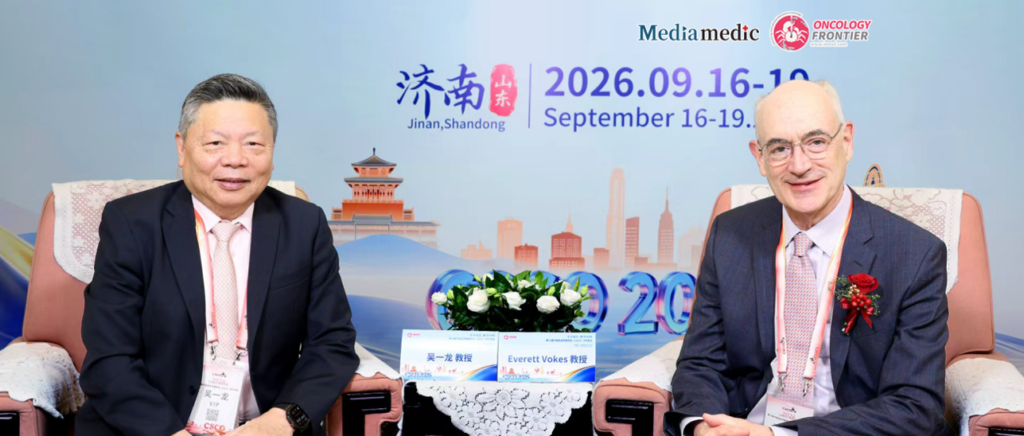
Editor's Note: The 2026 CSCO Academic Annual Meeting was held in Jinan from September 16 to 19, bringing together oncology experts from China and around the world. On this occasion, Oncology Frontier invited Professor Yi-Long Wu of Guangdong Provincial People's Hospital to speak with Professor Everett Vokes, Chair of the Department of Medicine at the University of Chicago and former President of the American Society of Clinical Oncology (ASCO). Their discussion explored the biological characteristics of MET-amplified non-small cell lung cancer (NSCLC), the current diagnostic and treatment landscape in China and the United States, and future directions for international collaboration.As an important mechanism of resistance to EGFR tyrosine kinase inhibitors (EGFR-TKIs), MET amplification has long presented clinical challenges, including inconsistent testing standards and limited targeted treatment options. In 2025, China’s innovative drug vebreltinib received domestic approval for MET-amplified NSCLC, becoming the first MET-TKI approved worldwide as monotherapy for this indication [1]. Later that year, findings from the KUNPENG study were published in the internationally renowned journal The Lancet Oncology, marking a significant shift in understanding MET amplification—from a resistance mechanism to an actionable oncogenic driver [2]. Both professors agreed that MET amplification should be incorporated into routine clinical testing and that international multicenter collaboration and regulatory dialogue are essential to advancing this field globally.
From Resistance Mechanism to Actionable Oncogenic Driver
Biological Characteristics of MET Amplification and the Current Diagnostic and Treatment Landscape in China and the United States
Oncology Frontier:
Thank you, Professor Wu and Professor Vokes, for accepting our invitation. To begin, what are the biological characteristics of MET-amplified NSCLC? Based on your clinical experience, could you describe the current diagnostic and treatment landscape for MET-amplified NSCLC in China and the United States?
Professor Yi-Long Wu: It is a great pleasure to discuss the diagnosis and treatment of MET-amplified NSCLC with my good friend Professor Vokes. As we all know, MET is a widely recognized oncogenic driver, and MET alterations encompass several distinct types.
The first is MET exon 14 skipping, a well-known alteration for which targeted therapies are now available. Some of these drugs have received approval from both the US Food and Drug Administration (FDA) and China’s National Medical Products Administration (NMPA).
The second category includes the less common MET fusions and MET amplification. Only a small number of lung cancer cases involving MET fusions have been reported worldwide, but available evidence suggests that these tumors can respond favorably to MET inhibitors. MET amplification, by contrast, has attracted greater clinical attention because it is an important mechanism of resistance to EGFR inhibitors. Among patients whose disease progresses following EGFR-TKI-targeted therapy, approximately 20%–40% develop resistance associated with MET amplification [3–5]. This is a clinically significant finding.
The third category is MET protein overexpression. At the upcoming ESMO Congress, we will announce the results of a phase III clinical trial targeting MET-overexpressing tumors, which should help further refine treatment strategies directed at MET.
However, I believe the most pressing issue is how to standardize testing and accurately identify the different types of MET alterations.
- MET exon 14 skipping: Testing can be performed using next-generation sequencing (NGS), polymerase chain reaction (PCR), and other technologies.
- MET fusions: DNA- or RNA-based sequencing can be used to identify fusion subtypes. However, testing for MET amplification is fundamentally different from testing for mutations or fusions. The central challenge is that the field lacks a universally accepted threshold for defining amplification.
- MET protein overexpression: Immunohistochemistry (IHC) testing faces similar challenges, including the difficulty of standardizing positivity thresholds and the absence of consistent criteria for interpreting results.
That is the current situation regarding MET diagnostics in China. I would now like to invite Professor Vokes to discuss the diagnostic and treatment systems in the United States and other Western countries.
Professor Everett Vokes: First, congratulations on your contributions throughout your career. You have produced a substantial body of valuable research on MET as a therapeutic target. As faculty members at the University of Chicago, our team has followed your work in this field with great interest.
Our team began exploring MET quite early. At that time, Professor Ravi Salgia was still at the University of Chicago. He had previously conducted research at Harvard University and continued his work on MET after moving to Chicago, focusing particularly on the mechanisms underlying different MET alterations. As many of you know, the subsequent breakthrough discoveries concerning MET exon 14 skipping emerged from this foundation of research.
Among the known oncogenic driver alterations in lung cancer, at least 10 or more are now routinely tested. Some alterations are extremely complex. I would put HER2 and MET in this category because abnormalities in these genes do not necessarily occur in a single form; they can involve amplification, overexpression, mutations, and other alterations. In China, patients with EGFR mutations may develop several different resistance mechanisms when their disease progresses, and you have made major contributions across these areas.
In the United States, the proportion of patients found to have MET alterations at initial diagnosis is relatively low. MET exon 14 skipping does occur, however, and testing for it has become part of routine molecular testing, even though its overall incidence remains low.
At present, MET protein overexpression is not yet a universally required routine test, although an increasing number of medical centers have begun to assess it. The same is true of MET amplification: it has not yet been incorporated into routine testing systems. In my view, however, MET amplification should absolutely be included in routine testing, particularly in light of the KUNPENG study of vebreltinib that you have been advancing and that we will discuss further. This study explored the possibility of MET amplification acting as an independent oncogenic driver, thereby enabling the identification of patients most likely to benefit from this type of targeted treatment.
We now understand that MET-targeted drugs can be used to intervene in MET amplification or overexpression that emerges following resistance to first- or third-generation EGFR inhibitors. A substantial number of influential clinical trials have been conducted worldwide. One particularly notable example is the China-led SACHI study of savolitinib, although savolitinib has not yet received FDA approval in the United States.
Overall, the clinical value of MET as a therapeutic target is widely recognized in the field. At least in clinical practice at the University of Chicago, the use of MET-related diagnostic testing and treatment has become highly established.
The National Comprehensive Cancer Network (NCCN) publishes clinical practice guidelines used internationally [6], and its recommendations incorporate MET-related diagnosis and treatment. For MET exon 14 skipping, several drugs, including capmatinib and tepotinib, have been approved. These drugs may also be used in patients with high-level MET amplification or MET overexpression. For MET-overexpressing tumors, the ADC telisotuzumab vedotin is another treatment option.
Nevertheless, the clinical efficacy of these MET-targeted therapies remains suboptimal. Patients can respond to treatment, but responses are generally short-lived, and only a minority achieve durable benefit. We therefore still need to develop better next-generation MET-targeted drugs.
Professor Yi-Long Wu: You have just mentioned several MET-targeted drugs recommended by the NCCN guidelines. However, we have also noticed that some NCCN-recommended drugs have not yet received formal FDA approval. What is your perspective on this?
Professor Everett Vokes: I work at an academic medical institution rather than a regulatory agency, so I cannot fully represent the reasoning of regulators. However, I believe the FDA carefully reviews the complete clinical trial data during the approval process. It also evaluates several key considerations, including whether a trial was conducted across multiple international centers or exclusively in a single country. These factors are important in regulatory decision-making.
I sincerely hope that many promising MET-targeted drugs currently under development in China will eventually receive approval in the United States. As more mature clinical data become available, we are increasingly able to see that these drugs can provide meaningful survival benefits for patients.
Professor Yi-Long Wu: In 2025, vebreltinib became the first drug approved by China’s NMPA for MET-amplified NSCLC, particularly in patients with de novo MET amplification. Let us focus on MET amplification. Should it be regarded as a clearly established, independent oncogenic driver, or is its status as a targetable driver still uncertain?
Professor Everett Vokes: I fully agree that it is a well-established, independent oncogenic driver. Your clinical data have already demonstrated that treatment with vebreltinib as first-line monotherapy produces an objective response rate approaching 50% [2]. In my view, this provides compelling evidence that MET amplification represents a distinct oncogenic driver that can be therapeutically targeted.
At present, MET amplification is not yet a routinely required test at initial diagnosis. Its adoption in clinical testing often depends on the availability of an approved targeted therapy. Previously, no targeted drug had been approved for this indication anywhere in the world, so testing remained relatively uncommon. I hope clinical practice worldwide will gradually evolve in this direction.
Professor Yi-Long Wu: I agree. Is this the first MET-TKI approved worldwide specifically for MET-amplified NSCLC?
Professor Everett Vokes: Absolutely. It is also the first major study in this field to have its findings formally published. You were the first author of the paper, which was published in The Lancet Oncology last December [2]. Its clinical prospects are very encouraging. I sincerely hope the drug will proceed to global multicenter clinical trials so that patients in more countries can benefit.
Professor Yi-Long Wu: The KUNPENG study provided the first clear evidence that MET amplification can function as an independent oncogenic driver and can be targeted therapeutically. I would also like to invite you to share your views with our clinical colleagues in China: How should we advance the clinical adoption and wider use of this MET-amplification-targeted therapy globally, particularly in China?
Professor Everett Vokes: I am not a drug-development specialist in regulatory affairs, but regulatory agencies in China, the United States, and most other countries place considerable emphasis on whether a drug has been adequately evaluated in diverse populations worldwide, including whether genetic and treatment-response differences across ethnic groups have been characterized.
These core questions need to be addressed early. For example, we must establish the optimal dose. In the past, we sometimes selected doses that were too high, resulting in additional adverse effects. During the very early stages of drug development, it may be worth evaluating two or three dose levels in parallel to determine whether a somewhat lower dose can maintain comparable efficacy while further reducing toxicity.
The historical principle of administering the maximum tolerated dose originated in the chemotherapy era and was entirely reasonable in that context. However, it is not necessarily appropriate for the development of targeted therapies and immunotherapies today. We need to redefine how optimal doses should be determined for these newer treatments.
I strongly recommend establishing a global multicenter development strategy at an earlier stage, rather than conducting all studies exclusively within a single country.
Professor Yi-Long Wu: As you mentioned, the landmark findings from the KUNPENG study of vebreltinib were published in The Lancet Oncology only last year. At present, there are relatively few dedicated discussions worldwide about MET amplification in NSCLC. I believe that future major international oncology conferences should organize dedicated sessions to systematically examine the full spectrum of diagnosis, treatment, and ongoing management of MET-amplified disease.
Professor Everett Vokes: This is critically important. You have just returned from the World Conference on Lung Cancer, I believe. I was unable to attend this year because of scheduling conflicts, but colleagues across the global lung cancer community have reached a consensus: MET amplification must be incorporated into routine clinical testing. Drugs targeting this alteration are advancing rapidly through development, and the corresponding patient population can clearly derive meaningful survival benefits from targeted treatment.
Professor Yi-Long Wu Guangdong Provincial People’s Hospital
This represents the opening of an entirely new window for MET amplification—and potentially amplification of other oncogenic drivers—in cancer diagnosis and treatment. We now recognize that many gene amplifications can occur as co-alterations or function as independent drivers of tumor development.
From Chinese Innovation to Global Collaboration
The Future of Precision Diagnosis, Treatment, and Research in MET-Amplified Disease
Oncology Frontier:
Let us move to the next topic. How can researchers in China and internationally strengthen collaboration to improve the accurate identification and treatment of MET-amplified disease?
Professor Yi-Long Wu: Over the past two years, many innovative drugs originating in China have emerged on the global stage, particularly ADCs, small-molecule agents, and bispecific antibodies. Several important clinical trials have also originated in China. Professor Vokes, how do you think Chinese and international researchers can collaborate to advance clinical oncology together?
Professor Everett Vokes: I believe collaboration is extremely important. China is clearly developing many excellent drugs and has successfully brought numerous new medicines forward. Judging by the number of abstracts submitted to this year’s ASCO Annual Meeting, China was among the leading countries. Overall, I believe China’s participation in global oncology has increased substantially. I am therefore confident that collaboration will expand—and that it will happen soon.
Professor Yi-Long Wu: I believe there are several ways to collaborate. First, we can work together on clinical trials. When investigators participate in clinical trials, they gain firsthand experience of the drugs being evaluated and can directly assess their potential. This is very important.
Professor Everett Vokes: Major organizations such as CSCO, ASCO, and ESMO are already collaborating. This is also why I am attending this meeting. As a faculty member at the University of Chicago, I came because I want to learn about the best new drugs. If some of these drugs eventually become available in the United States, we may be interested in conducting research on them. Collaboration is therefore essential.
Professor Yi-Long Wu: As you mentioned, clinical trials could be one starting point. Perhaps we could establish platforms or organize small workshops to help investigators maintain communication and develop collaborative relationships.
Professor Everett Vokes: Regulatory agencies may also need to be involved, including those in China and other countries, to clarify how international collaboration can be conducted more efficiently.
Conclusion
The shift in understanding of MET amplification—from an important mechanism of EGFR-TKI resistance to an independent oncogenic driver that can be targeted with monotherapy—reflects the continued advancement of precision oncology in lung cancer.
The approval of vebreltinib in China and publication of the KUNPENG study have not only addressed an important gap in targeted monotherapy for MET-amplified NSCLC but have also brought Chinese innovation onto the global academic stage. As both professors emphasized, MET amplification should be incorporated into routine clinical testing. Cross-border multicenter collaboration, regulatory dialogue, and data sharing could help fundamentally improve outcomes for patients worldwide.
As Chinese innovation continues to converge with global scientific expertise, MET amplification—once a major treatment challenge—is emerging as a new opportunity for breakthroughs in precision medicine.

Professor Yi-Long Wu

Professor Everett Vokes