
At the selected target dose of 60 mg, obrixtamig combined with standard therapy as first-line induction and maintenance treatment for extensive-stage small cell lung cancer (ES-SCLC) achieved an objective response rate of 76% and a 6-month progression-free survival rate of 85%. The safety profile was consistent with the known safety profiles of the individual agents.The 29th Annual Meeting of the Chinese Society of Clinical Oncology (CSCO) was held in Jinan from September 17 to 19, 2026. During the meeting, Professor Xinghao Ai from the Clinical Medical Center for Lung Cancer at Shanghai Chest Hospital presented data from the phase I DAREON®-8 clinical trial in an oral presentation.
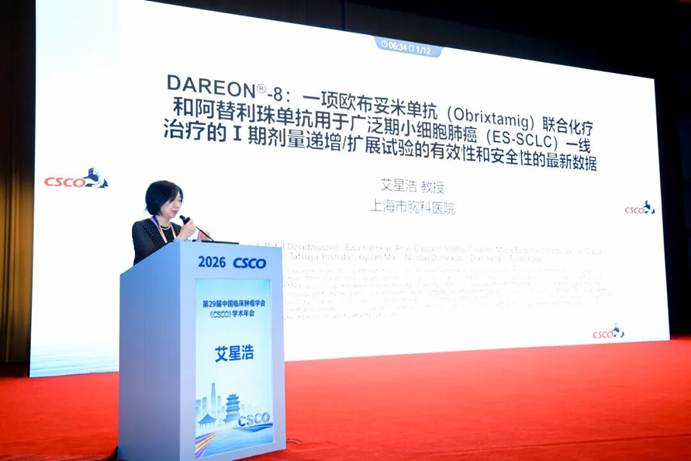
The study evaluated obrixtamig in combination with first-line standard of care (SoC)—carboplatin, etoposide, and atezolizumab—as induction and maintenance treatment for adults with ES-SCLC. The findings showed that the combination had a safety profile consistent with the known safety profiles of the individual agents. At the selected target dose, the regimen demonstrated encouraging and durable clinical activity, offering a new avenue for investigation in this highly aggressive lung cancer subtype, for which treatment options remain limited. These results were previously presented at the 2026 Annual Meeting of the American Society of Clinical Oncology (ASCO) in May.
Professor Xinghao Ai presents data from the phase I DAREON®-8 clinical trial.
The primary endpoint of the study was dose-limiting toxicity (DLT). The results showed that obrixtamig plus SoC did not produce any new or unexpected safety signals. No patients experienced grade 3 or higher cytokine release syndrome (CRS) or grade 3 or higher immune effector cell-associated neurotoxicity syndrome (ICANS), and the combination was generally well tolerated.
In terms of efficacy, obrixtamig plus SoC also demonstrated encouraging results in the first-line treatment of ES-SCLC. Among patients who received the selected target dose of obrixtamig (60 mg; n=29), the confirmed objective response rate (cORR) was 76% (95% confidence interval [CI], 58–88), with three patients (10%) achieving a complete response (CR). Regarding progression-free survival (PFS), the 6-month PFS rate was 85% (95% CI, 72–99), and the 9-month PFS rate was 73% (95% CI, 55–90).
These findings are particularly noteworthy given the longstanding treatment challenges faced by patients with ES-SCLC. Lung cancer is the leading malignancy in China in terms of both incidence and mortality, with approximately 1.0606 million new cases and 733,300 deaths reported in 2022. Small cell lung cancer (SCLC) accounts for approximately 15% of lung cancer cases and is characterized by high malignancy, substantial heterogeneity, and aggressive behavior. Most patients are diagnosed with ES-SCLC, an advanced stage in which the disease has spread to the contralateral lung or distant organs. The prognosis is extremely poor, with a 5-year survival rate of approximately 10%.
Currently, platinum-based chemotherapy with etoposide combined with an immune checkpoint inhibitor has become the first-line standard of care for ES-SCLC. Although this approach has improved survival outcomes to some extent, substantial limitations remain. Most patients still experience rapid disease progression, while second-line treatment options are limited and their efficacy remains modest. Improvements in overall survival remain unsatisfactory. Furthermore, this standard treatment approach has not demonstrated a clear survival advantage for patients with brain metastases. Overall, the unmet medical needs of patients with ES-SCLC remain considerable.
In recent years, continued advances in precision oncology have brought innovative therapeutic strategies targeting delta-like ligand 3 (DLL3) into the spotlight, offering new treatment possibilities for patients with SCLC. Obrixtamig, currently under investigation, is a DLL3/CD3 bispecific T-cell engager (TcE) that targets DLL3. It can simultaneously bind to DLL3 on the surface of tumor cells and CD3 on the surface of T cells, bringing T cells into close proximity to tumor cells and activating T-cell-mediated cytotoxicity to kill DLL3-expressing tumor cells.
The phase I DAREON®-8 study demonstrated that obrixtamig in combination with first-line SoC was well tolerated and showed promising efficacy, potentially establishing a new direction for precision treatment in SCLC.
Professor Xinghao Ai commented:
“For patients with extensive-stage small cell lung cancer, the disease progresses rapidly, and some patients experience rapid progression even during induction therapy. As a result, treatment options in subsequent lines are extremely limited.
“The phase I DAREON®-8 study showed encouraging signals in both tolerability and efficacy with obrixtamig combined with standard therapy. The duration of response and PFS data suggest that patients may be able to achieve a longer period of disease control while maintaining a relatively manageable quality of life.
“Meanwhile, SCLC has long lacked breakthrough therapeutic targets and innovative drugs, and the first-line treatment landscape has changed little over the years. The emergence of DLL3-targeted TcEs introduces a completely new mechanism of action and combination strategy for first-line treatment of ES-SCLC. This approach may overcome some of the limitations of traditional chemotherapy combined with immunotherapy and further improve long-term survival outcomes.
“If subsequent phase III studies confirm a survival benefit with this strategy, it could mark a new stage in the development of first-line SCLC treatment and bring greater hope to patients.”
Professor Xinghao Ai presents data from the phase I DAREON®-8 clinical trial.

Professor Xinghao Ai