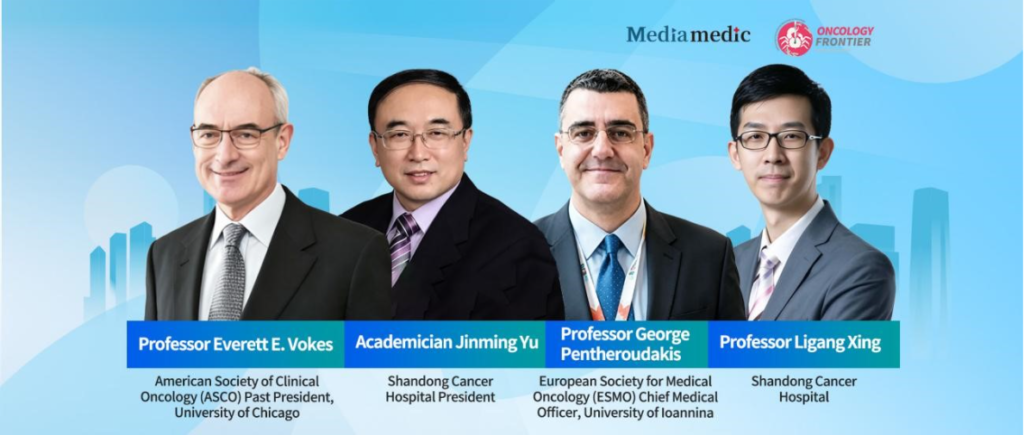
Editor's Note: Translating evidence from clinical trials into routine clinical practice involves multiple stages, including translational research, regulatory approval, reimbursement, and adaptation to clinical settings. Overcoming these challenges is a shared priority for the global oncology community. During the 2026 Annual Meeting of the Chinese Society of Clinical Oncology (CSCO), Oncology Frontier brought together three leading figures for an international dialogue: Academician Jinming Yu, President of CSCO and President of Shandong Cancer Hospital; Professor George Pentheroudakis, Chief Medical Officer of the European Society for Medical Oncology (ESMO) and Professor at the University of Ioannina; and Professor Everett E. Vokes, former President of the American Society of Clinical Oncology (ASCO) and Professor at the University of Chicago. Professor Ligang Xing of Shandong Cancer Hospital served as the invited moderator.
Under the central theme of “From Evidence to Practice,” the discussion examined practical barriers to clinical translation, explored the distinctive contributions of collaboration among the three organizations, and looked ahead to new pathways for coordinated global efforts against cancer.
01. Identifying Barriers to Translation
Key Bottlenecks in Moving from Clinical Trials to Practice
Professor Ligang Xing: The theme of this year’s ASCO–ESMO–CSCO Joint Symposium is “From Evidence to Implementation: Which Frameworks to Move Clinical Trials to Practice.” Drawing on your respective experience in clinical research and practice, what are the most significant bottlenecks currently preventing oncology research findings from being translated into clinical practice? How can a practical implementation framework balance efficacy, toxicity management, regulatory approval, reimbursement, accessibility, and real-world evidence?
Academician Jinming Yu: Translating new drugs and technologies from research into clinical practice requires the active involvement of researchers and translational medicine specialists, financial investment, and support from government regulatory and approval systems. It is a complex process that depends on coordination among multiple stakeholders. In recent years, governments at various levels in China have made substantial efforts to strengthen the translational ecosystem. Regulatory review and approval timelines for drugs and technologies have become significantly shorter, while commercial partnerships in biomedicine and the international expansion of Chinese innovation have also improved considerably.
Professor George Pentheroudakis: Several major bottlenecks arise as drugs move from development into clinical practice.
First, there are barriers to patient participation in clinical research. Second, reimbursement and payment remain major challenges shared by countries around the world. Third, the clinical implementation of artificial intelligence (AI) is still a challenge. Although AI can accelerate advances in diagnosis and treatment, clinical systems are not yet fully prepared for its widespread integration. Fourth, we need to make better use of real-world evidence. Clinical trials cannot cover every clinical scenario or answer every relevant question, so real-world data must be incorporated into clinical practice to further refine and optimize treatment strategies.
Professor Everett E. Vokes: One of the most prominent problems in clinical translation today is the waste of resources caused by redundant research. Immunotherapy provides a good example: numerous clinical trials involving PD-1/PD-L1 inhibitors pursue highly overlapping objectives and repeatedly confirm findings that are already well established. This consumes substantial research and development resources while requiring patients to undergo similar trial procedures again and again.
From a scientific innovation perspective, PD-1 and PD-L1 are already well-established targets in immunotherapy, yet progress in developing therapies against other emerging targets, such as TIGIT and LAG, remains limited. The oncology community therefore needs to identify the most urgent scientific questions and clarify the priorities for developing the next generation of drugs.
Academician Jinming Yu: We need to learn from advanced international experience and established best practices. China has the world’s largest cancer patient population and an enormous unmet need for high-quality innovative drugs, diagnostic and treatment technologies, and advanced medical equipment. This makes it particularly important for us to translate research findings into clinical practice more effectively, rapidly, and with higher quality.
02. Exploring the Value of Collaboration
The Strengths and Future Direction of Cooperation Among ASCO, ESMO, and CSCO
Professor Ligang Xing: As the former President of ASCO, the Chief Medical Officer of ESMO, and the President of CSCO, respectively, could each of you explain the distinctive value and strengths of collaboration among these three organizations? What forms of cooperation should they prioritize in the future to accelerate the translation of clinical trials into practice? Are there any initial plans or ideas?
Academician Jinming Yu: One innovation at this year’s CSCO annual meeting was the introduction of the ASCO–ESMO–CSCO Joint Symposium. It established an academic exchange platform spanning China, the United States, Europe, Russia, Central Asia, and other regions. This is highly significant for promoting cooperation among China, the United States, and Europe.
Professor Everett E. Vokes: The CSCO annual meeting brings together oncology specialists from different disciplines and provides an important platform for colleagues to exchange ideas and learn from one another. This is precisely the kind of collaboration that ASCO has consistently advocated.
Founded in 1964, ASCO is dedicated to advancing cancer research, education, and patient care. ESMO and CSCO were subsequently established, and the three organizations share highly aligned core objectives. This common ground provides a solid foundation for our collaboration.
Professor George Pentheroudakis: ESMO currently has more than 50,000 members, one-third of whom come from the Asia-Pacific region. We therefore share a substantial membership base with CSCO.
In education, ESMO has launched 30 international research fellowship awards annually for the first time and welcomes applications from Asian researchers. These programs provide valuable opportunities for talent exchange. In the area of clinical guidelines, we collaborate with CSCO and oncology societies in 10 Asia-Pacific countries to facilitate the adaptation of ESMO guidelines to local contexts.
At a recent symposium, we discussed with CSCO the globalization of oncology drug development in China and Asia, along with the practical challenges involved. ESMO’s position is clear: we welcome original innovation from all parts of the world, support comparisons and mutual recognition of regulatory standards across countries, and remain firmly committed to rigorous scientific methodology.
Building on these shared principles, we will jointly explore ways to improve global patient access to innovative therapies and make innovative treatment options more accessible. This collaboration has now formally begun, and we look forward to further in-depth discussions with CSCO on this important issue.
Professor Everett E. Vokes: I would like to add that ASCO has a dedicated Regional Council for Asia and offers young researchers a range of professional development opportunities, including Young Investigator Awards and early-career faculty development programs. I consistently encourage young physicians and researchers to learn about these initiatives and apply for them, using international platforms to advance their professional growth.
Academician Jinming Yu: The United States has accumulated extensive experience in advanced technologies and drug development. European countries bring together diverse innovative ideas and practical expertise. China, meanwhile, has one of the world’s fastest-growing oncology markets, with rapid advances in drug development, technological innovation, and advanced medical equipment, as well as the world’s largest cancer patient population.
Collaboration among these three regions can help advance international cancer diagnosis and treatment, basic research, translational medicine, and clinical outcomes. At next year’s CSCO annual meeting, we will continue to deepen this cooperation and work toward further achievements in academic exchange and collaborative research.
03. Shaping the Future
CSCO’s Strategic Priorities and Career Development Pathways for Chinese Physicians
Professor Ligang Xing: Clinical oncology research and innovative drug development in China are becoming increasingly integrated into the global landscape. What are CSCO’s plans and expectations for future research, education, and international collaboration? What advice would you offer Chinese physicians on making the most of the international platform established by CSCO to strengthen their research and clinical practice?
Academician Jinming Yu: As China’s largest and one of its leading academic organizations in oncology, CSCO has made steady progress in several areas in recent years.
The first is the standardization of diagnosis and treatment. Chinese clinical oncology guidelines are continuously updated and refined, and they are increasingly reaching international audiences, helping improve cancer care.
The second is strengthening capabilities at the grassroots level. This year, for example, CSCO provided 1,000 fully funded places covering travel, accommodation, and meals to support physicians from less-developed regions, including Xinjiang, Tibet, and Qinghai, in attending this academic meeting. Such initiatives help improve the standard of cancer care in underserved areas.
The third is developing young talent. CSCO selects outstanding young physicians to participate in international academic meetings, including the ESMO Congress and ESMO Asia, where they can exchange ideas and learn from their international peers, strengthening both their research and clinical capabilities.
Professor George Pentheroudakis: International guidelines developed by organizations such as ASCO, NCCN, and ESMO are capable of integrating scientific advances from around the world. High-quality clinical research data—whether relating to therapeutic innovations or cancer classification—can be incorporated into guidelines rapidly.
Since China joined the International Council for Harmonisation of Technical Requirements for Pharmaceuticals for Human Use (ICH) in 2017, its regulatory system has become increasingly aligned with international standards.
ESMO uses a continuously updated guideline system. High-quality evidence on treatments and tumor genomic profiles can be incorporated promptly, with clinical recommendations assigned according to the level of evidence. ESMO also applies the ESMO-Magnitude of Clinical Benefit Scale (ESMO-MCBS) to objectively assess the magnitude of clinical benefit.
In addition, multinational, multiregional clinical trials are an important way to improve the generalizability of evidence and reduce duplication in drug development. Although the underlying scientific principles of oncology are universal, regions differ in pharmacogenomic characteristics, clinical practice patterns, and supportive and palliative care systems.
These regional differences need to be taken into account from the trial design stage. By integrating them into the study design, a single trial can generate high-quality evidence that is more broadly applicable across different populations and healthcare settings.
Professor Everett E. Vokes: I strongly agree with this point. When the strength of the evidence is sufficient, it can be adopted by clinical guidelines in different countries. Although individual professional societies may review the evidence independently, their conclusions are often very similar.
Therefore, patients from multiple regions should be included early in drug development. By recognizing inherent pharmacogenomic differences and evaluating the efficacy and safety of new compounds across diverse populations, we can generate more robust evidence to support their broader clinical application.