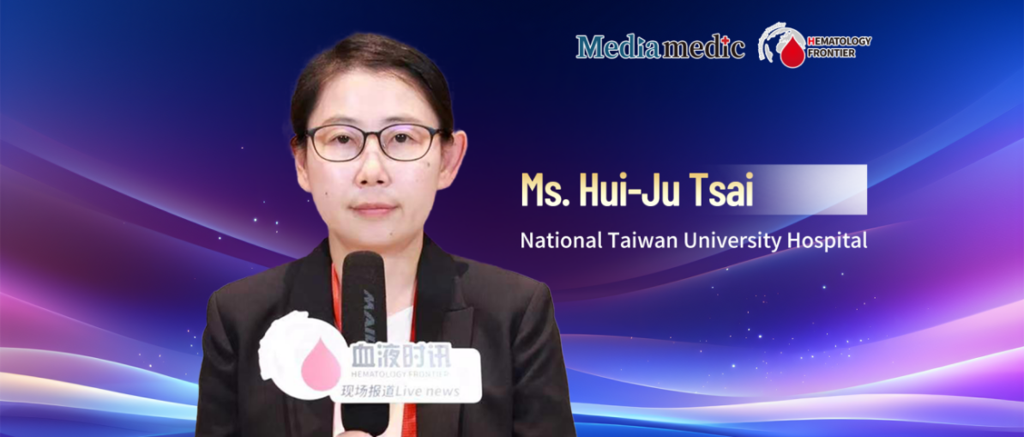
Editor's Note: In the golden autumn season, experts from across the Taiwan Strait gathered in Zhuhai. The 2026 Cross-Strait Hematology Academic Conference was held in Zhuhai, Guangdong, on August 21–22, bringing together hematology experts and scholars from both sides of the Taiwan Strait, as well as Hong Kong and Macao, for in-depth discussions on cutting-edge developments, clinical practice, and innovations in nursing. During the conference, Oncology Frontier – Hematology Frontier invited Ms. Huiju Tsai of National Taiwan University Hospital to share her perspectives on cross-Strait exchanges in hematology nursing, the application of digital tools in the comprehensive management of hematopoietic stem cell transplantation patients, and prospects for future collaboration in nursing between the two sides.Oncology Frontier – Hematology Frontier: You have come to Zhuhai to participate in the 2026 Cross-Strait Hematology Academic Conference. What were your particular impressions of the meeting? With hematology experts and colleagues from both sides of the Taiwan Strait, as well as Hong Kong and Macao, gathering at this conference, what significance do you think such a platform has for communication and development in hematology nursing?
Ms. Huiju Tsai: I am very honored to participate in this professional academic conference, and I gained a great deal from exchanging ideas with colleagues. I deeply felt that both sides of the Taiwan Strait have their own strengths in specialized hematology nursing, and that everyone is working toward the shared goal of improving the quality of patient care. I was particularly impressed by the excellent practical experience shared by nursing managers at the conference. Especially in the current context of digital transformation, leveraging information technology to empower clinical nursing can help us provide patients with more comprehensive and higher-quality care. This is certainly an area worthy of deeper study and learning.
The focus of this conference was not only on specific nursing practices, but also on how to sustain and disseminate these high-quality care experiences. We hope to establish replicable nursing models so that valuable clinical experience can be passed on and ultimately benefit more patients. Looking ahead, I hope we can establish long-term and regular mechanisms for academic exchange and communication between the two sides, jointly promoting the continued development of specialized hematology nursing.
Oncology Frontier – Hematology Frontier: At this conference, you shared your experience with the “TBMT APP: Clinical Application Experience at National Taiwan University Hospital.” Could you briefly introduce this APP? What major nursing challenges does it address, and how does it help improve the comprehensive management of patients undergoing hematopoietic stem cell transplantation?
Ms. Huiju Tsai: The core value of this APP lies in its ability to transform the traditional passive nursing model. In the past, we often discovered problems and intervened only after patients developed obvious symptoms. Now, with the help of this APP, we can identify potential problems at an earlier stage.
Through education and guidance provided by the APP, patients are also empowered to participate in their own self-management. They can proactively and promptly report symptoms of discomfort, enabling the healthcare team to intervene earlier and provide targeted treatment. This can effectively prevent subsequent symptoms from progressing to an irreversible stage. This is precisely the core concept behind the design of this APP.
Oncology Frontier – Hematology Frontier: In recent years, exchanges in hematology nursing among mainland China, Taiwan, Hong Kong, and Macao have become increasingly in-depth. Looking ahead, what are your expectations and prospects for further strengthening exchanges and collaboration in nursing between the two sides? In which areas do you think both sides could pursue greater cooperation and exploration?
Ms. Huiju Tsai: As academic exchanges between the two sides continue to deepen, we very much hope that this type of cross-Strait collaboration and exchange can become a regular practice, with opportunities to organize related activities every year. As I experienced during this conference, the diverse and distinctive experiences shared by colleagues were extremely valuable and benefited me greatly. These exchanges not only inspired me to think more deeply but also provided valuable directions for the ongoing optimization and development of our APP.
Looking ahead, we hope to further deepen collaboration between the two sides. Whether in mainland China or Taiwan, our fundamental commitment to caring for patients is the same: to provide patients with better and more comprehensive care. This is the fundamental motivation and core significance behind promoting exchange and collaboration between the two sides.
Expert Profile
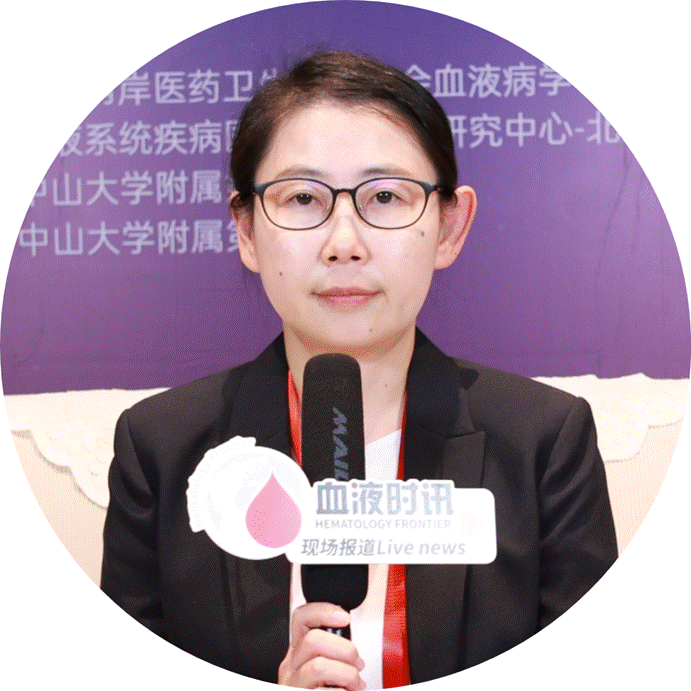
Ms. Huiju Tsai
National Taiwan University Hospital
Current Position: Bone Marrow Transplantation Case Manager, National Taiwan University Hospital
Department: Department of Nursing, National Taiwan University Hospital
Education: Department of Nursing, Taipei National University of Nursing and Health Sciences
Professional Experience:
- Mar 2002–Mar 2014: Clinical Nurse, Department of Hematology, National Taiwan University Hospital
- May 2018–Sep 2019: Clinical Research Nurse, Department of Hematology, National Taiwan University Hospital
- Oct 2019–Feb 2020: Clinical Nurse, Department of Oncology, National Taiwan University Hospital
- Mar 2020–Present: Bone Marrow Transplantation Case Manager, National Taiwan University Hospital