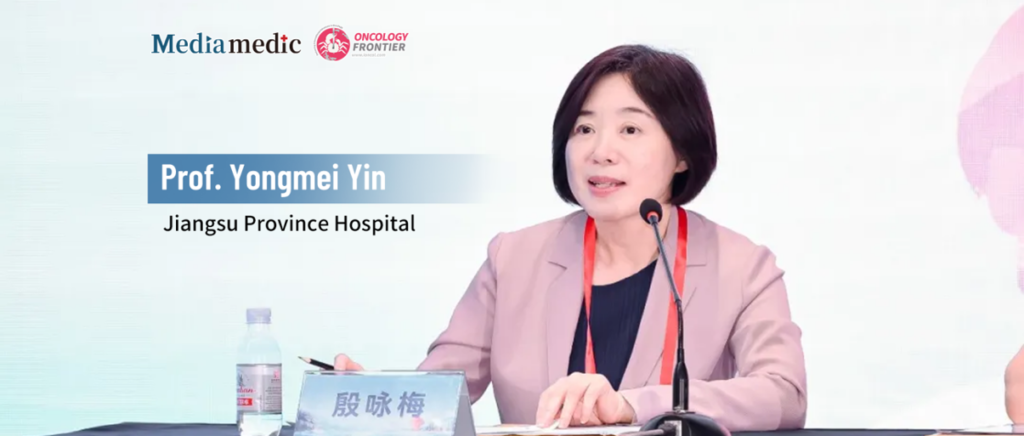
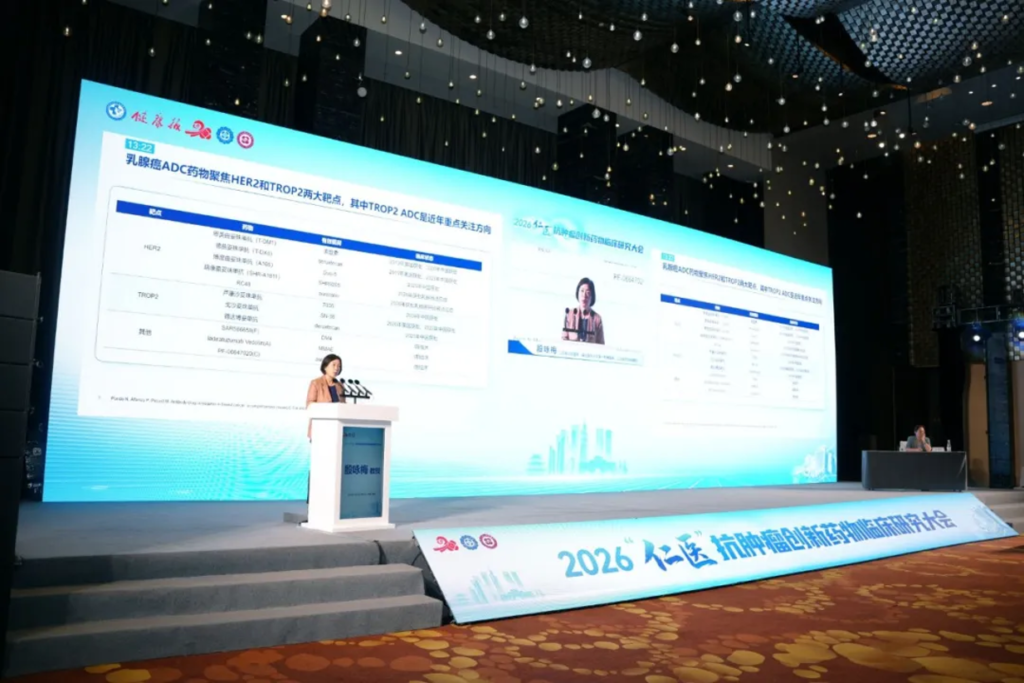
Editor's Note: From July 31 to August 2, 2026, the 2026 “Renyi” Clinical Research Conference on Innovative Anticancer Drugs was held in Nanjing. The conference was part of the academic events celebrating the 90th anniversary of Jiangsu Province Hospital (the First Affiliated Hospital of Nanjing Medical University and Jiangsu Women and Children’s Medical Center). Under the theme “Innovating Drug Development, Driving Translational Research, Celebrating 90 Years of Medical Excellence, and Embarking on a New Journey,” the conference focused on the full development pathway of clinical research on innovative anticancer drugs.During the meeting, Oncology Frontier interviewed Professor Yongmei Yin of Jiangsu Province Hospital, inviting her to provide an overview of the conference highlights and share her perspectives on translating the concept of precision medicine into clinical practice amid the rapid development of innovative drugs in China.
01
Oncology Frontier: Could you introduce the rationale behind the conference agenda and its overall design? What key messages do you think the meeting sought to convey?
Professor Yongmei Yin: The 2026 “Renyi” Clinical Research Conference on Innovative Anticancer Drugs was part of the academic events celebrating the 90th anniversary of Jiangsu Province Hospital (the First Affiliated Hospital of Nanjing Medical University and Jiangsu Women and Children’s Medical Center). The three-day agenda was designed around the entire development pathway of innovative anticancer drugs, covering several key dimensions.
The sessions on the afternoon of the first day focused on mechanistic interpretation of novel drugs and the standardization of their clinical application. On the morning of the second day, discussions shifted to the perspective of clinical research design, exploring paradigms for innovative anticancer drug development and the top-level design of clinical studies from both industrial and academic perspectives. For example, during the opening “Intelligence-Enabled Innovation” session, Academician Hongbing Shen, Vice Minister of the National Health Commission, provided a detailed overview of the innovative research initiatives planned in the healthcare sector during the 15th Five-Year Plan period, offering a broad vision and direction for conducting standardized clinical research in the years ahead.
The afternoon sessions returned to the field of translational medicine, presenting a comprehensive framework spanning basic research through clinical application. On the morning of the third day, the focus turned to the latest evidence supporting innovative drugs in precision oncology. The afternoon program featured multidisciplinary team (MDT) case discussions in breast cancer, bringing together recent research advances and perspectives from specialists across different disciplines.
In recent years, China has assumed an increasingly important role in the global landscape of anticancer drug development. The topics selected for this conference clearly demonstrated that China’s domestically developed innovative drugs have progressed from “following” to “running alongside” global leaders. Particularly in areas such as antibody-drug conjugates (ADCs), small-molecule targeted therapies, and cell therapy, a number of internationally competitive products have emerged.
We particularly hoped to showcase more high-quality clinical research generated by Chinese investigators, while encouraging young experts and scholars to develop stronger academic confidence and demonstrate China’s capabilities to the international community. Looking ahead, China’s innovative drug development should not merely address the needs of Chinese patients, but also contribute Chinese solutions to the global fight against cancer.
02
Oncology Frontier: At this meeting, you participated in both the “Precision Planning” and MDT Discussion sessions, witnessing the contrast between academic presentations and real-world clinical cases. Based on your observations, what challenges do clinicians face when translating the concept of precision medicine into treatment decisions for individual patients? Are there any common approaches that can serve as a reference?
Professor Yongmei Yin: From the academic presentations in the morning to the real-world MDT case discussions in the afternoon, my strongest impression was that the concept of “precision” has already become deeply embedded in clinical thinking, but there is still a long way to go in translating it into practice. At present, I believe the major challenges can be summarized in three dimensions.
First, the accessibility and standardization of molecular testing. Precision treatment begins with precision testing. However, in real-world clinical practice, a considerable proportion of patients do not have access to comprehensive genomic testing, or the timing and methodology of testing may not yet be sufficiently standardized. We have consistently emphasized the importance of repeat testing in patients with recurrent or metastatic disease, because an accurate molecular reassessment can provide critical guidance for treatment decisions. Nevertheless, disparities remain in testing costs, accessibility, and the ability to interpret results across different levels of healthcare institutions, particularly between primary hospitals and leading medical centers.
Second, the gap between evidence-based medicine and clinical reality. Academic presentations generally provide data generated under ideal conditions, with strict eligibility criteria, standardized treatment regimens, and comprehensive follow-up systems. By contrast, the patients we encounter during MDT discussions come from the real world. They may have multiple comorbidities, complicated treatment histories, varying financial circumstances, and significant differences in drug accessibility. How to make the best possible decision when the available evidence does not perfectly match the individual patient’s circumstances is a major test of a clinician’s comprehensive capabilities.
Third, the pace of knowledge development far exceeds the pace at which clinicians can learn and assimilate new information. New drugs are emerging continuously, and clinical guidelines are updated every year. Yet clinicians already face highly demanding workloads, leaving limited time and energy to track every new development. Consequently, when faced with a particular patient at a particular treatment decision point, physicians may still rely heavily on clinical experience.
In response to these challenges, we have summarized several practical principles.
First, “Follow guidelines when guidelines are available; when they are not, refer to consensus recommendations.” Guidelines provide the primary standardized framework, while expert consensus and clinical experience can help physicians navigate situations where guidelines do not provide a clear answer.
Second, precision medicine should be viewed as a dynamic process. Every disease progression event and every change in treatment should prompt a careful reassessment. The cases that are managed most effectively are often those in which clinicians conduct a thorough reassessment at every major decision point.
Finally, precision is not simply about selecting the right drug. It also requires considering whether the patient can afford the treatment, tolerate it, and adhere to it over time. A truly optimal treatment decision represents a careful balance among efficacy, safety, accessibility, and patient preference.
Expert Profile
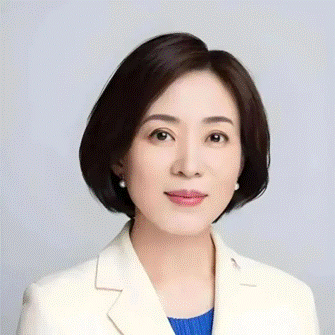
Professor Yongmei Yin
Jiangsu Province Hospital / The First Affiliated Hospital of Nanjing Medical University
Professor Yongmei Yin is a leading specialist in clinical oncology and innovative anticancer drug research at Jiangsu Province Hospital. Her work focuses on translating advances in precision oncology and innovative drug development into clinical practice, with particular attention to individualized treatment strategies and multidisciplinary cancer care.