Editor's Note: Bringing together leading experts in Hebei and staying true to its mission for 14 years. On August 21, 2026, the 14th Lu Daopei Hematology Forum officially opened at Hebei Yanda Lu Daopei Hospital. Building on 14 years of academic experience, this year's conference focused on cutting-edge topics including hematopoietic stem cell transplantation, cellular immunotherapy, and precision diagnosis and treatment of hematologic diseases. Experts and scholars from across China gathered to discuss the development of the field, making the conference an important academic platform for advancing hematologic disease diagnosis and treatment in China. During the conference, Oncology Frontier – Hematology Frontier interviewed Professor Xingyu Cao of Lu Daopei Hospital, who shared her expert insights on the role of transplantation in myelodysplastic syndromes (MDS), the timing of transplantation, advances in conditioning regimens, and strategies for preventing relapse.Oncology Frontier – Hematology Frontier: Your presentation at this conference focused on “Hematopoietic Stem Cell Transplantation for MDS.” Could you introduce the current role of HSCT in the treatment of MDS? Which patients with MDS are the most suitable candidates for transplantation?
Professor Xingyu Cao: MDS is a group of diseases that cannot be cured with conventional chemotherapy or standard treatments. Hematopoietic stem cell transplantation remains the only potentially curative treatment for MDS. However, HSCT itself carries certain treatment-related risks. For patients with low-risk or lower-intermediate-risk MDS, using transplantation as first-line treatment does not necessarily provide a net benefit. In contrast, patients with higher-intermediate-risk, high-risk, or very-high-risk MDS can derive clear survival benefits from HSCT and represent appropriate candidates for transplantation.
Oncology Frontier – Hematology Frontier: The optimal timing of transplantation in MDS—early versus delayed—has long been a subject of clinical debate. How do you balance the risk of disease progression against the risks of transplant-related complications? What factors influence the decision regarding transplant timing?
Professor Xingyu Cao: The core of this question is consistent with the logic used to determine transplant eligibility: clinicians must always seek a balance between treatment benefit and treatment-related risk. Clinically, the Molecular International Prognostic Scoring System (IPSS-M) can be used for risk stratification. Patients classified as higher-intermediate-risk, high-risk, or very-high-risk have indications for HSCT and can benefit from transplantation. However, having an indication does not mean that transplantation should be initiated immediately. A comprehensive assessment is still required, including pre-transplant evaluation of organ function, performance status, and other aspects of the patient’s overall condition. HSCT can only be performed when the patient’s organ function and general health meet the minimum requirements for transplantation.
Oncology Frontier – Hematology Frontier: What advances have been made in conditioning regimens and post-transplant maintenance therapy for MDS in recent years? How can the risk of post-transplant relapse be reduced?
Professor Xingyu Cao: MDS has several distinctive disease characteristics. First, the median age at diagnosis is relatively high. International data indicate a median age of approximately 70 years, while in China it is also above 60 years. Consequently, many of these patients have relatively compromised organ function. Therefore, even when transplantation is indicated, their physical ability to tolerate treatment must first be assessed.
When patients are able to tolerate conditioning therapy, there are currently two major approaches: myeloablative conditioning (MAC) and reduced-intensity conditioning (RIC). Prospective clinical trials have demonstrated that among patients who are able to tolerate either RIC or standard myeloablative conditioning, those receiving myeloablative conditioning have a lower risk of post-transplant relapse. Therefore, MAC remains the preferred approach for these patients to reduce the risk of relapse after transplantation.
For patients who cannot tolerate standard myeloablative conditioning, reduced-intensity conditioning is preferred. Comparative studies have shown that conditioning with melphalan plus fludarabine can reduce the risk of relapse, although it is associated with an increased risk of transplant-related non-relapse mortality. The busulfan (BU) plus fludarabine regimen has a more favorable safety profile, with the overall outcomes of the two strategies being broadly comparable. Clinicians can therefore select the appropriate approach based on the patient’s relapse risk and treatment tolerance.
In addition, novel conditioning strategies are currently being investigated. For example, decitabine or venetoclax can be incorporated into conditioning regimens, and preliminary findings suggest that these approaches may further improve patient outcomes.
About the Expert
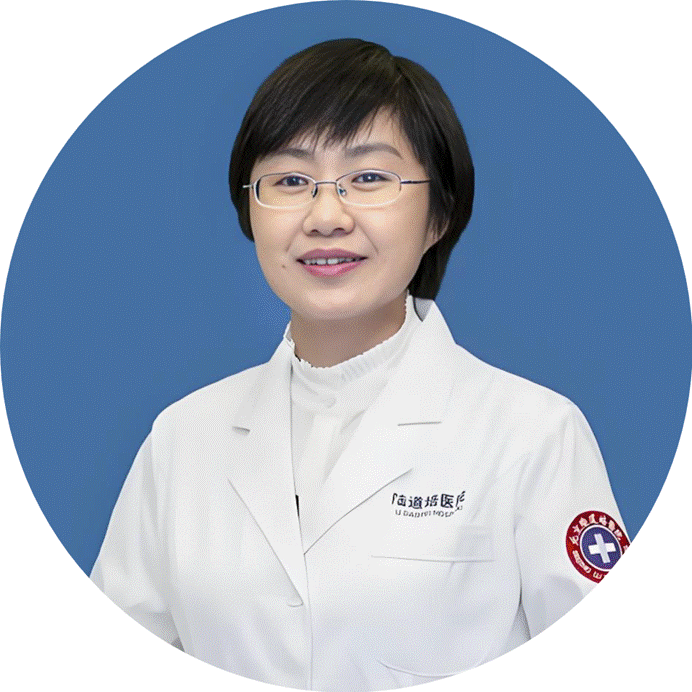
Professor Xingyu Cao
Lu Daopei Hospital
MD, Chief Physician, Transplantation Physician
Director of the Bone Marrow Transplantation Department, Beijing Lu Daopei Hospital and Hebei Yanda Lu Daopei Hospital (Deputy Hospital President level)
Committee Member, Hematology Branch, Beijing Medical Association
Committee Member, Hematopoietic Stem Cell Transplantation Committee, Beijing Cancer Prevention and Control Society
Standing Committee Member, Hematopoietic Stem Cell Application Committee, Hebei Society of Experimental Hematology
Youth Committee Member, Hematologic Disease Translational Medicine Committee, Chinese Anti-Cancer Association