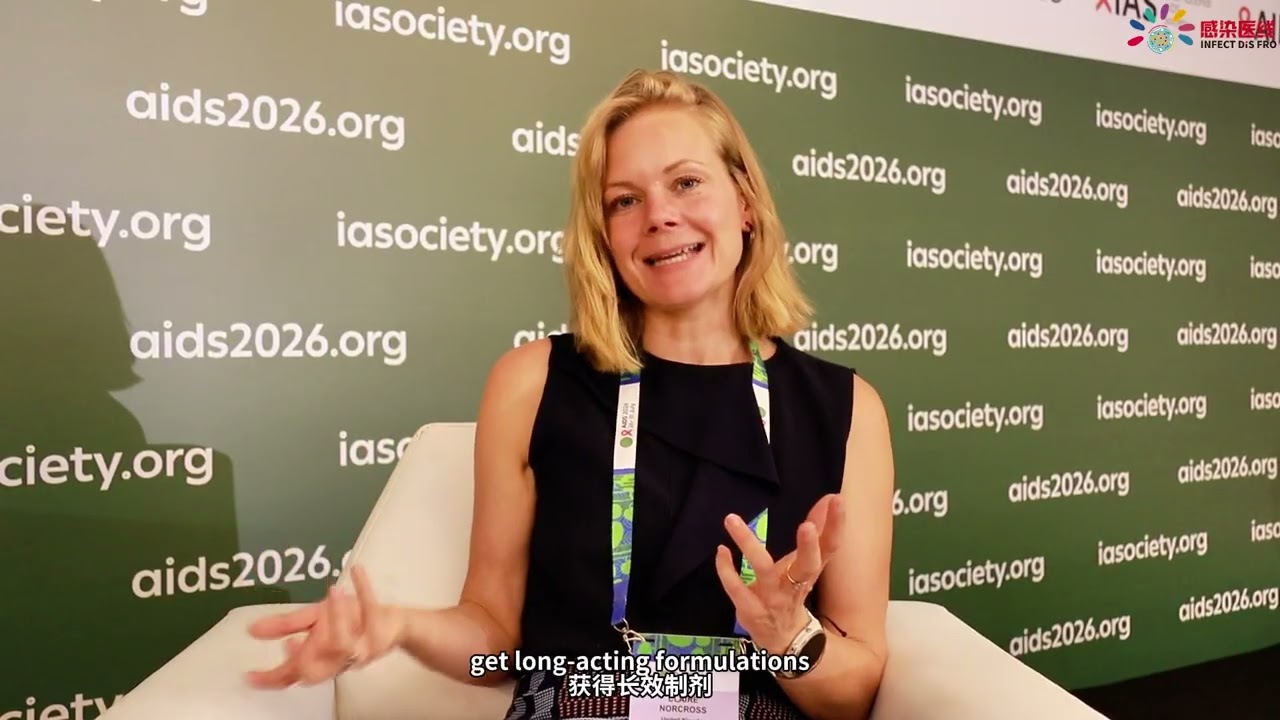
Editorial Note: The 2026 International AIDS Conference (AIDS 2026) was held in Rio de Janeiro, Brazil, covering diverse themes in global HIV/AIDS prevention and treatment. This exclusive interview features Dr. Claire Norcross from Brighton & Sussex Medical School, United Kingdom. Her research focuses on African adult people living with HIV (PLWH) with suboptimal treatment adherence, centering on regional HIV viral subtypes, prevailing drug resistance patterns, and the rollout barriers of long-acting antiretroviral formulations. Sub-Saharan Africa is plagued by constrained medical resources, highly diverse viral subtypes, and wide disparities in patient adherence; expanding access to long-acting therapies and managing drug resistance risks have long been top priorities for local public health programs. Drawing on data from her cohort studies, Dr. Norcross addresses limitations of long-acting drug application, clinical patient screening, and surveillance management frameworks, providing robust research evidence and actionable guidance for frontline HIV care across Africa.Infectious Disease Frontier: Your research centers on African adult PLWH with poor medication adherence. Could you outline the prominent characteristics of overall drug resistance prevalence and dominant HIV viral subtypes within this population? Do viral subtype diversities directly elevate the risk of resistance to conventional oral antiretrovirals?
Dr. Norcross: First, regarding the overall drug resistance landscape of this cohort. When we initiated this study, our primary concern was that the high proportion of participants with suboptimal adherence would lead to substantially higher pretreatment drug resistance (PDR) rates compared to well-adherent patient groups. However, our study employed strict enrollment criteria: all participants had no prior documented treatment failure and remained on first-line dolutegravir-based therapy throughout follow-up. This defining demographic trait is critical to interpreting our results.
Despite these adherence deficits, our initial fears of elevated resistance prevalence were not borne out, yielding reassuring overall findings. The proportion of participants carrying resistance to non-nucleoside reverse transcriptase inhibitors (NNRTIs) stood at just under 15%, consistent with routine surveillance data from African cohorts. Specifically, resistance to rilpivirine affected fewer than 6% of participants, slightly lower than regional baseline surveillance averages.
A key methodological distinction merits clarification: we sequenced proviral DNA extracted from participants’ peripheral blood mononuclear cells (PBMCs), whereas most routine surveillance assays target viral RNA from viremic patients or those reinitiating treatment. Routine surveillance populations frequently include individuals with prolonged historical NNRTI exposure and repeated treatment interruptions, which drive cumulative resistance mutations and inflate baseline resistance levels. This methodological difference makes our study cohort uniquely informative.
Notably, even with poor adherence and inconsistent treatment monitoring, all participants maintained sustained viral suppression on dolutegravir-based first-line therapy. Our NNRTI and integrase inhibitor resistance profiles aligned with regional reference surveillance datasets, revealing no abnormal resistance risks and supporting a favorable safety profile for this population.
Turning to viral subtype characteristics: the vast majority of global HIV registration clinical trials are conducted in the Northern Hemisphere and focus almost exclusively on subtype B, leaving critical data gaps for non-B subtypes. Sub-Saharan Africa exhibits a drastically distinct subtype distribution, with subtype B extremely rare and subtypes A1 and C dominating clinical isolates.
Genetic polymorphisms and subtle structural variations across HIV subtypes alter binding affinity between antiretroviral drugs and viral target proteins. This creates subtype-specific disparities in drug susceptibility and inherent resistance risk—underscoring the urgent need for region-specific research tailored to sub-Saharan African populations. Our completed validation analyses produced encouraging datasets that strongly support the resistance safety profile of standard first-line regimens within the region.
Infectious Disease Frontier: The long-acting cabotegravir plus rilpivirine regimen represents a cornerstone long-acting antiretroviral option for patients struggling with adherence. In light of your drug resistance and viral subtype findings, how do Africa’s unique subtype landscape and background resistance patterns impact the real-world efficacy and scope of use for this long-acting regimen? What practical limitations surround its deployment?
Dr. Norcross: This is an exceptionally pertinent question. The long-acting cabotegravir/rilpivirine regimen transforms clinical HIV management by improving patients’ quality of life and psychological wellbeing, reducing HIV-related stigma, and delivering a superior therapeutic alternative for poorly adherent populations. That said, several critical considerations must be weighed ahead of widespread scale-up.
This cohort study was designed precisely to address this gap: universal point-of-care testing for resistance mutations and viral subtyping is logistically unfeasible in routine African clinical settings. We therefore characterized regional resistance prevalence and subtype distributions at population level to quantify latent risks of mass rollout for this injectable regimen.
Our proviral DNA-based resistance data confirms that population-level resistance risks remain manageable for broad implementation across Africa, without cause for excessive alarm. Supplementary long-term follow-up data from the IMPALA trial reinforces the regimen’s safety profile: only one participant with virological failure harbored baseline rilpivirine resistance mutations, while all other failure cases showed no identifiable resistance-related viral risk factors.
Among participants who experienced virological failure, several were infected with subtype A1, yet this subtype alone did not raise treatment failure odds. Prior landmark trials have identified four independent risk factors predictive of regimen failure: subtype A1, subtype A6, rilpivirine resistance, and a body mass index (BMI) ≥30. Significantly, elevated failure risk only emerges when two or more of these factors co-occur—and none of our virological failure patients presented overlapping high-risk traits.
Our reassuring 96-week follow-up data further demonstrates that baseline resistance status cannot reliably predict subsequent definitive virological failure. While we are conducting additional statistical analyses to formalize this evidence, existing results show low overall rilpivirine resistance prevalence with no meaningful correlation between baseline resistance and downstream treatment failure. This carries profound clinical utility and alleviates major resistance-related hesitations around prescribing this long-acting therapy.
When evaluating implementation barriers, viral subtypes and resistance take a secondary role to limited drug accessibility as the primary bottleneck. Rilpivirine has stringent cold chain storage and transportation requirements, creating formidable logistical and warehousing hurdles for deployment across rural African regions. This necessitates targeted patient stratification and prioritized dosing strategies to allocate limited supplies to groups poised to derive the greatest clinical benefit. In summary, access gaps—not viral subtypes or background resistance—constitute the primary barrier to scaling long-acting cabotegravir/rilpivirine across Africa.
Infectious Disease Frontier: Against Africa’s backdrop of constrained healthcare resources, heterogeneous viral subtypes, and variable patient adherence, what optimized strategies can clinical and public health stakeholders adopt for targeted long-acting formulation screening, routine drug resistance surveillance, and patient care management? How can these measures minimize emergent resistance and maximize treatment success rates?
Dr. Norcross: This is a vital line of inquiry. The overarching systemic barrier to advancing these efforts is sustained research and operational funding; the core optimization priority lies in ensuring long-acting therapies reach appropriate candidates.
Key risk factors linked to subsequent treatment failure have been defined in registration trials, including viral subtype, rilpivirine resistance, and abnormal BMI. However, it remains unconfirmed whether these risk stratification criteria apply equally to sub-Saharan African populations, given the region’s unique subtype epidemiology. My research team will launch dedicated follow-up investigations to resolve this uncertainty. Low absolute counts of virological failure cases create statistical challenges for identifying robust predictive biomarkers, so we will prioritize evaluating routinely collected clinical metrics—such as prior antiretroviral regimens and cumulative treatment duration—rather than resource-intensive viral subtyping or baseline resistance testing. This approach enables accurate identification of patients most suited for long-acting formulations, maximizing therapeutic gains and curbing new resistance emergence.
On drug resistance surveillance: Africa has established a functional regional surveillance network, whose continuity hinges on consistent funding streams. The WHO has expanded its antiretroviral treatment guidelines to incorporate diversified options: alongside dolutegravir (DTG)-based first-line therapy, lamivudine (3TC)/dolutegravir dual therapy is now recommended, while cabotegravir plus rilpivirine is listed as a long-acting switch option for virally suppressed patients.
As novel simplified regimens and long-acting injectables expand in reach, routine resistance surveillance grows ever more indispensable. Sustained financial investment is non-negotiable to maintain consistent, population-wide monitoring systems.
For patient care management: WHO standardized care pathways deliver streamlined, low-complexity clinical workflows that simplify routine HIV service delivery. The TLD regimen is accessible to most treatment-naive patients with minimal clinical training requirements. Nevertheless, this uniform, one-size-fits-all framework lacks flexibility to accommodate individualized therapeutic needs.
Daily oral antiretroviral therapy (ART) continues to suffer pervasive adherence gaps, spurring growing research into weekly and monthly simplified dosing alternatives. However, widespread rollout of personalized patient care and novel treatment modalities is severely hampered by chronic underfunding.
HIV care services are increasingly integrated into general public health platforms, meaning many frontline clinicians lack specialized HIV management training—compounding challenges to consistent, individualized patient follow-up. Insufficient funding undercuts progress across all programmatic workstreams. Our immediate core priorities are expanding the breadth of available therapeutic options and improving equitable drug access, enabling all PLWH to receive personalized, effective treatment and sustain long-term health outcomes.