

The treatment landscape for renal cell carcinoma (RCC), one of the most common malignancies of the urinary system, continues to evolve rapidly, with targeted therapy combined with immunotherapy now established as a standard first-line approach for advanced and metastatic disease. However, for patients with oligometastatic RCC, a standardized treatment strategy has yet to be established.At the same time, advances in local therapies—including stereotactic body radiotherapy (SBRT), radiofrequency ablation, and surgical resection—are creating new opportunities for multidisciplinary treatment. Against this background, Prof. Liru He and colleagues from Sun Yat-sen University Cancer Center recently demonstrated that combining sunitinib with SBRT can significantly improve the objective response rate (ORR) and progression-free survival (PFS) in patients with oligometastatic RCC. The study was published in Cell Reports Medicine, providing prospective evidence for a potentially valuable treatment strategy.
Oncology Frontier invited Prof. He to discuss the respective roles of systemic therapy and SBRT, interpret the efficacy and safety of their combination, and share his perspective on the future management of oligometastatic RCC.
Oncology Frontier: Congratulations to you and your team on the publication of your study of sunitinib plus SBRT in Cell Reports Medicine. Oligometastatic RCC is considered to have potentially curable characteristics. By combining local treatment such as SBRT for visible lesions with systemic therapy such as sunitinib to control micrometastatic disease, long-term disease control may become possible. Could you explain the clinical value of these two treatment approaches?
Prof. Liru He:
At present, there is still no established optimal standard treatment for oligometastatic RCC. Because oligometastatic disease remains a form of metastatic RCC, systemic therapy undoubtedly plays an important role. Sunitinib is a classic treatment for metastatic RCC, and its efficacy has been well established through many years of clinical practice. Based on our own clinical experience, we also recognize its therapeutic value.
Recent clinical studies have suggested that oligometastatic RCC—generally characterized by no more than three to five metastatic lesions—differs to some extent from widely metastatic disease, with one of its defining characteristics being the limited number of metastatic sites.
This creates an opportunity for SBRT to precisely target and comprehensively treat these lesions, enabling local treatment of all radiographically visible disease. Previous studies have demonstrated that SBRT-based strategies can effectively delay disease progression.
Combining systemic and local therapies therefore represents a potentially powerful strategy. Local therapy can eradicate a limited number of radiographically visible lesions, while systemic therapy can address potential micrometastatic disease and suppress further tumor progression.
Based on previous clinical experience and retrospective data from Sun Yat-sen University Cancer Center, this combined treatment approach has demonstrated encouraging therapeutic activity in patients with oligometastatic RCC while maintaining a favorable safety profile.
Oncology Frontier: Your team conducted a prospective phase II study evaluating first-line sunitinib combined with SBRT in patients with oligometastatic RCC. The results showed significant improvements in ORR and PFS. Could you walk us through the key data and explain what these findings mean for patients?
Prof. Liru He:
Previous studies of oligometastatic RCC conducted by international centers, including teams at MD Anderson Cancer Center, have largely used single-arm designs, meaning that the level of evidence has remained somewhat limited.
Our recent phase II study published in Cell Reports Medicine is, to our knowledge, the first prospective controlled study internationally to specifically evaluate this approach in oligometastatic RCC. It therefore helps fill an important gap in prospective comparative evidence.
The results were very encouraging.
Compared with the sunitinib-alone control group, the addition of SBRT significantly increased the objective response rate from 29.2% to 83.3% (P<0.001).
Local disease control was also excellent. At a median follow-up of 40.6 months, the 1-year local control rate exceeded 90%.
Most importantly, the combination produced a substantial improvement in progression-free survival. Median PFS reached 17.3 months in the sunitinib-plus-SBRT group, representing an improvement of approximately 11 months compared with the control group.
These findings support the concept that oligometastatic RCC should not necessarily be approached in the same way as extensively metastatic disease. When the metastatic burden is limited, aggressive treatment of visible lesions with SBRT, combined with systemic therapy to control microscopic disease, may provide a meaningful opportunity to achieve deeper and more durable disease control.
The marked improvement in ORR and PFS observed in our study also provides prospective evidence supporting the synergistic value of systemic therapy plus comprehensive local treatment in appropriately selected patients with oligometastatic RCC.
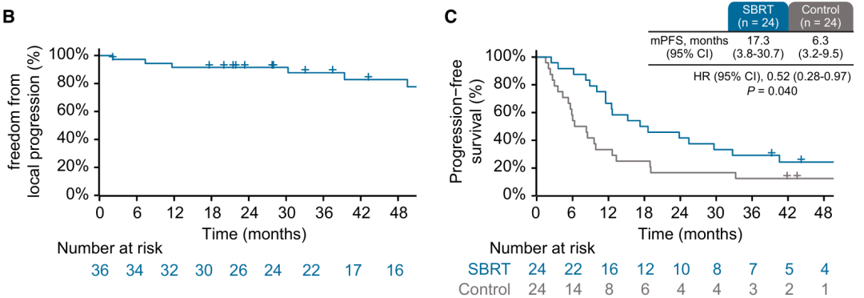
Sunitinib Plus SBRT: Local Control and PFS Analysis
Based on these findings, sunitinib combined with SBRT has the potential to become a promising treatment option for patients with oligometastatic RCC. The strategy highlights the synergistic benefit of combining local therapy with systemic treatment while offering an important advantage in terms of tolerability: compared with dual targeted therapy–immunotherapy combinations, the incidence of grade 3 adverse events was lower.
Using sunitinib plus SBRT as an initial treatment could therefore provide patients with oligometastatic RCC with an effective and relatively well-tolerated first-line option. Subsequent transition to targeted therapy plus immunotherapy could establish a stepwise treatment strategy across the disease course, potentially extending overall survival by preserving additional effective treatment options for later lines.
Oncology Frontier: Current consensus recommendations generally suggest temporarily withholding TKIs around SBRT, although these recommendations are largely based on evidence from hepatocellular carcinoma. Several studies in RCC, however, have suggested that concurrent SBRT and TKI therapy is tolerable, which is consistent with the findings of your study. Could you discuss the safety findings and quality-of-life outcomes? What clinical implications do these results have for the future use of sunitinib plus SBRT?
Prof. Liru He:
In clinical practice, particularly when SBRT is involved, the decision of whether targeted therapy should be temporarily interrupted depends on both the specific drug being used and the tumor type being treated.
In renal cell carcinoma, most patients have normal coagulation function. Furthermore, available retrospective and prospective evidence suggests that, provided SBRT can be administered safely, the concurrent use of targeted agents such as sunitinib generally has a favorable safety profile.
Our clinical study provides additional evidence supporting this approach. Compared with patients receiving sunitinib alone, those treated with sunitinib plus SBRT had a comparable incidence of severe adverse events, with no statistically significant difference between the two groups.
Importantly, the addition of SBRT did not compromise patients’ quality of life. On the contrary, quality-of-life measures showed a trend toward improvement following SBRT.
Taken together, these findings provide important evidence that SBRT can be delivered concurrently with ongoing targeted therapy without substantially increasing severe toxicity or negatively affecting quality of life.
From a clinical perspective, this supports the safety and feasibility of integrating SBRT into systemic treatment for appropriately selected patients with oligometastatic RCC. Rather than viewing local and systemic therapies as separate or sequential interventions, our findings suggest that they can potentially be combined within an integrated treatment strategy to maximize disease control while maintaining acceptable tolerability and patients’ quality of life.
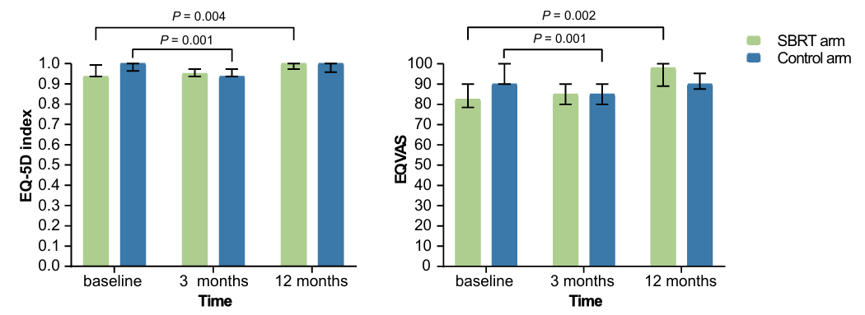
Quality-of-Life Analysis: Sunitinib Plus SBRT vs Sunitinib Alone
Oncology Frontier: In recent years, targeted therapies and immunotherapies have become increasingly integrated into the treatment of renal cell carcinoma. Against this rapidly evolving therapeutic landscape, how do you view the value of sunitinib combined with SBRT? What further research directions will your team pursue?
Prof. Liru He:
The treatment landscape for renal cell carcinoma has changed substantially with continued advances in systemic therapy. Targeted therapy–immunotherapy combinations have become a mainstream treatment approach, while newer agents such as belzutifan are providing additional therapeutic opportunities. Nevertheless, the ultimate goal remains to prolong overall survival (OS). At the same time, achieving effective tumor reduction while extending the period without disease progression remains an important clinical objective.
For patients with oligometastatic RCC, precise risk stratification is particularly important. Unlike patients with widespread metastatic disease, these patients have an opportunity to benefit from local treatment. SBRT can effectively reduce visible tumor burden and delay disease progression, raising an important question: for oligometastatic patients—particularly those with favorable- or intermediate-risk disease—is an intensive dual-drug systemic regimen always necessary?
Based on a series of studies conducted by our team at Sun Yat-sen University Cancer Center, we believe there may be an opportunity to explore a safer, less intensive approach for selected patients. One potential strategy is to combine SBRT with a single systemic agent, such as sunitinib or immunotherapy monotherapy.
Such an approach could offer several advantages. It may reduce treatment costs while maintaining effective tumor control, lower the risk of grade 3 adverse events, and preserve highly effective systemic treatment combinations for subsequent lines of therapy.
If patients can achieve a prolonged period of disease control with SBRT plus single-agent systemic therapy, they would still retain additional effective treatment options should the disease eventually progress. This sequential approach could potentially maximize overall survival and establish a more sustainable long-term disease management strategy.
Looking ahead, we believe that developing differentiated treatment strategies according to individual patient risk profiles will become increasingly important in RCC.
Our team is currently conducting the phase III STROKER study in patients with oligometastatic RCC. This study is evaluating the addition of radiotherapy to standard systemic treatment, with the aim of determining whether this strategy can improve survival outcomes.
Importantly, we also hope to use subgroup analyses to identify which patients derive the greatest benefit from radiotherapy and what intensity of systemic therapy is appropriate for different patient populations.
As the STROKER study continues to mature, we expect its findings to provide clearer answers to several important questions facing clinicians and patients and, ultimately, help define a more individualized treatment paradigm for oligometastatic RCC.

Prof. Liru He