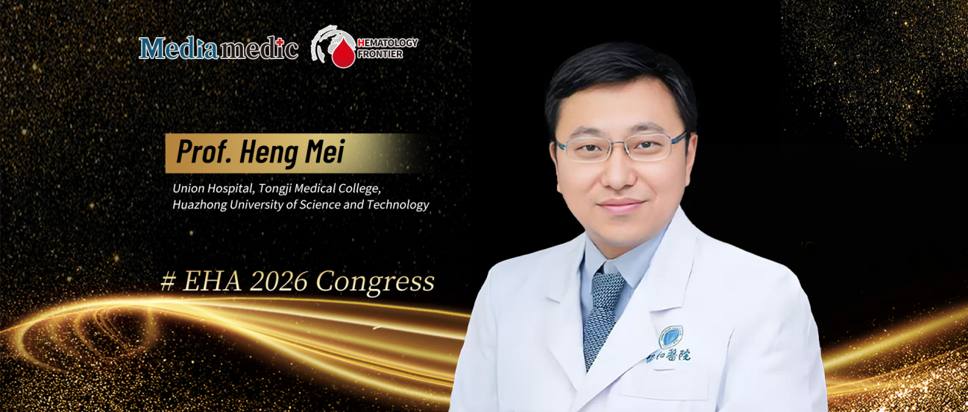
Refractory immune thrombocytopenia (ITP) remains a major clinical challenge. Characterized by frequent relapses, chronic treatment dependence, and limited curative options, many patients struggle to achieve durable remission despite multiple lines of therapy.At the 2026 European Hematology Association (EHA) Congress, a groundbreaking study led by Professor Heng Mei from Union Hospital, Tongji Medical College, Huazhong University of Science and Technology, was selected for the prestigious Late-Breaking Oral Session (LBA). The study represents the first successful application of BCMA CAR-T therapy in refractory ITP, extending CAR-T technology beyond hematologic malignancies and demonstrating durable treatment-free remission in patients with severe disease.
Using comprehensive multi-omics analyses, the investigators uncovered patterns of immune remodeling following treatment and proposed the novel concept of “immune resetting” in autoimmune diseases. The findings challenge traditional treatment paradigms and provide a new theoretical framework for achieving long-term disease control—and potentially functional cure—in autoimmune disorders.
During the meeting, Oncology Frontier – Hematology Frontier interviewed Professor Mei to discuss the clinical significance and future implications of this landmark research.
Moving Refractory ITP Toward Functional Cure
Oncology Frontier – Hematology Frontier:
Congratulations on having your study selected for the EHA 2026 Late-Breaking Oral Session. For patients with refractory ITP, who have long lacked effective treatment options, your study demonstrated rapid and durable treatment-free remission. How might these findings reshape current treatment concepts? Could this signal the beginning of a “functional cure” era for refractory ITP?
Professor Heng Mei:
It is a great honor for our work to be selected for the Late-Breaking Abstract session at EHA 2026. This platform highlights the most important emerging developments in hematology and reflects future directions for the field.
Our study represents an innovative intersection between autoimmune disease and cellular therapy. Although the current data remain preliminary, the clinical and scientific implications are highly significant.
From a clinical perspective, the study achieved two major breakthroughs.
First, we successfully introduced BCMA CAR-T therapy—originally developed for multiple myeloma—into the treatment of ITP, making this the first reported use of a BCMA-targeted CAR-T strategy in this disease.
Second, several patients achieved prolonged treatment-free remission, with the longest remission duration approaching sixteen months. This addresses one of the most frustrating challenges in chronic ITP: long-term dependence on continuous medication.
From a scientific standpoint, single-cell sequencing allowed us to visualize the evolution of immune-cell clones throughout treatment.
Unlike cancer therapy, where the goal is complete eradication of malignant clones and elimination of measurable residual disease (MRD), autoimmune diseases such as ITP require a fundamentally different approach. The central issue is not simply the presence of abnormal cells but the loss of immune balance.
We therefore believe that the key therapeutic objective is immune resetting—restoring equilibrium between dysregulated T-cell and B-cell populations and re-establishing immune homeostasis.
This concept of immune resetting represents the most important scientific contribution of our study and will be a major focus of future investigation.
Understanding the Concept of “Immune Resetting”
Oncology Frontier – Hematology Frontier:
Beyond the efficacy results, your study employed single-cell sequencing as well as BCR and TCR analyses to characterize immune remodeling after BCMA CAR-T therapy. How do you define immune resetting, and what insights do these findings provide regarding autoimmune disease pathogenesis and curative treatment strategies?
Professor Heng Mei:
My interest in applying CAR-T therapy to ITP dates back to 2022, when German investigators first reported successful use of CD19 CAR-T therapy in systemic lupus erythematosus (SLE). That work demonstrated that eliminating pathogenic B cells could effectively control autoimmune disease.
Inspired by those findings, our team initiated our own CD19 CAR-T clinical studies in SLE.
During those studies, we observed two particularly important phenomena.
First, most patients achieved rapid clinical remission.
Second, unlike clonal malignancies, B-cell recovery occurred remarkably early. Some SLE patients demonstrated B-cell reconstitution within approximately one month after treatment, and B-cell recovery appeared even faster in ITP.
These observations suggested fundamental biological differences between autoimmune diseases and hematologic cancers.
To better understand these differences, we performed extensive analyses including TCR sequencing, BCR sequencing, and myeloid-cell profiling to capture the dynamic evolution of the immune system during therapy.
Our results showed that although B cells rapidly returned, the newly regenerated B-cell population was fundamentally different from the disease-associated population present before treatment. The post-treatment immune landscape displayed features consistent with extensive immune remodeling.
We also observed significant alterations in cytokine profiles, T-cell signaling pathways, and myeloid-cell networks.
Based on these findings, we propose a bold hypothesis: the therapeutic activity of CAR-T therapy in autoimmune disease extends far beyond simple B-cell depletion.
Instead, CAR-T appears to initiate a comprehensive process of immune reconstruction involving:
- Reorganization of antibody-producing cell populations
- Modulation of antigen presentation
- Reprogramming of cytotoxic T-cell responses
- Remodeling of myeloid-cell–driven inflammatory networks
This broader process is what we define as immune resetting.
The concept provides a new framework for understanding both autoimmune disease biology and the mechanisms underlying successful cellular therapies.
Expanding CAR-T Beyond Oncology
Oncology Frontier – Hematology Frontier:
This study demonstrates the potential of BCMA CAR-T therapy beyond cancer treatment. What key challenges remain, and could BCMA CAR-T eventually be expanded to a broader range of antibody-mediated autoimmune diseases?
Professor Heng Mei:
CAR-T therapy has now evolved for nearly fifteen years, particularly within hematologic malignancies.
The successful translation of CD19 CAR-T from leukemia and lymphoma into autoimmune disease, and now the extension of BCMA CAR-T from multiple myeloma into ITP, highlight the value of identifying disease-driving targets.
The application of BCMA CAR-T to ITP represents not only a therapeutic innovation but also a conceptual shift in how we think about autoimmune diseases.
Historically, treatment strategies focused primarily on suppressing T-cell activity. Going forward, the goal should be more fundamental: identifying and eliminating the pathogenic cellular sources responsible for producing disease-causing autoantibodies.
This represents a profound change in both scientific understanding and therapeutic philosophy.
At the same time, broader implementation will require careful patient selection.
In our clinical trial, enrollment criteria specifically targeted patients with demonstrable autoantibody involvement who had failed or become dependent on corticosteroids, intravenous immunoglobulin, and thrombopoietin receptor agonists. These patients appear most likely to benefit from CAR-T–based intervention.
For patients whose disease is driven more heavily by T-cell dysfunction, we are exploring next-generation approaches that combine CAR-T therapy with strategies designed to restore T-cell homeostasis.
The potential applications extend well beyond ITP.
Other investigators have already begun exploring CAR-T therapy in autoimmune hemolytic anemia. Theoretically, diseases such as autoimmune cytopenias, aplastic anemia, and even certain forms of myelodysplastic syndromes (MDS) and myeloproliferative neoplasms (MPNs) may ultimately become candidates for cellular immunotherapy.
At its core, CAR-T therapy—like stem-cell transplantation and gene therapy—is a platform technology for engineering immune cells.
As these technologies continue to evolve, their applications will increasingly extend beyond hematologic malignancies and into a broader spectrum of immune-mediated diseases.
Emerging innovations such as in vivo CAR-T and universal CAR-T platforms may further accelerate this transformation and unlock entirely new therapeutic possibilities.