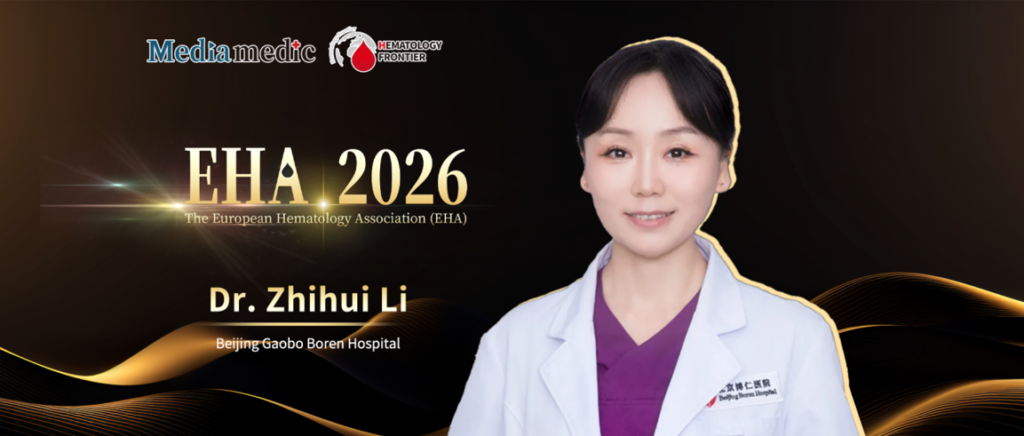
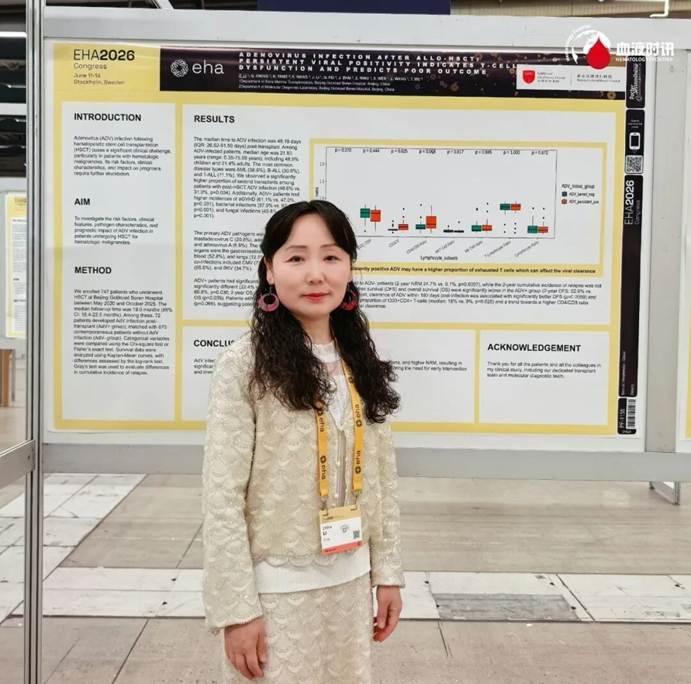
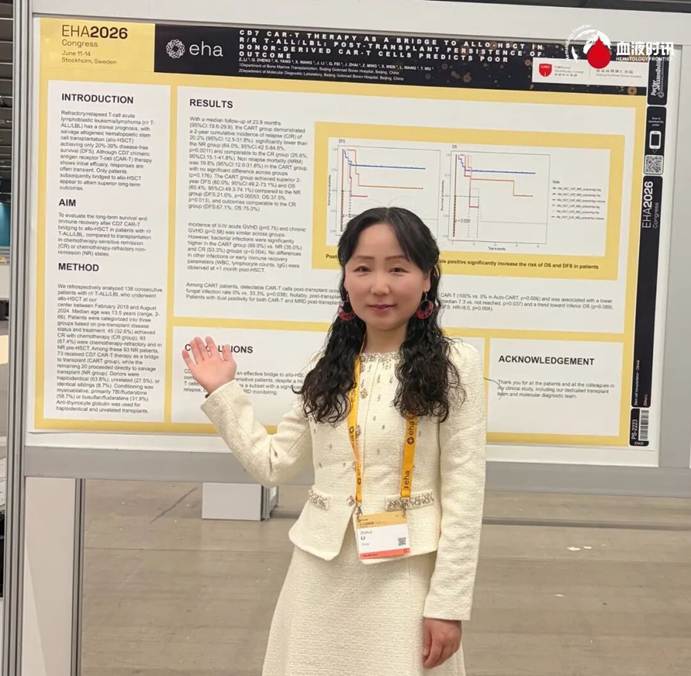
At the 2026 European Hematology Association (EHA) Congress, the team led by Director Zhihui Li from Beijing GoBroad Boren Hospital presented two studies selected for poster presentation.One study demonstrated the impressive efficacy of CD7 CAR-T therapy followed by allogeneic hematopoietic stem cell transplantation (allo-HSCT) in patients with relapsed/refractory T-cell acute lymphoblastic leukemia/lymphoblastic lymphoma (T-ALL/LBL). Importantly, the findings challenged conventional assumptions by showing that persistent donor-derived CD7 CAR-T cells after transplantation are an independent adverse prognostic factor.
The second study identified persistent adenovirus positivity as an early indicator of T-cell functional impairment, supporting a shift in post-transplant immune assessment from simply measuring immune cell counts to evaluating actual immune function.
During the meeting, Oncology Frontier – Hematology Frontier invited Director Li to discuss the clinical significance of these findings and to highlight the most important transplantation-related developments presented at this year’s EHA Congress.
Long-Term Outcomes of CD7 CAR-T Bridging to Allo-HSCT in R/R T-ALL/LBL
Oncology Frontier – Hematology Frontier:
One of your studies presented at EHA evaluated long-term survival and immune reconstitution in patients with relapsed/refractory T-ALL/LBL treated with CD7 CAR-T therapy followed by allo-HSCT. Could you discuss the key findings and their clinical implications?
Director Zhihui Li:
Our long-term follow-up data demonstrate that CD7 CAR-T therapy followed by allogeneic transplantation can effectively induce deep remission and provide a meaningful opportunity for long-term survival, making it a potentially curative approach for this high-risk patient population.
More importantly, the study revealed two novel findings.
First, persistent donor-derived CD7 CAR-T cells after transplantation should not necessarily be viewed as a favorable anti-tumor signal. Instead, we found that their continued presence was independently associated with poorer outcomes.
Second, persistent adenovirus positivity following transplantation appears to directly reflect impaired T-cell function and may serve as an early warning marker for defective immune reconstitution and adverse clinical outcomes.
We also observed that delayed immune recovery and persistent T-cell dysfunction are common among these patients and represent important determinants of long-term prognosis.
These findings have several important implications for clinical practice:
Updating Prognostic Assessment
Traditional monitoring strategies should be expanded to include donor-derived CD7 CAR-T persistence and adenoviral viral load alongside measurable residual disease (MRD) assessment and immune subset analysis. Such integrated monitoring may facilitate earlier and more accurate identification of high-risk patients.
Optimizing Longitudinal Management
The relationship among CAR-T persistence, infection surveillance, and immune reconstitution requires further clarification to support the development of more personalized long-term management strategies.
Emphasizing Functional Immune Assessment
Immune recovery should not be evaluated solely through lymphocyte counts. Functional immune competence must also be assessed, incorporating virologic markers to better understand actual T-cell performance and to establish immune surveillance systems specifically designed for patients undergoing CAR-T bridging transplantation.
Adenovirus as a Marker of Immune Function
Oncology Frontier – Hematology Frontier:
In your adenovirus study, persistent adenovirus positivity was associated with higher non-relapse mortality and poorer survival outcomes while also suggesting underlying T-cell dysfunction. How do you view the relationship between infection monitoring and immune reconstitution assessment?
Director Zhihui Li:
Adenovirus infection is closely linked to post-transplant immune recovery. It should no longer be considered merely an infectious complication but rather a biological marker that reflects the functional status of the immune system, particularly T-cell immunity.
Conventional immune monitoring primarily evaluates lymphocyte counts and phenotypes but provides limited information regarding actual immune effectiveness. Persistent adenovirus positivity, however, directly indicates deficiencies in T-cell activation, cytotoxic activity, and antiviral immune responses.
Therefore, incorporating virologic monitoring into immune assessment can help shift clinical practice from focusing exclusively on immune cell quantity toward evaluating immune function.
Combining traditional immune monitoring with viral surveillance may substantially improve both the accuracy and predictive value of immune reconstitution assessment.
Future Intervention Strategies
Several potential approaches warrant further investigation:
Precision Immune Modulation
Targeted therapies designed to restore T-cell activation and cytotoxic function may help rebuild effective antiviral immunity.
Adoptive Cellular Therapy
The infusion of adenovirus-specific T cells represents a promising strategy for targeted viral clearance while minimizing the adverse effects associated with broad immunomodulation.
Risk-Adapted Antiviral Therapy
Rather than applying a uniform treatment strategy, antiviral interventions should be individualized according to both viral load and T-cell functional status, helping to avoid unnecessary overtreatment.
Five Major Transplantation Advances from EHA 2026
Oncology Frontier – Hematology Frontier:
Beyond your team’s studies, which transplantation-related developments presented at EHA 2026 do you believe will have the greatest impact on clinical practice?
Director Zhihui Li:
Several important developments stood out during this year’s meeting.
1. Refinement of GVHD Prevention Strategies
Large Phase III studies further confirmed that antithymocyte globulin (ATG) remains a standard approach for matched unrelated donor transplantation.
Although post-transplant cyclophosphamide (PTCy) demonstrated strong efficacy in GVHD prevention, infection-related mortality remains a concern.
Meanwhile, Chinese investigators reported encouraging results with low-dose ATG combined with anti-CD25 antibodies, a strategy that may be particularly well suited to haploidentical transplantation settings.
2. Salvage Transplantation After CAR-T Failure
For patients with relapsed/refractory B-cell acute lymphoblastic leukemia (B-ALL), transplantation following achievement of complete remission after CAR-T therapy demonstrated substantial benefit, with reported two-year overall survival rates reaching 66.1%.
3. Off-the-Shelf Allogeneic CD7 CAR-T Therapy
Universal donor-derived CD7 CAR-T therapy showed impressive efficacy, with overall response rates reaching 86% in adults and complete remission rates of approximately 80% in pediatric patients.
This strategy addresses key limitations of autologous CAR-T manufacturing, including production capacity and treatment delays, and may provide a readily available option for elderly, frail, or heavily pretreated patients with T-cell malignancies.
The emergence of an “allogeneic CAR-T followed by transplantation” treatment paradigm could significantly reshape future management approaches.
4. Functional Immune Monitoring Becomes a Priority
Markers such as regulatory T-cell (Treg) recovery and adenoviral viral load are increasingly being recognized as valuable tools for identifying immune dysfunction and predicting poor outcomes before clinical deterioration becomes apparent.
5. Expansion of Transplant Eligibility
Evidence presented at EHA suggests that allogeneic transplantation may provide meaningful survival benefits even for highly challenging populations, including patients with TP53-mutated hematologic malignancies or severe cardiac dysfunction.
Looking Ahead
Overall, the transplantation field is clearly moving toward a new era characterized by precision risk stratification and function-oriented management.
The studies presented by Director Li and colleagues underscore an important evolution in post-transplant care: success is no longer measured solely by disease control and immune cell recovery but increasingly by a deeper understanding of immune function, infection dynamics, and long-term survivorship.
As these advances continue to be integrated into clinical practice, they hold significant potential to improve outcomes for patients with high-risk hematologic malignancies throughout every stage of their treatment journey.

Expert Profile

Director Zhihui Li
Beijing GoBroad Boren Hospital
Director, Hematology Department II (Hematopoietic Stem Cell Transplantation)
Beijing GoBroad Boren Hospital
GoBroad Institute of Hematology Research, Beijing
Chief Physician, MD
Clinical Expertise
Director Li has extensive experience in both clinical hematology and translational research, with particular expertise in:
- CAR-T bridging allogeneic hematopoietic stem cell transplantation
- B-ALL and T-ALL
- NK/T-cell lymphoma
- Hemophagocytic lymphohistiocytosis (HLH)
- Aplastic anemia
- Myelodysplastic syndromes (MDS)
- Prevention and management of transplantation-related complications
Academic Appointments
- Vice Chairman, Hematology Digital Diagnosis and Treatment Committee
- Committee Member, Chinese Medical Biotechnology Association
- Committee Member, Chinese Anti-Cancer Association Hematologic Malignancies Committee
- Committee Member, Chinese Society of Pediatric Oncology Nutrition
- Committee Member, Chinese Research Hospital Association Committee on Infection and Inflammation Radiology
- Committee Member, Beijing Cancer Prevention and Treatment Society Stem Cell Transplantation Committee
- Editorial Board Member, Radiology Science