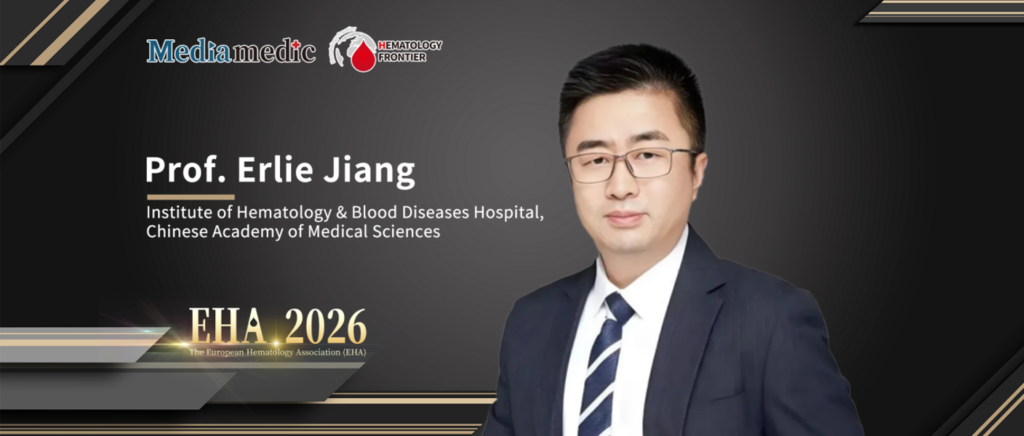
At the 2026 European Hematology Association (EHA) Congress, the team led by Professor Erlie Jiang from the Institute of Hematology & Blood Diseases Hospital, Chinese Academy of Medical Sciences, presented an impressive portfolio of 27 research studies spanning multiple dimensions of hematopoietic stem cell transplantation (HSCT).The research covered precision risk stratification, CAR-T and transplantation integration strategies, targeted therapy bridging and maintenance approaches, early warning systems for transplant-related complications, and standardized nursing care pathways. Together, these studies form a comprehensive framework that extends from risk assessment and innovative treatment to peri-transplant management and long-term survivorship care.
During an interview with Oncology Frontier – Hematology Frontier, Professor Jiang discussed the scientific rationale behind these studies, their key clinical implications, and how they contribute to a more precise, integrated, and patient-centered model of transplantation medicine.
Building a More Precise Transplantation Framework
Oncology Frontier – Hematology Frontier:
Your team presented numerous studies at EHA covering transplant risk stratification, CAR-T and transplantation combinations, complication management, and nursing systems. Could you summarize the major themes of this research portfolio and its value for clinical transplantation practice?
Professor Erlie Jiang:
Our research this year focused on three major directions.
The first was the development of more accurate transplantation risk assessment systems.
We conducted multiple studies involving patients with acute myeloid leukemia (AML), myelodysplastic syndromes (MDS), and myeloproliferative neoplasms (MPNs). These investigations evaluated the prognostic significance of the 2022 ELN classification system, genetic abnormalities, and measurable residual disease (MRD) status, while also exploring new predictive models.
The goal is to identify high-risk patients more accurately before transplantation and to guide individualized treatment and transplant strategies based on risk profiles. Ultimately, this approach aims to improve long-term survival while reducing relapse risk.
The second focus was the development of innovative treatment strategies for high-risk hematologic malignancies.
For patients with acute leukemias and lymphoid malignancies who face a substantial risk of relapse, we explored several approaches, including CAR-T therapy combined with transplantation, targeted therapy as a bridge to transplantation, and post-transplant maintenance strategies.
Rather than focusing solely on whether a patient can successfully proceed to transplantation, we emphasize achieving deeper remission before transplant and implementing post-transplant interventions to reduce relapse risk.
Our vision is to establish a comprehensive management framework covering the entire treatment continuum—from induction therapy and bridging treatment to transplantation and maintenance therapy.
The third area involved optimization of the entire transplantation process through refined management strategies.
Beyond disease control, we have devoted significant attention to transplantation-related complications. Our studies addressed engraftment promotion, infection prevention, graft-versus-host disease (GVHD) biology, transplant-associated thrombotic microangiopathy (TA-TMA), and nursing system development.
Together, these efforts create a complete management system encompassing pre-transplant assessment, peri-transplant care, and long-term follow-up. The objective is not only to increase transplant success rates but also to reduce non-relapse mortality and improve patients’ quality of life.
Innovative Combination Strategies for High-Risk Hematologic Malignancies
Oncology Frontier – Hematology Frontier:
Several of your studies investigated innovative approaches including autologous transplantation combined with CAR-T therapy, targeted triplet regimens as transplant bridges, and post-transplant maintenance strategies. Compared with conventional transplantation approaches, what advantages do these strategies offer?
Professor Erlie Jiang:
We have made important progress in three areas.
Autologous HSCT Combined with CD19 CAR-T for High-Risk B-ALL
For adults with high-risk B-cell acute lymphoblastic leukemia (B-ALL), we conducted a phase II study evaluating autologous hematopoietic stem cell transplantation combined with autologous CD19 CAR-T cell infusion.
The rationale was to eliminate residual leukemia cells through two complementary mechanisms and thereby reduce relapse risk.
The results were highly encouraging. The regimen proved both safe and feasible. All patients achieved successful hematopoietic recovery, and CAR-T infusion did not delay engraftment.
At a median follow-up of 13.4 months, every patient remained MRD-negative at a sensitivity level of 10⁻⁶. Estimated one-year progression-free survival and overall survival both reached 100%.
Importantly, toxicity remained manageable, with no severe cytokine release syndrome (CRS) or immune effector cell-associated neurotoxicity syndrome (ICANS).
These findings support a promising consolidation strategy for patients with high-risk B-ALL.
Venetoclax–Azacitidine–Gilteritinib as a Bridge to Transplantation
For patients with relapsed/refractory FLT3-ITD–positive AML or persistent MRD positivity, we evaluated a triplet regimen consisting of venetoclax, azacitidine, and gilteritinib.
The regimen demonstrated excellent bridging potential and a favorable safety profile, with no treatment-related deaths observed.
After just one treatment cycle, 81.3% of patients achieved complete remission (CR) or complete remission with incomplete hematologic recovery (CRi).
This substantially improved the likelihood of proceeding to allogeneic transplantation.
When followed by post-transplant gilteritinib maintenance, long-term outcomes were particularly encouraging, with one-year overall survival reaching 83.3% and one-year relapse-free survival reaching 75.0%.
Low-Dose Inotuzumab Ozogamicin Maintenance After Transplant
To address post-transplant relapse in high-risk B-ALL, we investigated low-dose inotuzumab ozogamicin maintenance therapy.
Traditionally, post-transplant management relies largely on immunologic effects without specific targeted approaches to eliminate residual disease. Consequently, relapse remains a major challenge, particularly for MRD-positive patients.
Using a stepwise low-dose administration strategy, we observed only manageable myelosuppression. No sinusoidal obstruction syndrome (SOS) or acute GVHD occurred.
After a median follow-up of 12.5 months, no relapses or deaths had been reported.
These results suggest that short-course, low-dose inotuzumab maintenance may offer an effective and safe strategy for relapse prevention in high-risk patients.
Why Comprehensive Transplant Management Matters
Oncology Frontier – Hematology Frontier:
Many of your studies focused on transplantation-related complications such as engraftment failure, cytomegalovirus infection, TA-TMA, and GVHD, while also incorporating nursing quality initiatives. How important is comprehensive transplant management for improving long-term outcomes?
Professor Erlie Jiang:
Transplantation medicine has entered the era of long-term survivorship management.
As transplant procedures become increasingly successful, simply achieving hematopoietic recovery can no longer be considered the ultimate goal.
Today, long-term outcomes are increasingly influenced by factors such as infections, chronic GVHD, TA-TMA, delayed engraftment, and functional recovery issues rather than by the transplantation procedure itself.
As a result, transplantation centers must shift their focus from disease treatment alone toward comprehensive long-term health management.
Through continuous risk monitoring and personalized intervention strategies, we can reduce non-relapse mortality and chronic complications while maximizing the long-term benefits of transplantation.
Looking ahead, the future of transplantation will depend heavily on the integration of biomarkers, risk prediction models, digital monitoring tools, and artificial intelligence–assisted clinical decision-making.
These technologies will allow earlier identification of complications and more precise interventions.
At the same time, patient outcomes must be defined more broadly than laboratory measurements alone.
Optimal care requires multidisciplinary collaboration involving physicians, nurses, rehabilitation specialists, psychologists, and nutrition experts.
Many of the nursing studies presented by our team were designed specifically to support this vision by creating a continuous care system that extends from pre-transplant evaluation through hospitalization and into long-term follow-up.
The ultimate objective is not only longer survival but also better recovery, improved daily functioning, and higher quality of life.
Looking Ahead
The 27 studies presented by Professor Jiang’s team reflect a broader transformation occurring in transplantation medicine.
The field is moving beyond the traditional goal of successful engraftment toward a precision-based, lifecycle-oriented model that integrates risk assessment, innovative therapeutic strategies, complication prevention, survivorship care, and multidisciplinary support.
By combining precision medicine with comprehensive long-term management, these efforts aim to ensure that successful transplantation translates into durable survival and meaningful improvements in patients’ lives.