On June 11, the online program of the 16th Peking University Gastrointestinal Oncology Forum and CGOG Annual Meeting continued with a dedicated session, “ASCO Highlights: Precision Oncology and Novel Therapeutics.” The session was livestreamed across multiple platforms and attracted more than 15,000 online viewers.In her opening remarks, Lin Shen from Peking University Cancer Hospital noted that the field of novel drug development is advancing rapidly worldwide, with each ASCO Annual Meeting bringing a wealth of important updates. She emphasized the importance of timely review and dissemination of these findings and encouraged participants to engage in open discussion and meaningful exchange of ideas to further advance understanding of the latest developments in precision medicine and innovative cancer therapies.
The session was chaired by Jifang Gong from Peking University Cancer Hospital.
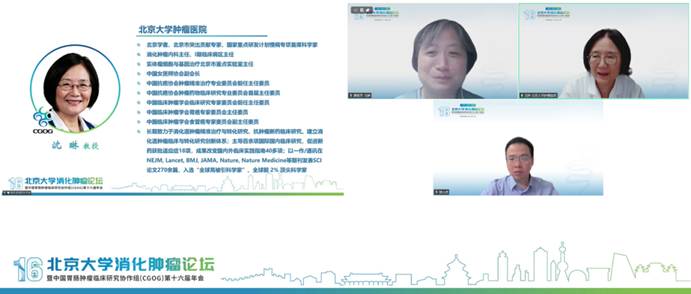
Figure Caption: Conference Chair Prof. Lin Shen; Session Chair Prof. Jifang Gong
During the scientific presentation session, Ran Xue from Peking University Cancer Hospital provided a comprehensive overview of the latest advances in immuno-oncology therapeutics presented at the 2026 ASCO Annual Meeting.
She noted that cancer immunotherapy has entered the “post-PD-1 era,” with the field shifting from simple checkpoint blockade toward more precise immune modulation. This year’s ASCO meeting featured a large number of first-in-class immunotherapeutic agents, reflecting clear trends toward greater target diversity, increasingly sophisticated mechanism-based combinations, and innovative drug delivery strategies.
Among the notable developments, the novel immune checkpoint inhibitor NTX1088 combined with pembrolizumab demonstrated the potential for durable responses in patients previously treated with immunotherapy, with some patients remaining on treatment for up to 20 months. A PD-1/IL-15 bispecific antibody also showed preliminary activity in MSS colorectal cancer, achieving an objective response rate (ORR) of up to 33.3% among patients without liver metastases.
In addition, Prof. Xue highlighted cases of tumor regression observed with a CD80 trifunctional fusion protein in combination with pembrolizumab in traditionally immunologically “cold” tumors, including pancreatic cancer and colorectal cancer. She also reviewed translational evidence suggesting that an oral ERAP1 inhibitor may help overcome resistance to PD-1-directed therapy.
Importantly, immune microenvironment-targeted therapies are no longer limited to monoclonal antibodies and bispecific antibodies. Antibody-drug conjugates (ADCs) directed against immune microenvironment-related targets have also shown encouraging activity. For example, B7-H3 ADCs demonstrated promising antitumor efficacy across multiple gastrointestinal malignancies, including pancreatic, esophageal, and liver cancers. Meanwhile, a CD56-targeted ADC, currently the most advanced agent of its class globally, has produced preliminary signs of clinical activity in neuroendocrine tumors.
Collectively, these advances highlight a rapidly evolving immuno-oncology landscape, characterized by a shift from conventional immune checkpoint blockade toward multi-target strategies and the exploration of diverse therapeutic modalities.
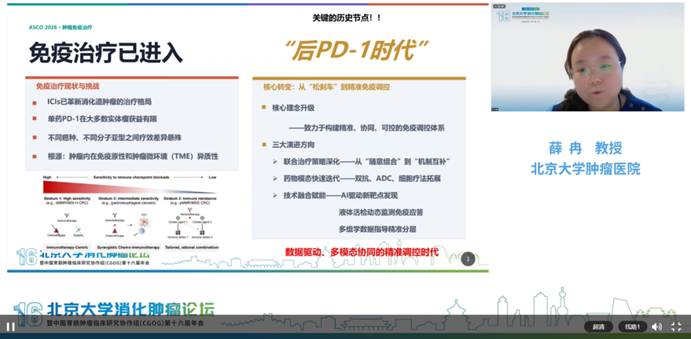
Figure Caption: Speaker Prof. Dan Liu
Dan Liu from Peking University Cancer Hospital focused on the latest advances in targeted therapies, providing an overview of ongoing drug development efforts targeting key biomarkers such as HER2, KRAS, and CLDN18.2.
Prof. Liu highlighted the breakthrough results of the pan-KRAS inhibitor RMC-6236, which demonstrated a doubling of both progression-free survival (PFS) and overall survival (OS) compared with chemotherapy in the second-line treatment of advanced pancreatic cancer. She also discussed future strategies for the differentiated development of KRAS-targeted therapies, as well as opportunities for combination treatment approaches.
In addition, she reviewed the promising therapeutic potential of PRMT5 inhibitors, a novel synthetic lethality strategy targeting MTAP-deficient tumors, in gastrointestinal malignancies. While these agents have shown encouraging prospects, particularly in combination with KRAS inhibitors and other targeted therapies, several developmental and clinical challenges remain to be addressed.
With respect to HER2 and CLDN18.2, Prof. Liu noted that these targets have already been extensively investigated, with a broad range of monoclonal antibodies, bispecific antibodies, ADCs, and bispecific ADCs currently under development. Given the maturity of these research areas, the emergence of entirely new therapeutic concepts in the near term is considered less likely. Instead, future development will likely focus on optimizing treatment strategies across different tumor types and disease settings.
In the ADC field targeting other molecular pathways, DLL3-targeted ADCs have demonstrated encouraging activity in neuroendocrine carcinomas (NECs). Meanwhile, several bispecific ADCs—including MUC1/HER3 ADCs, EGFR/MET ADCs, and CEACAM5/6 ADCs—have shown preliminary antitumor activity in gastrointestinal cancers. However, further research is needed to better define the advantages of target selection and to clarify the relationship between target expression levels and clinical efficacy.
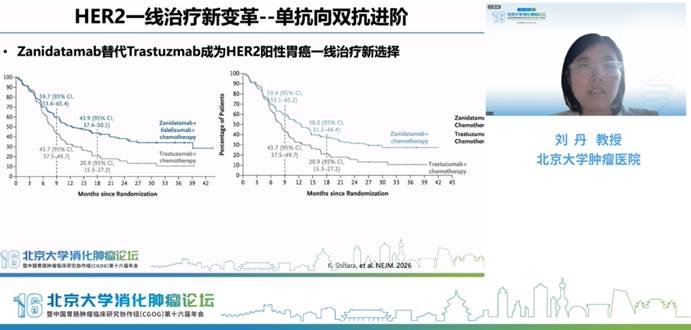
Figure Caption: Speaker Prof. Jiarui Li
Jiarui Li from Peking University Cancer Hospital focused on advances in cell therapy for solid tumors, reviewing 61 cell therapy-related studies presented at this year’s ASCO Annual Meeting. His presentation highlighted developments across the three major cell therapy platforms: CAR-T cells, TCR-T cells, and tumor-infiltrating lymphocyte (TIL) therapy.
Prof. Li explained that CAR-T cell therapy is increasingly being optimized through strategies such as cellular “armoring” and locoregional administration. For example, a GPC3-targeted armored CAR-T therapy achieved an objective response rate (ORR) of 50.0% in hepatocellular carcinoma. However, the enhanced efficacy was accompanied by potential safety concerns, including cytokine release syndrome (CRS) and immune effector cell-associated neurotoxicity syndrome (ICANS), underscoring the need for careful toxicity management.
In the TCR-T field, encouraging early signals have been observed against both established targets, such as PRAME and MAGE-A4, and emerging neoantigen targets, including TP53 and KRAS G12V. Prof. Li emphasized the importance of monitoring the development of different therapeutic modalities directed against the same target and identifying how the unique strengths of each approach can be matched to the most appropriate patient populations.
Of particular significance, a randomized controlled study of TIL therapy (GC101) led by Chinese investigators reported positive results. The trial demonstrated a median progression-free survival (PFS) of 4.3 months, compared with 1.6 months for investigator’s choice chemotherapy. These findings represent an important milestone, providing higher-level clinical evidence for cell therapy in solid tumors and marking a significant step forward in the maturation of the field.
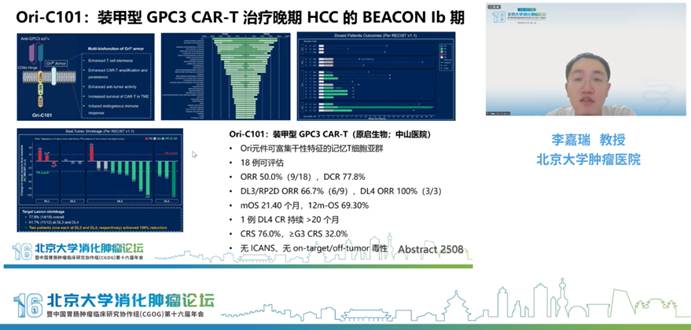
Figure Caption: Speaker Prof. Jiarui Li
Following the insightful presentations by the three speakers, the meeting moved into an expert panel discussion.
The session was moderated by Jifang Gong and featured a distinguished panel including Xiaohu Zheng from the University of Science and Technology of China, Jing Yang from Shanghai Celan Biotech Co., Ltd., Fengbin Zhang from the Fourth Hospital of Hebei Medical University, Jiayong Liu, Changsong Qi, and Miao Zhang from Peking University Cancer Hospital.
The panel engaged in in-depth discussions and lively exchanges on several key topics, including the rationale for combination immunotherapy strategies, the future development potential of PRMT5 inhibitors, resistance mechanisms and combination approaches involving KRAS inhibitors, target discovery in rare tumors, safety management in clinical trials, and the prospects for cancer vaccine development.
The experts agreed that continued progress in novel drug development will require close collaboration among researchers, clinicians, industry partners, and regulatory stakeholders. They emphasized that, alongside maximizing therapeutic efficacy, equal attention must be paid to treatment tolerability and patient experience. Such a balanced approach will be essential to advancing the field of precision oncology and delivering more effective, personalized treatment options for patients.
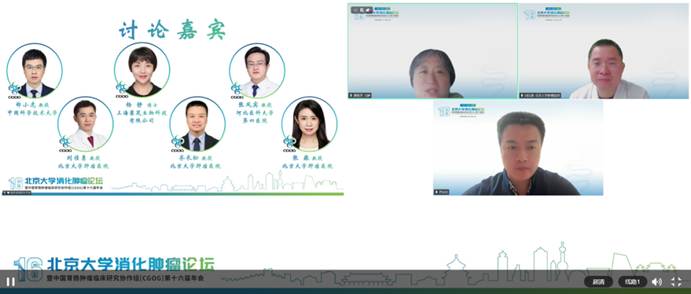
Figure Caption: Panel Discussion Participants
At the conclusion of the meeting, Jifang Gong delivered the closing remarks, thanking all speakers and panelists for their insightful presentations and engaging discussions.
Prof. Gong noted that the session had provided a comprehensive overview of the latest drug development advances presented at the 2026 ASCO Annual Meeting across three key areas: immunotherapy, targeted therapy, and cell therapy. He emphasized that these developments continue to expand the possibilities for precision oncology and offer new opportunities to improve patient outcomes.
Looking ahead, he expressed his hope that the CGOG platform will continue to foster collaboration among experts across China, facilitating the advancement of innovative drug development, accelerating clinical translation, and ultimately bringing more effective treatment options to patients with cancer.
Original article: Department of Gastrointestinal Oncology, Peking University Cancer Hospital
Author: Yuqi Zhao
Reviewer: Dan Liu