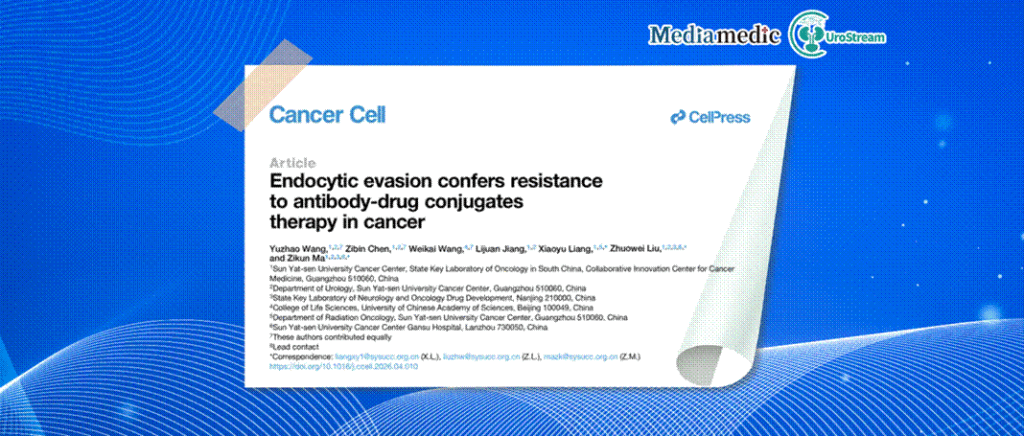
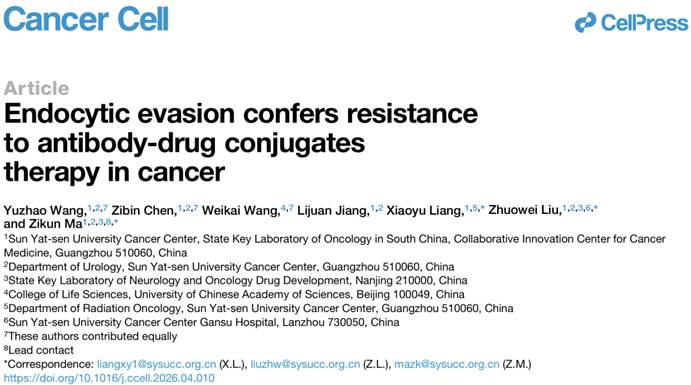
On May 21, 2026, a research team led by Professor Zhuowei Liu, Dr. Zikun Ma, and Associate Research Fellow Xiaoyu Liang from Sun Yat-sen University Cancer Center published a study in Cancer Cell entitled “Endocytic Escape Drives Tumor Resistance to Antibody–Drug Conjugate Therapy.” The study systematically characterized the adaptive remodeling processes underlying resistance to antibody-drug conjugates (ADCs) using humanized mouse models, single-cell sequencing, and spatial transcriptomics.The investigators identified distinct tumor cell subpopulations associated with different resistance mechanisms and proposed potential therapeutic strategies to overcome resistance. These findings provide important mechanistic insights that may help optimize ADC-based treatment approaches in urothelial carcinoma and other solid tumors.
ADC Therapy Has Transformed Urothelial Carcinoma Treatment—But Resistance Remains a Major Challenge
Antibody-drug conjugates (ADCs) represent a new generation of precision cancer therapeutics. By selectively recognizing tumor-associated surface antigens, ADCs deliver highly potent cytotoxic agents directly into cancer cells while minimizing systemic exposure.
In urothelial carcinoma, Nectin-4-targeting ADCs such as enfortumab vedotin have demonstrated significant clinical benefits across multiple treatment settings, ranging from advanced disease to neoadjuvant therapy. Combination regimens pairing ADCs with anti–PD-1 immune checkpoint inhibitors have already been incorporated into clinical practice guidelines.
However, the efficacy of ADCs depends on a complex sequence of cellular events, including:
- Target binding
- Internalization
- Intracellular trafficking
- Payload release
- Tumor-cell killing
Despite the remarkable progress achieved with Nectin-4 ADCs combined with PD-1 blockade, approximately half of treated patients still fail to achieve complete tumor remission.
These observations suggest that tumor cells may undergo adaptive remodeling during treatment, resulting in acquired resistance. Until now, the underlying mechanisms have remained largely unclear.
Two Distinct Resistant Tumor Cell Populations Identified
The research team first discovered that resistant tumors exhibit heterogeneous resistance phenotypes characterized by two major tumor-cell populations:
NECTIN4Low Tumor Cells
These cells demonstrated:
- Downregulation of the ADC target Nectin-4
- Lysosomal dysfunction
- Enhanced stemness-associated features
- Increased drug efflux activity
- Upregulation of cellular detoxification pathways
Together, these adaptations reduce intracellular payload delivery and diminish ADC efficacy.
NECTIN4High Tumor Cells
In contrast, this population displayed:
- Further upregulation of Nectin-4 expression
- Markedly impaired endocytic function
- Active elimination of membrane-bound ADCs through extracellular vesicle secretion
These findings were particularly striking because high target expression is traditionally viewed as a favorable predictor of ADC response.
The study revealed that high target expression alone does not guarantee effective intracellular drug delivery.
Tumor Cells Evade ADC Uptake Through Endocytic Escape
Mechanistic investigations demonstrated that uptake of Nectin-4-targeting ADCs primarily depends on the AP2M1-mediated clathrin-dependent endocytosis pathway.
However, in NECTIN4High resistant tumor cells, the enzyme AKR1C1 was found to be aberrantly overexpressed.
AKR1C1 contributes to resistance through two complementary mechanisms:
- Blocking ADC Internalization
AKR1C1 binds directly to Nectin-4 and interferes with AP2M1 recognition of the receptor, thereby preventing efficient endocytosis of the ADC.
- Promoting ADC Export
AKR1C1 recruits the E3 ubiquitin ligase WWP2, which stimulates extracellular vesicle formation.
As a result, ADC molecules bound to the tumor-cell surface are packaged into extracellular vesicles and expelled from the cell before they can be internalized.
This process dramatically reduces intracellular drug accumulation and ultimately drives therapeutic resistance.
The investigators further identified the transcription factor ELF3 as a key upstream regulator responsible for maintaining both the formation of this resistant tumor-cell population and its resistance-associated phenotype.
Clinical Validation in Patients with Urothelial Carcinoma
To determine whether these findings were clinically relevant, the research team collected paired tumor samples from patients with urothelial carcinoma before and after treatment with Nectin-4 ADC plus anti–PD-1 therapy.
Spatial transcriptomic analysis revealed the presence of NECTIN4High resistant tumor-cell populations within patient tumors.
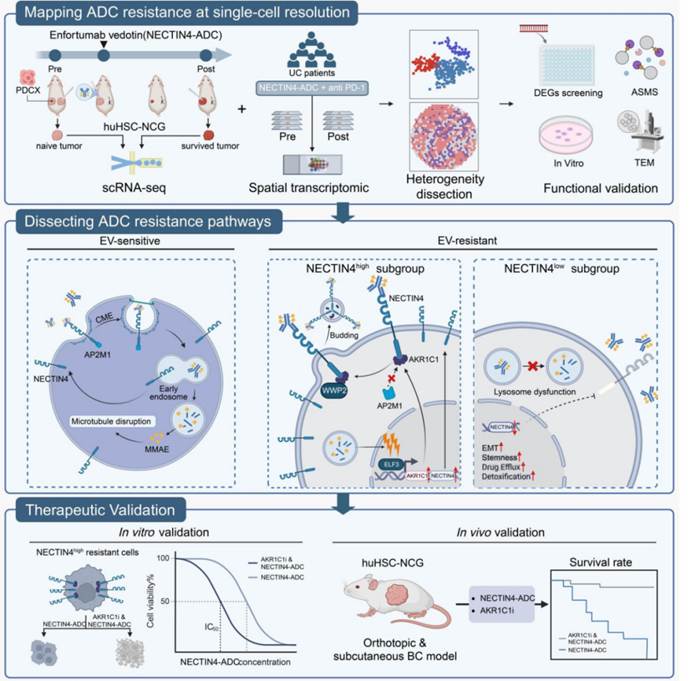
Importantly, these cells exhibited molecular signatures highly consistent with those identified in preclinical models, strongly supporting the clinical relevance of the endocytic escape mechanism.
These findings suggest that the resistance pathway observed experimentally is also active in human disease.
Beyond Target Expression: A New Framework for Predicting ADC Response
One of the study’s most important conclusions is that target expression alone may be insufficient to predict response to ADC therapy.
Current clinical practice often relies heavily on immunohistochemical assessment of target abundance. However, the investigators demonstrate that ADC efficacy is influenced by multiple additional factors, including:
- Endocytic efficiency
- Intracellular trafficking capacity
- Spatial distribution of target molecules
- Adaptive resistance remodeling within tumor cells
Consequently, two tumors with similar levels of target expression may exhibit very different responses to ADC treatment.
Potential Strategies to Overcome ADC Resistance
The study also highlights several potential approaches for enhancing ADC efficacy:
Dual-Target ADCs with Alternative Internalization Mechanisms
Combining targets that utilize different endocytic pathways may reduce the likelihood of resistance arising through endocytic blockade.
Dual-Payload ADCs
ADCs carrying payloads with distinct mechanisms of action may help overcome resistance associated with a single cytotoxic agent.
Targeting Endocytic Escape Pathways
Therapeutic inhibition of resistance pathways involving AKR1C1, WWP2, or related regulators may restore ADC internalization and improve intracellular drug delivery.
These strategies provide a conceptual framework for future ADC development and combination therapies.
Significance of the Study
This work offers one of the most comprehensive analyses to date of adaptive resistance mechanisms during ADC therapy.
By demonstrating that tumor cells can effectively “refuse entry” to ADCs and actively package them into extracellular vesicles for export, the study reveals a previously underappreciated mechanism of therapeutic escape.
The findings not only deepen our understanding of ADC resistance in urothelial carcinoma but also provide important guidance for the development of next-generation ADCs and rational combination strategies aimed at improving patient outcomes.
Corresponding Authors

Professor Zhuowei Liu
Sun Yat-sen University Cancer Center

Dr. Zikun Ma
Sun Yat-sen University Cancer Center

Associate Research Fellow Xiaoyu Liang
Sun Yat-sen University Cancer Center
First Author
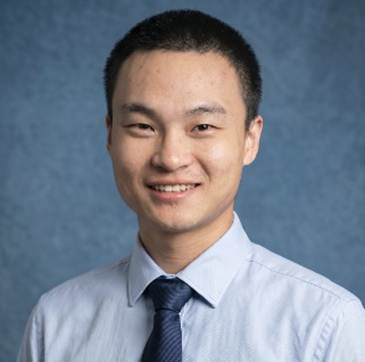
Yuzhao Wang, PhD Candidate
Sun Yat-sen University Cancer Center