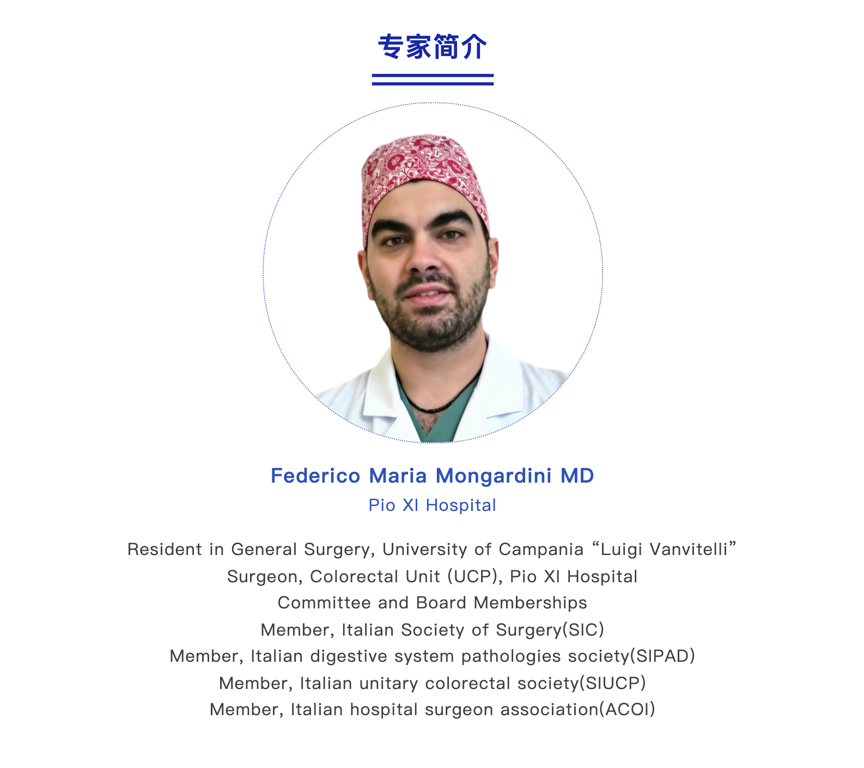
On March 21, 2026, the Academic Seminar on Clinical Practices of Colorectal Surgery was held in Hangzhou. Dr. Federico Maria Mongardini, Consultant Surgeon at PIO XI Hospital, Rome, Italy, and PhD Candidate at the University of Campania Luigi Vanvitelli, Naples, Italy, attended the symposium for the third consecutive year and shared his insights on multimodal deep learning, obesity management, and Italy-China collaboration.Obesity as a Key Perioperative Factor
Dr. Mongardini noted that obesity is increasing worldwide, particularly in Italy. Visceral obesity, in particular, complicates surgery due to a thicker mesentery, shorter vascular pedicles, and more difficult access to the inferior mesenteric artery (IMA) origin. To address these challenges, his team has adopted an integrated approach that combines bariatric and oncological expertise to optimize patient management from the outset.
He is also participating in the LOVO trial led by Professor Li Jun of Zhejiang University, which distinguishes visceral from peripheral obesity. Looking ahead, Dr. Mongardini believes that advances in deep learning and artificial intelligence will play an increasingly important role in integrating obesity-related factors into precision colorectal cancer (CRC) care.
Deepening the Italy-China Bridge
Dr. Mongardini trained under Professors Ding Kefeng and Li Jun in 2023 and 2025, gaining firsthand experience with differences in surgical oncology, multidisciplinary team (MDT) practices, and postoperative care between Italy and China.
He highlighted several anatomical and clinical distinctions observed in daily practice. Chinese patients often present with a longer sigmoid colon, reducing the need for splenic flexure mobilization, whereas Italian patients more commonly require routine splenic flexure takedown due to a shorter sigmoid colon. He also noted that diverticulitis is predominantly left-sided in Italy but more frequently right-sided in China.
Reflecting on the value of international collaboration, Dr. Mongardini emphasized that these differences create opportunities for mutual learning and scientific advancement. He advocated for the establishment of a long-term collaboration mechanism involving joint clinical publications, multicenter trials, and fellowship exchange programs to further strengthen cooperation and understanding between the two countries.
“China is going head by head with technology advancement; Italy is following,” he said. “We hope this bridge can be helpful for both sides.”