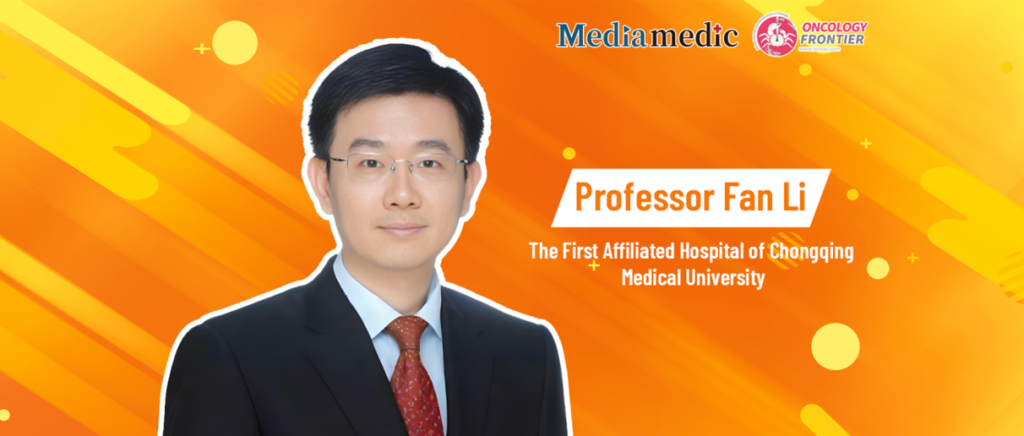
Editor’s Note: Against the backdrop of Chongqing’s mountainous skyline and flowing rivers, the 15th Sino-French Breast Reconstruction Congress and the 13th Sino-French Breast Cancer Academic Conference were successfully held in Chongqing from April 15–19, 2026.During the meeting, Oncology Frontier had the privilege of interviewing Professor Fan Li from The First Affiliated Hospital of Chongqing Medical University. He shared his perspectives on several cutting-edge topics, including surgical de-escalation strategies following neoadjuvant therapy, precision assessment of surgical margins, and the evolving role of breast surgeons in the modern treatment era.
The key highlights of the interview are summarized below.
01
Oncology Frontier: At this conference, you presented on “Advances in Breast Surgery Following Neoadjuvant Therapy.” As systemic therapies continue to improve, an increasing proportion of patients experience substantial tumor shrinkage or even achieve pathological complete response (pCR). For these exceptionally responsive patients, how can we truly achieve surgical “de-escalation” in terms of operative extent? In your opinion, what are the greatest challenges in preoperative imaging assessment and intraoperative margin evaluation?
Professor Fan Li:
“One of the most important goals of neoadjuvant therapy in breast cancer is to increase breast-conservation rates. For patients who initially present with relatively large tumors but experience substantial tumor regression after neoadjuvant treatment—or even complete radiologic disappearance—the primary strategy for surgical de-escalation is to maximize opportunities for breast-conserving surgery. In other words, we aim to convert patients who were previously unsuitable for breast conservation into candidates for breast-preserving procedures.
However, breast-conserving surgery after neoadjuvant therapy remains technically challenging. Success requires integration of newer surgical approaches, advanced imaging assessment, and intraoperative localization techniques to improve the accuracy and safety of breast conservation. In cases where the tumor demonstrates a scattered or “Swiss cheese-like” regression pattern, surgeons must proceed even more cautiously.
For patients whose imaging suggests complete tumor regression, there are ongoing studies exploring whether surgery might eventually be omitted altogether. However, this concept remains investigational and has not entered routine clinical practice. Radiologic complete response does not necessarily equate to pathological complete response. Even when biopsy sampling of the tumor bed is negative, residual cancer cannot be completely excluded.
Therefore, there is currently insufficient evidence and clinical trial support to justify routine omission of surgery. At present, our primary goal remains maximizing breast-conservation opportunities whenever possible.
Regarding the biggest challenges in preoperative imaging assessment and intraoperative margin evaluation, I believe the key issue for imaging is accuracy. Current modalities—including breast ultrasound, mammography, and MRI—still cannot achieve perfect accuracy in assessing residual disease. Improving imaging precision therefore remains one of our greatest challenges.
Margin assessment after neoadjuvant therapy is equally difficult. Tumor regression often leads to necrosis, fragmentation, and scattered distribution of residual cancer cells, frequently accompanied by fibrosis. This creates major challenges for both intraoperative frozen-section assessment and postoperative pathological evaluation of surgical margins. Defining the true extent of resection during surgery can also be difficult.
Fortunately, several emerging technologies may help address these challenges. At this conference, French experts discussed magnetic seed localization, radioguided localization techniques, and MRI-based 3D reconstruction technologies, all of which may assist surgeons in more precisely defining resection boundaries.”
02
Oncology Frontier: For patients whose tumor beds regress irregularly after neoadjuvant therapy—or even exhibit a “Swiss cheese-like” regression pattern—how can endoscopic or robotic surgery ensure accurate negative margins? Compared with traditional open surgery, what are the key advantages of these approaches?
Professor Fan Li:
“For patients with irregular or scattered regression patterns after neoadjuvant therapy, accurately defining the resection area during endoscopic or robotic-assisted breast-conserving surgery is indeed challenging.
To address this, we rely on highly precise preoperative imaging combined with the magnified, high-definition visualization provided by endoscopic or robotic systems, together with newer localization technologies.
For example, at this conference, Professor Ning Liao from Guangdong Provincial People’s Hospital presented a technique involving intratumoral injection of indocyanine green (ICG) to mark the tumor region. Even after the visible tumor has been removed, these localization techniques can still help delineate the original tumor extent.
In addition, surgeons may integrate advanced technologies such as three-dimensional reconstruction, intraoperative ultrasound, or intraoperative mammography to help define resection boundaries more accurately. Intraoperative frozen pathology can also be used simultaneously to evaluate whether cancer cells remain at the margins in real time.
By combining all of these approaches, we can more reliably achieve negative margins and complete tumor resection.
The core advantage of endoscopic and robotic surgery is that they compensate for the inability to directly palpate the tumor during surgery. In essence, they transform a tactile ‘blind zone’ into a visualized ‘target zone.’ Combined with real-time imaging and localization technologies, these systems enable surgeons to define tumor boundaries much more precisely and thereby achieve complete oncologic resection.”
03
Oncology Frontier: As antibody-drug conjugates (ADCs) and immunotherapy become increasingly incorporated into the neoadjuvant setting, postoperative pathology and tumor downstaging patterns are becoming more complex. In your view, should the role of breast surgeons in the “post-neoadjuvant era” evolve from that of a simple “tumor remover” to a decision-maker focused on precision reconstruction and functional preservation?
Professor Fan Li:
“In the past, breast surgeons often followed a ‘one-size-fits-all’ philosophy, focusing primarily on removing the tumor completely, with relatively limited attention paid to postoperative quality of life.
As therapies and systemic treatments have continued to improve, we are now able to convert many patients who were previously ineligible for breast conservation into candidates for breast-preserving surgery.
At the same time, axillary management has also evolved significantly. Not all patients now require axillary lymph node dissection. Surgical management has progressed from routine axillary dissection for nearly all patients, to sentinel lymph node biopsy, and now even toward selective omission of axillary dissection—or in some patients, potentially omission of sentinel node biopsy altogether.
In essence, breast surgery has evolved from a ‘one-size-fits-all’ approach to a philosophy that balances oncologic radicality with preservation of function and quality of life.
As neoadjuvant therapies continue to improve, the overall treatment principle increasingly centers on surgical de-escalation for breast cancer patients. Based on each patient’s individual characteristics and response to neoadjuvant therapy, we aim to design personalized surgical strategies that not only achieve oncologic control but also maximize preservation and reconstruction of breast appearance.
For patients eligible for breast-conserving surgery, we should preserve the breast whenever possible. Today, we have many reconstructive and oncoplastic options available, including standard breast-conserving surgery, volume displacement techniques, volume replacement procedures, and various perforator flap approaches.
In addition, endoscopic and robotic-assisted techniques can now be incorporated into both breast-conserving and reconstructive surgery, helping preserve breast aesthetics more effectively and facilitating patients’ return to normal social functioning.
The same principle applies to axillary management. Decisions regarding axillary dissection should be individualized according to each patient’s specific situation. Even when one or two positive sentinel lymph nodes are identified, some patients may still avoid axillary dissection.
Ultimately, our goal is not only to improve survival outcomes, but also to help patients achieve a better quality of life and reintegrate more fully into society.”