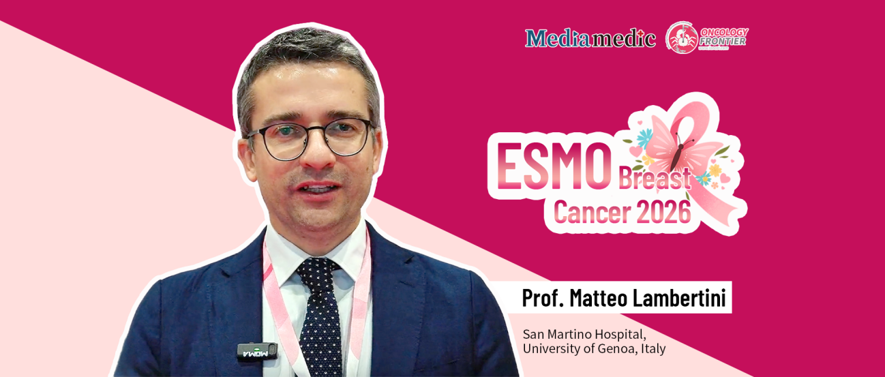
Editor’s Note: At the recently concluded ESMO Breast Cancer Congress 2026 (ESMO BC 2026), Professor Matteo Lambertini from IRCCS Ospedale Policlinico San Martino and the University of Genova served as one of the chairs of the session “Breast Cancer in Young Women (BCY) Session – Management of HR+ Breast Cancer in Young Women.” Together with fellow panelists, he participated in in-depth discussions on several key issues surrounding the management of breast cancer in young women.Following the session, Oncology Frontier invited Professor Matteo Lambertini to share his latest perspectives on breast cancer care in younger patients. He highlighted the important findings from the PRECoopERA study presented at this year’s meeting, noting that although previous studies of oral selective estrogen receptor degraders (SERDs) in premenopausal women have required concurrent ovarian function suppression (OFS), the PRECoopERA data demonstrated clinical activity even in the absence of OFS. These findings may open a new avenue for future research exploring endocrine treatment strategies that could potentially spare some young patients from ovarian suppression.
Oncology Frontier: Could you first briefly introduce yourself and share which new developments in breast cancer particularly caught your attention at this year’s meeting?
Professor Matteo Lambertini:
I am Matteo Lambertini from IRCCS Ospedale Policlinico San Martino and the University of Genova in Italy. I am currently attending the 2026 ESMO Breast Cancer Congress, which has been an outstanding three-day meeting covering every aspect of breast cancer management from a multidisciplinary perspective. The congress has also featured a large amount of highly important original clinical data.
My main focus has been on several sessions dedicated to breast cancer in young women. These discussions covered topics ranging from genetics and survivorship to endocrine therapy strategies, as well as important emerging datasets that may shape the future management of this specific patient population.
One topic I would especially like to highlight is the use of oral SERDs, particularly the possibility that, in certain situations, ovarian function suppression might eventually be avoided when using these agents. Up to now, all available data regarding oral SERDs in premenopausal women have required concurrent ovarian suppression.
However, based on the PRECoopERA trial results presented at this meeting, we observed that these drugs demonstrated clinical activity in premenopausal women even without ovarian function suppression. This is clearly an area that deserves further investigation in future studies.
Finally, I would sincerely like to invite everyone to attend the 2027 ESMO Breast Cancer Congress, which will be held in Milan, Italy, in May 2027.

Professor Matteo Lambertini