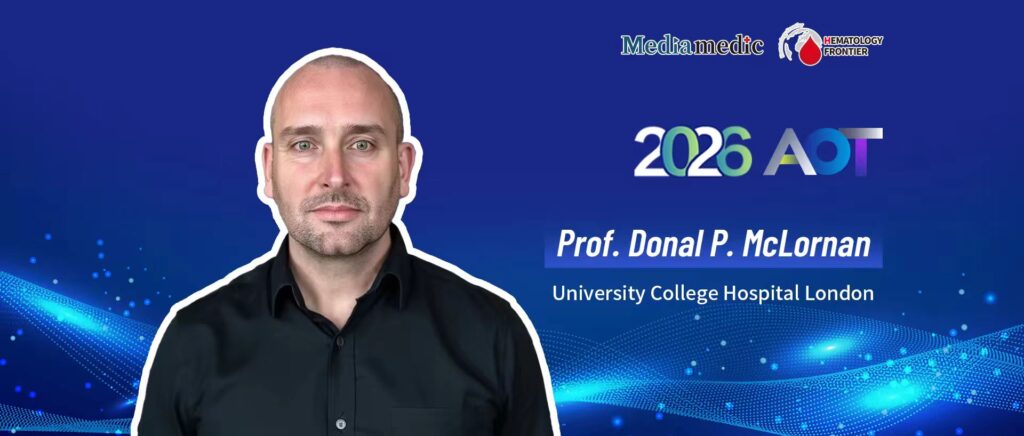
To comprehensively improve public health and strengthen strategies for the prevention and treatment of major diseases, medical innovation and international collaboration have become key drivers of clinical progress. Against this backdrop, the 2026 Beijing International Hematopoietic Stem Cell Transplantation Conference (AOT) was successfully held in Beijing from April 24 to 25, 2026. Organized by the Hematology Branch of the China International Exchange and Promotive Association for Medical and Health Care and hosted by the National Clinical Research Center for Hematologic Diseases and the Peking University Institute of Hematology, this year’s conference centered on the theme “The Art of Transplantation.” The meeting brought together leading hematology experts from around the world to discuss cutting-edge innovations and emerging trends in hematopoietic stem cell transplantation.During the conference, Oncology Frontier – Hematology Frontier conducted an exclusive interview with Professor Donal P. McLornan to discuss key clinical issues surrounding transplantation in patients with myelodysplastic syndromes/myeloproliferative neoplasms (MDS/MPN). Professor McLornan shared his academic insights and clinical experience with the aim of providing valuable guidance for clinical practice.
Q1、In patients with myelodysplastic syndromes (MDS) and myeloproliferative neoplasms (MPN), allogeneic hematopoietic stem cell transplantation (allo-HSCT) remains the only potentially curative treatment. Based on current guidelines, how do you determine the optimal timing of transplantation for patients across different risk strata? In real-world practice, is there a gap between guideline recommendations and clinical implementation?
Patients with myelodysplastic syndromes/myeloproliferative neoplasms (MDS/MPN) face numerous challenges when undergoing hematopoietic stem cell transplantation. This disease category is rare, with an estimated incidence in the European Union population of about 1 in 150,000, and patients are often older and in poor physical condition, resulting in limited clinical data to support transplant decision-making. Furthermore, these diseases exhibit high heterogeneity both at the molecular biological level and in clinical phenotypes. For disease types that do not overlap with chronic myeloid leukemia, transplantation is primarily suitable for two groups of patients: MDS/MPN with neutrophilia and MDS/MPN, unclassifiable. Molecular genetic testing is recommended for all patients.
Transplantation should be recommended if the patient is suitable in terms of both biological and chronological age, is in good general health, and a suitable donor can be found. This is because the median overall survival for patients with MDS/MPN with neutrophilia is typically less than 18 months, and the prognosis for unclassifiable overlap syndromes often resembles that of chronic myelomonocytic leukemia. A gap often exists between recommendations in international clinical guidelines and real-world practice. It is advised that clinicians refer to guidance from the European Society for Blood and Marrow Transplantation (EBMT) on the optimal timing for transplantation to optimize treatment decisions.
Q2、During transplantation in MDS/MPN patients, relapse, graft-versus-host disease (GVHD), and transplant-related mortality remain major challenges. How do you interpret the interplay among these risks? What key strategies in conditioning regimen optimization, donor selection, and post-transplant management can improve overall outcomes?
For the MDS/MPN patient population, clinical research is relatively limited in both non-transplant and transplant settings. Regarding the optimization of conditioning regimens, reduced-intensity conditioning is commonly used, often selecting regimens with higher intensity within this category. Compared to countries like China, the EU more frequently uses matched or mismatched unrelated donors based on human leukocyte antigen compatibility, rather than haploidentical donors. However, when observing all donor types, the relapse rate within the first two years post-transplantation can still reach 40% to 45%.
Therefore, for patients with rapidly progressing disease before transplantation, consideration can be given to using hypomethylating agents or JAK inhibitors targeting splenomegaly as pre-transplant therapy. Simultaneously, donor screening across all types should be expedited, employing higher-intensity reduced-intensity conditioning regimens, and post-transplant maintenance therapy with hypomethylating agents or JAK inhibitors should be considered.
Q3、With the advent of novel agents, such as JAK inhibitors and hypomethylating drugs, pre-transplant bridging therapies and post-transplant maintenance strategies are evolving. How do you view the role of these treatments in optimizing the transplantation pathway? Looking ahead, what are the most promising directions for individualized therapy and integrated strategy development?
For patients with pronounced proliferative overlap syndrome, significant symptoms, prominent hyperinflammatory responses, and marked splenomegaly, the use of JAK inhibitors should be considered whenever possible. When selecting, preference should be given to JAK inhibitors that target not only JAK1 and JAK2 but also possess other properties, such as ACVR1 inhibition, thereby addressing splenic-related symptoms, systemic symptoms, and anemia. Such JAK inhibitors include momelotinib and pacritinib, and future clinical trials should focus on these agents. If the patient presents primarily with a dysplastic phenotype before transplantation, hypomethylating agents can play a role.
However, the core challenge in current treatment remains relapse. Therefore, for post-transplant maintenance therapy, a regimen combining hypomethylating agents such as decitabine or azacitidine with venetoclax can be considered, with the decision to add a JAK inhibitor based on the specific phenotype of the patient. Given that these are rare diseases, with the EBMT registering only about 150 such cases annually, there is a necessity for global, prospective clinical trials and the development of a globally coordinated strategy to standardize future conditioning platforms and maintenance therapy strategies. Finally, a key gap in the current system lies in the development of biomarkers—that is, obtaining a characteristic signature before treatment that can define the optimal therapeutic path. This will help match therapies more precisely and ultimately lead to better treatment outcomes for MDS/MPN patients.
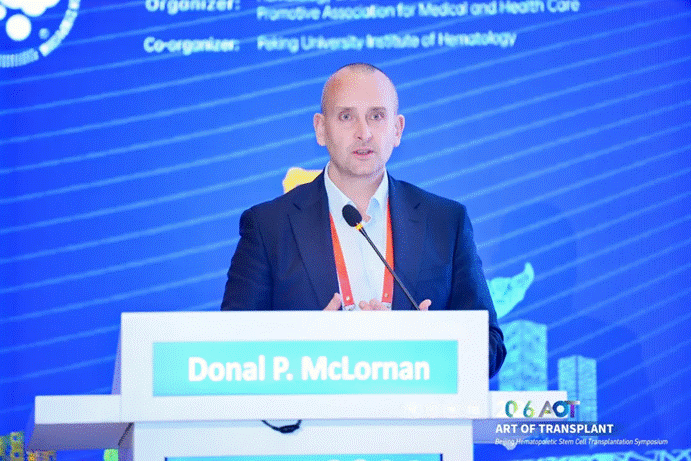
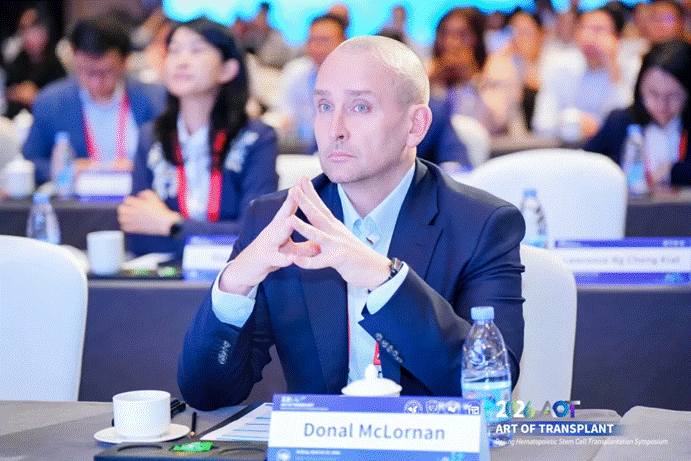
Expert Profile

Donal P. McLornan, MD
Consultant in the Myeloproliferative Neoplasms, Allogeneic Transplantation and CAR-T team at University College London Hospitals (UCLH)
His translational and clinical research and clinical trial work primarily focus on myelofibrosis, MDS/MPN overlap syndromes, and allogeneic stem cell transplantation, and he has published extensively on these topics.
He holds several significant positions nationally and internationally. He has been elected as the Chair of the Chronic Malignancies Working Party and Co-Chair of the Scientific Committee of the European Society for Blood and Marrow Transplantation (EBMT). Concurrently, he serves as the Chair of the UK Myeloproliferative Neoplasms (MPN) Clinical Trials Group of Blood Cancer UK, a network with over 70 members across the United Kingdom.