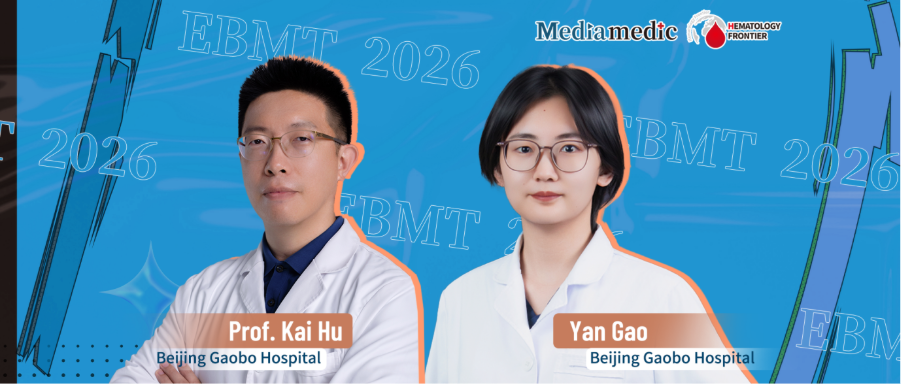
The 52nd EBMT Annual Meeting will take place in Madrid, Spain, from March 22 to 25, 2026. As one of the most influential international meetings in hematopoietic stem cell transplantation and cellular therapy, the congress brings together more than 6,000 experts from over 90 countries and regions to discuss advances in basic research, clinical translation, optimization of transplant strategies, and innovation in cellular therapies. This report presents a study conducted by Dr. Yan Gao from the team led by Prof. Kai Hu at Beijing Gaobo Hospital, entitled “Impact of the Treatment Sequence of Glofitamab and CAR-T Therapy on Efficacy, Survival, and Target Antigen Expression in Relapsed/Refractory B-NHL.”
Abstract Information
Abstract No.: A065 First Author: Yan Gao Corresponding Author: Kai Hu Institution: Beijing Gaobo Hospital
Background
Both CAR-T cell therapy and CD20×CD3 bispecific antibodies have demonstrated substantial efficacy in patients with relapsed or refractory B-cell non-Hodgkin lymphoma (R/R B-NHL). With the parallel development of these immunotherapeutic approaches, it has been observed that some patients who respond poorly to one modality or experience disease progression may still benefit from the other.
This study aimed to evaluate how the sequence of CAR-T therapy and bispecific antibody treatment influences treatment response, survival outcomes, and target antigen expression in patients with R/R B-NHL.
Methods
This retrospective analysis included patients with R/R B-NHL treated at Beijing Gaobo Hospital between October 2023 and October 2025. Eligible patients had either received a CD20×CD3 bispecific antibody as bridging therapy prior to CAR-T infusion, or received bispecific antibody therapy following disease progression after CAR-T.
Patients were divided into two groups based on treatment sequence. Group A (n = 19) received CAR-T therapy followed by bispecific antibody therapy. Group B (n = 11) received bispecific antibody therapy followed by CAR-T therapy.
Outcomes assessed included objective response rate (ORR), complete response rate (CRR), progression-free survival (PFS), overall survival (OS), and post-treatment target antigen expression.
Results
Patient Characteristics
Among the 30 patients included, 86.6% (26/30) were male, with a median age of 44 years (range, 24–75). Most patients (93.3%, 28/30) had advanced-stage disease (stage III–IV). Histologic subtypes included diffuse large B-cell lymphoma (DLBCL) in 21 cases, Burkitt lymphoma in 5 cases, central nervous system lymphoma in 2 cases, and other subtypes in 2 cases.
Efficacy by Treatment Sequence
In Group A (CAR-T followed by bispecific antibody), the median follow-up was 18.1 months (range, 3.40–66.03). The ORR was 68.4% (13/19), and the CRR was 42.1% (8/19). The median PFS was 19.4 months, and the median OS was 32.8 months.
In Group B (bispecific antibody followed by CAR-T), the median follow-up was 4.1 months (range, 1.87–17.67). The ORR was 54.5% (6/11), and the CRR was 27.3% (3/11). The median PFS was 4.4 months, and the median OS was 8.5 months.
Target Antigen Expression
A subset of patients underwent paired biopsies before and after treatment. Ten patients had evaluable samples before and after CAR-T therapy (9 in Group A and 1 in Group B), and five patients had paired samples before and after bispecific antibody therapy (3 in Group A and 2 in Group B).
Following CAR-T therapy, loss of CD19 antigen expression was observed in 20% of cases (2/10). In contrast, after bispecific antibody therapy, loss of CD20 antigen expression was observed in 100% of cases (5/5).
Interaction Analysis
To assess whether treatment sequence influenced the relationship between response to prior immunotherapy and overall treatment outcome, a logistic regression model including an interaction term was constructed. No significant interaction was identified (P = 0.857), suggesting that the beneficial effect of response to prior immunotherapy on final outcomes was consistent regardless of treatment sequence.
Impact of Prior Immunotherapy Response
Further analysis demonstrated that response to prior immunotherapy significantly influenced ORR (P < 0.05). Regardless of whether CAR-T or bispecific antibody therapy was used first, patients who responded to prior immunotherapy achieved an ORR of 86.7% (13/15) after sequential treatment, compared with only 40.0% (6/15) in those who did not respond.
In addition, patients who responded to prior immunotherapy had significantly better survival outcomes. Median PFS was 31.1 months versus 5.4 months (P = 0.029), and median OS was 32.9 months versus 7.4 months (P = 0.027).
Conclusion
The sequence of immunotherapy may influence survival outcomes in patients with relapsed or refractory B-NHL. Patients treated with CAR-T followed by bispecific antibody therapy appeared to achieve longer progression-free survival, warranting further investigation.
Compared with the relatively lower rate of CD19 antigen loss after CAR-T therapy, bispecific antibody treatment was associated with a markedly higher rate of CD20 antigen loss, which may represent a key mechanism of resistance.
Importantly, patients who initially responded to CAR-T or bispecific antibody therapy but later relapsed may still derive clinical benefit from switching to the alternative immunotherapeutic approach.
Expert Profiles

Kai Hu, MD, PhD Director of the Lymphoma and Myeloma Department, Beijing Gaobo Hospital
Prof. Hu has over 20 years of experience in hematologic oncology. His expertise includes the standardized treatment of hematologic malignancies such as leukemia, lymphoma, and multiple myeloma, with a focus on immunotherapy, including CAR-T, antibody-based therapies, and targeted treatments. He is highly experienced in integrating cellular therapy, transplantation, and targeted strategies, and has led numerous clinical trials with broad international recognition.

Yan Gao, MD
Resident Physician, Lymphoma and Myeloma Department, Beijing Gaobo Hospital
Dr. Gao holds a master’s degree in hematology from Beijing University of Chinese Medicine and is currently engaged in clinical practice in lymphoma. She has published more than ten papers in core medical journals, including three as first author.