Hepatocellular carcinoma (HCC) remains one of the deadliest malignancies worldwide. Approximately 60–70% of patients are diagnosed at intermediate or advanced stages, making the pursuit of innovative therapeutic strategies that deliver meaningful survival benefit a long-standing global challenge. Against this backdrop, the TALENTOP study, led by Fan Jia, Academician and Principal Investigator from Zhongshan Hospital, Fudan University, and presented orally at ESMO 2025 by Sun Huichuan, has drawn worldwide attention.This study is the first high-level evidence to address a long-standing international question:
Can patients with locally advanced HCC achieve a survival breakthrough through systemic therapy combined with surgery?
The success of TALENTOP marks a critical validation of conversion therapy in advanced HCC, providing a robust evidence base for global guideline updates and strategic optimization. It further accelerates the evolution of multidisciplinary team (MDT)-driven, individualized treatment paradigms toward international clinical practice.
During ESMO 2025, Oncology Frontier convened leading global experts to discuss the study’s implications for clinical translation and the global HCC treatment landscape, aiming to explore improved survival solutions for patients worldwide and contribute to the establishment of new international standards in HCC management.
Overview of the TALENTOP Study and Interpretation of Interim Data
Sun Huichuan
Currently, tumor downstaging and resection strategies have attracted significant attention in East Asia—particularly in China. Although such surgical attempts were made in earlier years, the lack of effective tumor-shrinking therapies limited patient benefit. With the advent of systemic therapies such as atezolizumab plus bevacizumab (atezo/bev), more patients have become eligible for resection. However, until now, no high-level evidence had demonstrated that systemic therapy plus surgery offers superior survival compared with continued systemic therapy alone.
The TALENTOP study was designed to compare atezo/bev followed by surgical resection versus continued atezo/bev alone, with a primary focus on survival benefit.
Eligibility Criteria
Patients with confirmed HCC who were:
- Treatment-naïve
- With ≥1 measurable lesion
- With macrovascular invasion (MVI)
- Without extrahepatic spread (EHS)
- Residual liver volume (RLV) ≥25%
- Child–Pugh A liver function
- ECOG PS 0–1
Study Design
All patients received induction therapy prior to randomization:
- 3 cycles of atezolizumab (1200 mg Q3W, IV) + bevacizumab (15 mg/kg Q3W, IV)
- Followed by 1 cycle of atezolizumab monotherapy
Patients achieving partial response (PR) or stable disease (SD) per RECIST v1.1 and deemed suitable for curative resection were randomized 1:1 into:
- Arm A: Surgery + atezo/bev maintenance
- Arm B: Continued atezo/bev
Arm A patients received surgery followed by 12 months of maintenance atezo/bev, or until loss of benefit or unacceptable toxicity.
The primary endpoint was time to treatment failure (TTF); secondary endpoints included overall survival (OS). Stratification factors included depth of response and performance status.
Interim Results
- 627 patients enrolled
- 489 received induction therapy
- 201 eligible for randomization (101 Arm A; 100 Arm B)
- 83 patients in Arm A completed surgery
Efficacy
- Median TTF: 20.4 months (Arm A) vs 11.8 months (Arm B)
- HR = 0.60; P = 0.015
- OS data immature, but trend favored surgery (HR = 0.67)
Safety
- No new safety signals with atezo/bev
- ≥Grade 3 surgical complications in Arm A: 21.7%, considered manageable
Scientific Rigor and Trial Design
Tan Guang
The trial design is scientifically rigorous. Induction with three cycles of atezo/bev maximized tumor shrinkage, while the subsequent atezolizumab monotherapy cycle effectively mitigated bevacizumab-related surgical bleeding risk. The continuous atezo/bev control arm minimized confounding, providing robust evidence for optimizing conversion therapy strategies.
Expert Commentary on Interim Outcomes
Peter R. Galle
Surgical trials uniquely enable tumor tissue acquisition, offering an opportunity to define optimal responder populations and elucidate tumor biology. A key question remains: Is benefit driven by tumor biology, systemic therapy efficacy, or their synergy? Molecular analysis of resected specimens will be essential to identify tumors most sensitive to combined therapy.
Liu Lianxin
For patients in the non-surgical arm showing favorable early responses, the timing of locoregional therapies such as TACE or radiotherapy—and the possibility of delayed conversion surgery—warrants further exploration.
Response and Conversion in Specific Subgroups
Yuan Yunfei
Subgroup analyses are needed to clarify differences between patients with minor tumor growth versus tumor shrinkage within the SD population. Quantifying the conversion rate from technically unresectable to resectable disease is critical to defining surgical timing.
Chi-Leung Chiang
Future trials should incorporate dynamic reassessment mechanisms that allow treatment adaptation—including crossover to surgery—for patients demonstrating strong responses. Such flexibility aligns with precision medicine principles and may enhance overall outcomes.
Liu Zuojin
As a surgeon, I find these data deeply encouraging. Successful conversion followed by surgery clearly translates into superior—and potentially dramatic—prognostic improvement.
Multidisciplinary Perspectives on Surgery, Risk Control, and Precision Therapy
Dynamic Surgical Feasibility — Western Surgical Oncology View
- Peter R. Galle emphasized proactive, continuous assessment of surgical feasibility during atezo/bev therapy.
- Christoph Roderburg stressed that passive waiting for surgical opportunities is unacceptable; surgery must be an integral component of treatment planning.
- Richard S. Finn noted that patients with VP3/VP4 invasion—traditionally excluded from surgery in Western practice—may warrant reassessment following tumor regression.
Surgical Complications and Experience
Stephen L. Chan
Although the study is highly impactful, the ~22% rate of grade ≥3 surgical complications highlights the need for experienced centers and careful patient selection.
High-Risk Subgroups and Depth of Response
Lin Ximing
Given that over 50% of patients had VP3/VP4 portal vein tumor thrombus, future analyses should correlate response depth with OS, particularly in these high-risk subgroups, to guide individualized decision-making.
Resectability Assessment and Bias Control
Kao Chia-Hung
MDT-based assessment of resectability should replace single-investigator judgment to reduce bias and improve generalizability in future studies.
Comparative Strategies and Interventional Perspectives
Liu Ruibao
Data from TALENTACE and TALENTOP suggest that atezo/bev + TACE significantly outperforms TACE alone in unresectable HCC. A stepwise strategy—systemic therapy → tumor downstaging → surgery—may expand curative opportunities.
Looking Ahead: Global MDT Collaboration in Precision HCC Therapy
Peter R. Galle
TALENTOP is a landmark trial. While surgical risk must be acknowledged, surgery remains essential for selected patients, often as part of a multimodal strategy. MDT discussion is indispensable.
Stephen L. Chan
What impressed me most is the speed, scale, and execution of Chinese research. While others are still discussing adjuvant strategies, China has already generated multiple high-quality datasets. This efficiency sets a global benchmark. Progress in HCC requires shared global wisdom and MDT-driven international collaboration.
Conclusion
TALENTOP represents a paradigm shift—transforming conversion therapy from concept to evidence, and redefining the role of surgery in advanced HCC. It stands as a milestone in global liver cancer research and a catalyst for future guideline evolution.
Expert Profiles
(Listed alphabetically by surname)
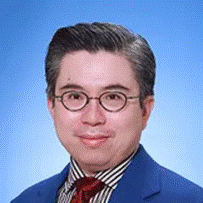
Stephen L. Chan, MD, PhD
President-Elect, International Liver Cancer Association (ILCA)
Faculty of Medicine, The Chinese University of Hong Kong
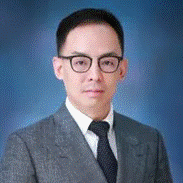
Chi-Leung Chiang, MD
Current Chair and Co-Founder, Hong Kong Stereotactic Body Radiotherapy (SBRT) Research Group
Faculty of Medicine, The University of Hong Kong
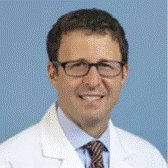
Richard S. Finn, MD
Former President, International Liver Cancer Association (ILCA)
David Geffen School of Medicine, University of California, Los Angeles (UCLA)
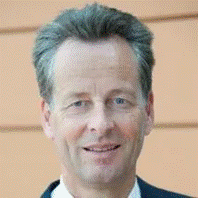
Peter R. Galle, MD
Former President, International Liver Cancer Association (ILCA)
University Medical Center Mainz, Germany
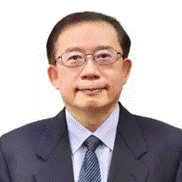
Chia-Hung Kao, MD
Vice President, National Taiwan University Hospital
President, Taiwan Society of Gastroenterology
Former President, Asian Pacific Association for the Study of the Liver (APASL)
Hsi-Ming Lin, MD
Chair, First Asian Conference on Tumor Ablation
Former President, Taiwan Liver Cancer Association
Chang Gung Memorial Hospital
Lianxin Liu, MD, PhD
Vice President, University of Science and Technology of China
Vice Chairman, Chinese Medical Doctor Association – Surgeons Branch
President-Elect, Chinese Anti-Cancer Association (CACA) Liver Cancer Committee
Ruibao Liu, MD, PhD
Vice Chairman, Tumor Committee of the Interventional Medicine Branch, Chinese Medical Doctor Association
Director, Department of Interventional Oncology, Harbin Medical University Cancer Hospital
Zuojin Liu, MD, PhD
Committee Member, Organ Transplantation Committee, Chinese Medical Doctor Association
Director, Department of Hepatobiliary Surgery, The Second Affiliated Hospital of Chongqing Medical University
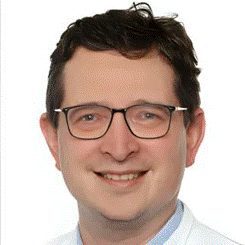
Christoph Roderburg, MD
Director, Abdominal Oncology Center
University Hospital Düsseldorf, Germany
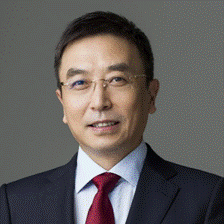
Guang Tan, MD, PhD
Vice Chairman, Liver Cancer Committee, Chinese Anti-Cancer Association (CACA)
Director, Department of Hepatobiliary Surgery, The First Affiliated Hospital of Dalian Medical University
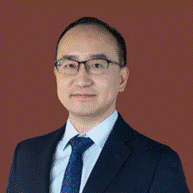
Huichuan Sun, MD, PhD
Chairman, Liver Cancer Committee, Chinese Anti-Cancer Association (CACA)
Deputy Director, Liver Cancer Institute, Fudan University
Deputy Director, Department of Liver Surgery, Zhongshan Hospital, Fudan University
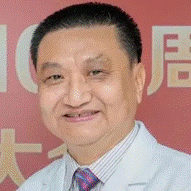
Yunfei Yuan, MD, PhD
Principal Investigator, State Key Laboratory of Oncology in South China
Department of Hepatic Surgery, Sun Yat-sen University Cancer Center