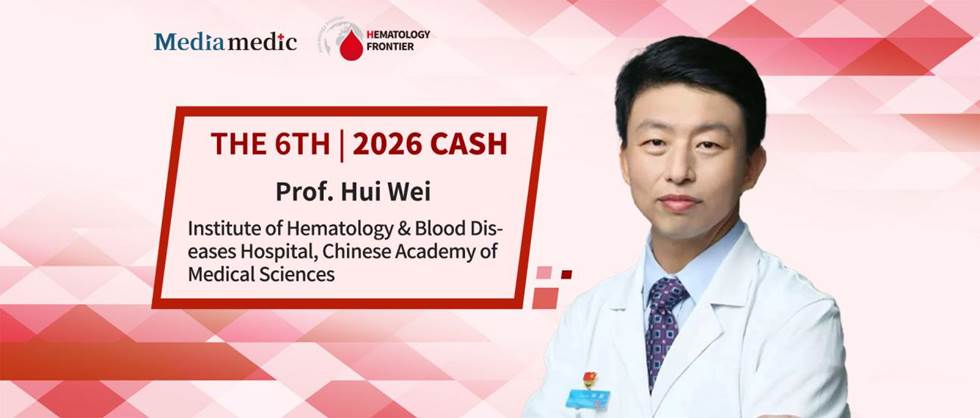
Editor’s Note: From January 9–11, 2026, the 6th China Hematology Discipline Development Conference (CASH) was held in Tianjin, bringing together leading experts to explore cutting-edge advances in hematology aligned with national health strategies. During the conference, Oncology Frontier – Hematology Frontier invited Professor Hui Wei from the Institute of Hematology & Blood Diseases Hospital, Chinese Academy of Medical Sciences, to provide in-depth insights into breakthroughs in FLT3 and IDH1/2 targeted therapy, precision strategies for elderly and high-risk AML populations, and MRD-guided dynamic treatment approaches, offering valuable perspectives for clinical practice and translational research.Breakthroughs in FLT3 and IDH1/2 Targeted Therapy in AML
Oncology Frontier – Hematology Frontier:
AML has entered a molecular subtype-driven precision treatment era. Could you summarize recent breakthroughs in FLT3 and IDH1/2 targeting, and their clinical value across AML molecular subgroups?
Professor Hui Wei:
Both FLT3 inhibitors and IDH inhibitors have demonstrated significant improvements in response rates and overall survival, particularly in relapsed/refractory AML. Importantly, these therapies increase the likelihood of achieving remission, thereby enabling more patients to proceed to allogeneic hematopoietic stem cell transplantation (HSCT), which improves long-term outcomes.
In first-line treatment, FLT3 inhibitors are increasingly being incorporated into standard induction chemotherapy, further improving efficacy in newly diagnosed adult AML. Looking ahead, these agents are expected to move earlier in treatment lines, forming more optimized combination regimens to maximize therapeutic benefit.
AML treatment is transitioning from a uniform treatment model to a genotype-driven precision approach. Treatment decisions will increasingly rely on molecular mutation profiling, rather than solely on post-treatment response. At our center, comprehensive genomic testing is performed at diagnosis, allowing us to tailor therapy based on each patient’s mutation profile to optimize efficacy and tolerability.
Precision Strategies for Elderly, Relapsed/Refractory, and TP53-Mutated AML
Oncology Frontier – Hematology Frontier:
Treatment of elderly AML patients and high-risk subgroups (including TP53-mutated disease) remains challenging. What progress has your team made in optimizing targeted or combination strategies for these populations?
Professor Hui Wei:
At our center, elderly AML patients are predominantly those aged 60–75 years who are fit for chemotherapy. For this group, standard induction chemotherapy remains the recommended first-line option according to current guidelines.
However, for patients with poor tolerance to intensive chemotherapy, low-intensity regimens combining hypomethylating agents (HMAs) with BCL-2 inhibitors have become increasingly common in real-world practice.
We conducted a comparative study evaluating three frontline strategies in elderly AML:
- Conventional intensive chemotherapy
- HMA + BCL-2 inhibitor
- Reduced-intensity chemotherapy + BCL-2 inhibitor
Results presented at ASH demonstrated that HMA + BCL-2 inhibitor regimens achieved comparable or superior efficacy relative to intensive chemotherapy, while offering better tolerability and lower early treatment-related mortality. These findings suggest that low-intensity targeted regimens may become a frontline option for elderly AML patients, pending further validation in prospective trials.
Relapsed/Refractory and TP53-Mutated AML
For relapsed/refractory AML, allogeneic HSCT remains the only potentially curative strategy. Our approach prioritizes:
- Selecting mutation-matched targeted therapy to induce remission
- Bridging to transplant once remission is achieved
For TP53-mutated AML, current evidence indicates that BCL-2 inhibitors may improve response rates but do not significantly prolong survival.
- Transplant-eligible patients: We favor BCL-2–based combination therapy followed by HSCT
- Transplant-ineligible or frail patients: Hypomethylating agent monotherapy is preferred to prolong survival and preserve quality of life
Future Directions: MRD-Guided Therapy and Precision Monitoring
Oncology Frontier – Hematology Frontier:
What key bottlenecks remain in AML precision treatment, and what future directions—particularly in MRD-guided therapy—are most promising?
Professor Hui Wei:
AML is fully entering the molecular-targeted era, and two major priorities remain:
- Expanding the arsenal of targeted agents
- Enhancing speed and accuracy of molecular diagnostics
While molecular testing at diagnosis is now routine, a critical challenge is shortening turnaround time so that genomic results are available within 3–5 working days, enabling rapid treatment selection.
MRD-Guided Dynamic Therapy
Traditionally, flow cytometry has been the main MRD monitoring tool. Moving forward, next-generation sequencing (NGS) will play an increasing role in detecting residual molecular clones, such as FLT3, IDH, or NPM1-mutated subclones.
By identifying mutation-specific residual disease, clinicians can:
- Dynamically adjust therapy
- Select mutation-targeted agents
- More effectively eradicate residual leukemia clones
- Improve depth of remission and long-term survival
This represents a key step toward truly personalized AML therapy.
Expert Profile

Professor Hui Wei
Institute of Hematology & Blood Diseases Hospital, Chinese Academy of Medical Sciences
- Chief Physician, PhD Supervisor
- Director, Leukemia Diagnosis and Treatment Center
- Deputy Director, National Clinical Research Center for Hematologic Diseases
- Member, Chinese Society of Hematology
- Deputy Head, Leukemia & Lymphoma Working Group
- Vice Chair, Chinese Anti-Cancer Association Hematologic Oncology Committee
- Associate Editor, Hematological Oncology
- Research focus: Basic and clinical leukemia research