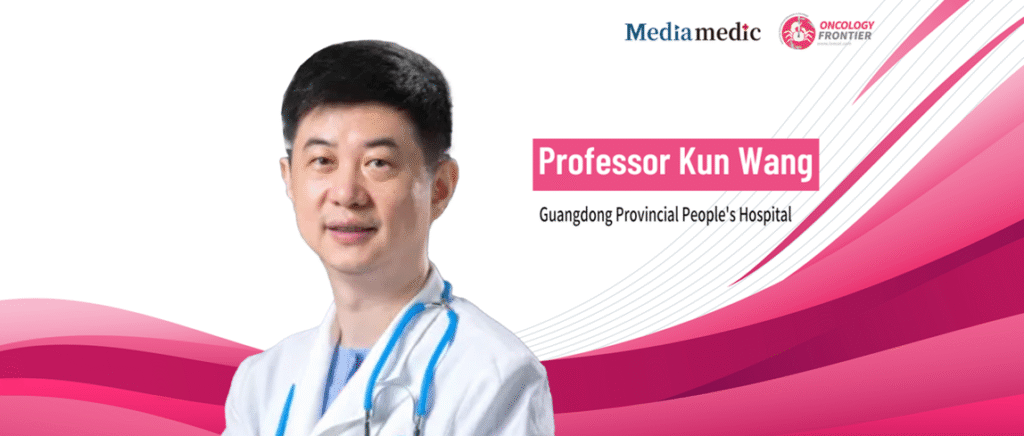
Editor’s Note: The 2025 Yixian Breast Cancer Conference, held alongside the 2025 CSCO Breast Cancer Southern Forum, the Second Chinese Young Breast Cancer Consensus Conference, and the Fourth Yixian Breast Cancer Nursing Conference, took place in Guangzhou on December 26–27, 2025. The meeting focused on standardization of breast cancer care, emerging therapeutic strategies, and precision management in young breast cancer patients, highlighting the latest scientific advances and future clinical directions.During the conference, Oncology Frontier interviewed Professor Kun Wang of Guangdong Provincial People’s Hospital, who shared insights into the latest progress in chemotherapy, immunotherapy, and antibody–drug conjugates (ADCs) in triple-negative breast cancer (TNBC), and discussed how evolving treatment strategies may further improve patient outcomes.
Q1: Which Recent Advances in Advanced TNBC Are Most Likely to Change Clinical Practice in 2026?
Professor Kun Wang: Triple-negative breast cancer remains the most aggressive and poorest-prognosis subtype among the four major breast cancer classifications. However, both early-stage and metastatic TNBC have seen meaningful progress in recent years.
One of the most impactful advances involves platinum-based chemotherapy. While platinum agents have long been known to improve pathologic complete response (pCR) rates in the neoadjuvant setting, their ability to improve long-term survival was previously debated.
Recently, several large Phase III trials, including two major Chinese Phase III studies presented at SABCS 2025 (CITRINE and RJBC-1501), demonstrated that adding platinum to standard anthracycline- and taxane-based chemotherapy reduced the risk of recurrence, progression, or death by over 30%, and significantly improved disease-free survival (DFS) and overall survival (OS).
Across five major Phase III platinum trials, four confirmed survival benefit, and meta-analyses further support platinum as a foundational component of TNBC chemotherapy.
Q2: How Is Immunotherapy Reshaping TNBC Treatment?
Professor Kun Wang: Immunotherapy has become increasingly central to TNBC management.
In the neoadjuvant setting, conventional chemotherapy may improve pCR by ~20%, but this often translates into only 4–5% long-term survival benefit. By contrast, immune checkpoint inhibitors may improve pCR by only 12–13%, yet yield a 10–15% survival advantage, suggesting a durable systemic immune effect that improves long-term outcomes.
Notably, PD-1 inhibitors have shown more consistent benefit across TNBC trials compared with PD-L1 inhibitors, whose survival benefit appears variable. As a result, PD-1 inhibitors are expected to remain the backbone of TNBC immunotherapy, while the role of PD-L1 inhibitors continues to evolve.
Biomarkers and Treatment Selection
- In metastatic TNBC, PD-L1 expression remains important to guide immunotherapy use.
- In early-stage TNBC, PD-L1 testing is not required, as neoadjuvant immunotherapy + chemotherapy benefits patients regardless of PD-L1 status—exemplified by the KEYNOTE-522 regimen (TP-AC + PD-1 inhibitor).
Q3: What Role Will ADCs Play in the Future TNBC Treatment Landscape?
Professor Kun Wang: Antibody–drug conjugates (ADCs) have emerged as game-changing therapies in metastatic TNBC.
Compared with traditional chemotherapy alone or chemo-immunotherapy, newer ADCs—such as Sacituzumab Govitecan—have demonstrated superior efficacy in both PD-L1–positive and PD-L1–negative populations, as shown in the ASCENT-03 and ASCENT-04 trials.
Additionally, Dato-DXd demonstrated superiority over standard chemotherapy in the TROPION-Breast02 trial.
As the number of ADCs for TNBC continues to expand, a new clinical challenge will be how to sequence, differentiate, and select among ADC options—including considerations of target antigen, payload, resistance mechanisms, and toxicity profiles.
Looking forward, ADCs are expected to:
- Move earlier into neoadjuvant and adjuvant settings
- Be combined with immunotherapy to amplify anti-tumor immune responses
- Become a cornerstone of precision-driven TNBC treatment
Expert Profile

Professor Kun Wang
Vice President, Guangdong Provincial People’s Hospital Cancer Center A leading expert in breast cancer systemic therapy, specializing in TNBC clinical research, immunotherapy integration, and ADC-based treatment strategies