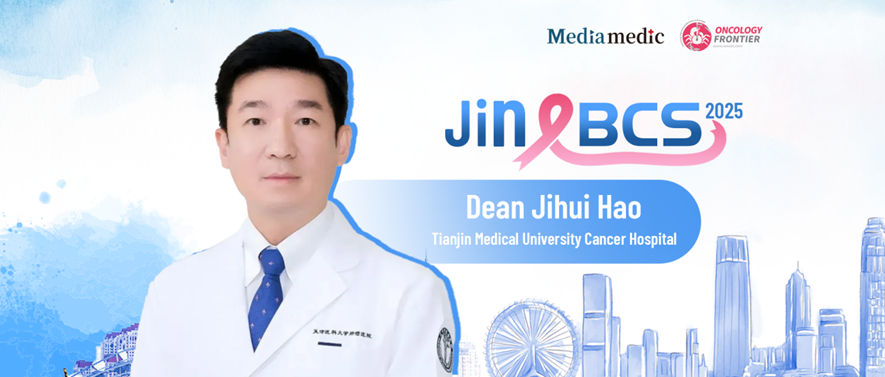
Editor’s Note From December 3 to 6, the Fifth Tianjin International Breast Cancer Conference was grandly held in Tianjin. The meeting was hosted by the Chinese Anti-Cancer Association and organized by Tianjin Medical University Cancer Institute and Hospital together with the National Clinical Research Center for Cancer. As a major academic event in the field of breast oncology, the conference brought together leading domestic and international experts to discuss cutting-edge advances in breast cancer prevention and treatment, while also unveiling several milestone scientific achievements. During the meeting, Oncology Frontier conducted an exclusive interview with Professor Jihui Hao, Conference Chair and President of Tianjin Medical University Cancer Institute and Hospital, who provided in-depth insights into the conference highlights and the innovative development of Tianjin’s breast cancer diagnosis and treatment system.
01
Oncology Frontier: Tianjin Medical University Cancer Institute and Hospital has achieved remarkable results in cancer prevention, diagnosis and treatment research, as well as in the application of intelligent technologies. Could you briefly introduce the key achievements released at this conference, and explain their significance for cancer diagnosis and treatment research?
Professor Jihui Hao: The Fifth Tianjin International Breast Cancer Conference was held as scheduled, and we took this opportunity to release two major research achievements from Tianjin Medical University Cancer Institute and Hospital.
The first achievement was the publication of five-year survival data for patients with malignant tumors treated at our hospital. This report reveals the long-term survival outcomes of cancer patients who were diagnosed and received initial treatment at Tianjin Medical University Cancer Institute and Hospital from 2019 onward. It provides critical real-world evidence for evaluating regional cancer diagnosis and treatment capacity and clearly demonstrates the strength of our leading specialty disciplines. As the largest regional cancer center in China, conducting large-scale, long-term survival outcome assessments offers valuable policy-level and data-driven support for national cancer prevention and control strategies.
Improvements in five-year survival rates reflect multiple factors: continuous advances in diagnostic and therapeutic technologies, ongoing optimization of comprehensive treatment strategies, and increasing maturity of interdisciplinary and multidisciplinary collaborative care models. By releasing this large-scale dataset, we not only demonstrate the overall clinical performance of our institution, but also provide stronger data support for national-level decision-making. Taking breast cancer as an example—it remains the leading threat to women’s health in China, yet through standardized diagnosis, treatment, and comprehensive longitudinal management, patient survival can be continuously improved. This report represents a systematic review of our hospital’s overall clinical work in recent years and further refines the framework of precision oncology.
During the 14th Five-Year Plan period, our hospital established a follow-up center and built an intelligent follow-up system. To ensure data quality and completeness, we implemented a three-track follow-up mechanism combining mortality data linkage, telephone follow-up, and pathology record queries. On the basis of high-quality data, refined management, and structured follow-up systems, we are able to transform overall survival statistics from isolated hospital data points into comprehensive treatment pathway maps—helping cancer care evolve from “being able to treat” to “treating well.” This report embodies our overall clinical capacity and patient-centered philosophy. Looking ahead to the 15th Five-Year Plan period, we will continue to improve the survival reporting system to provide stronger theoretical and empirical foundations for national cancer control policies.
The second major achievement was the first release of an important paradigm for AI-enabled healthcare: BRIGHT, a vertical large-scale AI model for breast pathology. This model was jointly developed by our Breast Pathology Research Laboratory in collaboration with Guangdong Provincial People’s Hospital and the Guangdong Key Laboratory of Medical Image Intelligent Analysis. It is based on one of the largest and most comprehensive breast cancer pathology datasets in China to date.
Breast cancer is the most common malignancy among women worldwide and ranks first in incidence among female cancers in China. Pathological diagnosis remains the gold standard for determining treatment strategies. Given the long training cycle for pathologists and the uneven distribution of medical resources, we adopted an AI-driven approach to build a data-supported diagnostic model. The goal is to expand access to high-quality pathological diagnosis, support grassroots medical institutions, and promote the downward extension and scaling of premium medical resources. The BRIGHT model addresses inter-observer variability in breast pathology diagnosis and advances standardization, scientific rigor, and consistency in pathology practice. Built upon more than 60,000 accumulated breast cancer pathology cases, and empowered by large-scale modeling and artificial intelligence, this platform can serve clinicians, patients, and educational systems alike. I believe that AI-driven empowerment across medical disciplines represents the overarching direction for future development.
02
Oncology Frontier: From the Tianjin model of single-disease, multidisciplinary integration, to forward-looking precision strategies and extensive collaboration, and from inherited traditions to innovation-driven dual-pillar development—what do you see as the core significance of building the Tianjin breast cancer diagnosis and treatment system? What future achievements can we look forward to from Tianjin?
Professor Jihui Hao: The Binhai Campus of Tianjin Medical University Cancer Institute and Hospital is the only dedicated breast disease center in China. For many years, we have upheld and implemented the Tianjin model of single-disease, multidisciplinary integration—breaking down traditional disciplinary boundaries and institutional barriers to provide truly holistic care for patients.
We have integrated medical oncology, surgery, pathology, imaging, radiotherapy, psychological rehabilitation, and basic research, delivering patient-centered, one-stop, full-cycle care and management. At the same time, the hospital adheres to a “one body, two wings” development strategy, with clinical demand as the core, supported by scientific innovation and high-level collaboration as the two wings, driving comprehensive disciplinary advancement.
Currently, the hospital has entered a critical development phase, particularly as implementation of the 15th Five-Year Plan approaches. We aim to transform prior achievements through Tianjin’s “first-trial, first-use” approach, advancing landmark Tianjin innovations from mere “technological high grounds” toward becoming “sources of policy innovation.”
Looking ahead, several promising Tianjin achievements are worth anticipating. For example, at this conference, we released China’s first large-scale AI model integrating artificial intelligence with breast pathology, combining big-data advantages with AI-driven intelligence to create synergistic value.
In addition, we are pursuing several key future directions:
- Launching a Tianjin-specific intelligent system for early breast cancer detection and clinical decision support, integrating AI-based imaging analysis, multi-omics liquid biopsy technologies, and big-data predictive models;
- Developing precision early-screening strategies tailored to Chinese populations, with strong clinical applicability, and promoting their adoption in primary healthcare settings;
- Leveraging our robust clinical resources to establish breast cancer–specific diagnostic and treatment pathways and standards for Chinese populations, and—through multiple investigator-initiated and multicenter clinical studies—amplifying China’s voice in global breast cancer research;
- Actively utilizing national clinical research centers and key laboratories to incubate original “Tianjin-developed” diagnostic technologies and therapeutics with independent intellectual property, achieving breakthroughs in frontier areas such as novel drug delivery systems, tumor cell therapies, and cancer vaccines, and translating basic research into clinical products;
- Building a high-level, international talent development hub by capitalizing on our strong clinical and research platforms. With the Binhai Campus as a base, we aim to attract outstanding young scientists and clinical leaders from China and abroad, lead high-quality breast cancer cohort construction, and advance the integrated development of clinical, basic, and translational research—the “three engines” driving a research-oriented hospital.
We will also use breast cancer as a pilot to promote high-level, peak-discipline development across the entire hospital, cultivating internationally influential disciplines, talents, technologies, and translational capabilities. Ultimately, this will allow disciplinary excellence to drive high-quality institutional development.

Professor Jihui Hao President Tianjin Medical University Cancer Institute and Hospital