Editor’s Note At the beginning of the new year, leading experts gathered in Tianjin. From January 9 to 11, 2026, the 6th China Congress on the Advancement of Hematology (CASH) was grandly held in Tianjin. The meeting brought together top hematology experts from China and around the world, focusing on disciplinary frontiers and national health priorities, fostering in-depth academic exchange and exploration of new directions for hematology.
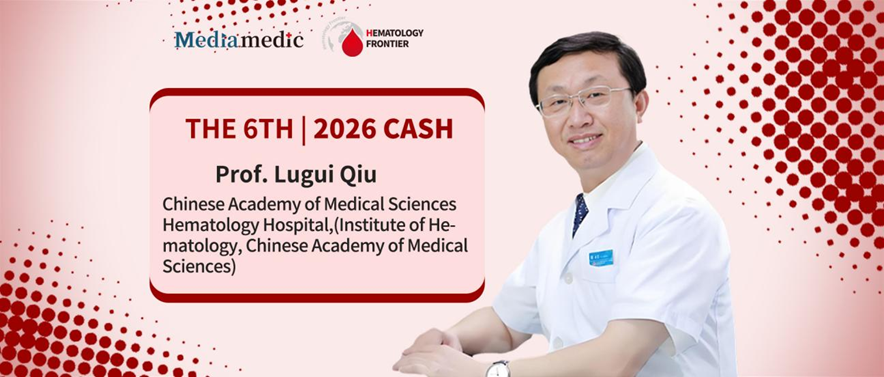
As one of the most influential guideline achievements in the field of multiple myeloma, the 2025 edition of the CSCO Guidelines for the Diagnosis and Treatment of Plasma Cell Neoplasms was published as an independent volume for the first time and underwent comprehensive, systematic updates. During the conference, Oncology Frontier – Hematology Frontier invited Lugui Qiu, Chair of the CSCO Multiple Myeloma Expert Committee and Chief Clinical Expert at the Institute of Hematology and Blood Diseases Hospital, Chinese Academy of Medical Sciences, to provide an authoritative review and interpretation of the key updates and their implications for clinical practice.
Oncology Frontier – Hematology Frontier:
The 2025 CSCO Guidelines for Plasma Cell Neoplasms were published as an independent volume for the first time, with major updates in areas such as the definition of high-risk multiple myeloma, standardization of CAR-T therapy, and criteria for minimal residual disease (MRD) assessment. As the founding Chair of the CSCO Multiple Myeloma Expert Committee, how do you interpret the clinical significance of these updates? What key recommendations would you give to primary-level physicians for understanding and implementing the new guidelines?
Professor Lugui Qiu: In the field of multiple myeloma, diagnostic and treatment guidelines developed by different academic organizations each have their own characteristics. The CSCO guidelines have long adopted a pocket-book format similar to that of the NCCN guidelines, presenting recommendations in tabular form to facilitate rapid clinical reference. In contrast, guidelines developed by the Chinese Anti-Cancer Association (CACA) Hematologic Oncology Committee are more comprehensive and structured in a monograph-like format. Guidelines issued by the Chinese Medical Association and the Chinese Medical Doctor Association tend to focus on concise narrative reviews.
In the previous CSCO guideline system, multiple myeloma and plasma cell neoplasms were included as part of the Guidelines for the Diagnosis and Treatment of Malignant Hematologic Diseases and were not published independently. After the establishment of the CSCO Multiple Myeloma Expert Committee, and following extensive discussion with Professor Jun Ma, we decided to publish the plasma cell neoplasm section as a standalone guideline.
The new edition not only covers multiple myeloma but also systematically incorporates several less common plasma cell–related disorders, including amyloidosis and POEMS syndrome. From a content perspective, the guideline underwent substantial updates and expansion, mainly including:
- Diagnostic and screening strategies for monoclonal gammopathy of undetermined significance (MGUS) and smoldering multiple myeloma;
- Criteria for identifying high-risk smoldering multiple myeloma and corresponding management recommendations;
- A dedicated expert consensus on the diagnosis and treatment of high-risk multiple myeloma;
- An expert consensus on cellular immunotherapy for multiple myeloma, which has been formally incorporated into the CSCO plasma cell neoplasm guidelines.
Following comprehensive revision, the guideline expanded from just over 10,000 words to nearly 50,000 words. In clinical practice, the new guideline has received strong recognition from peers. Since its first independent publication, more than 6,000 copies of the CSCO Guidelines for the Diagnosis and Treatment of Plasma Cell Neoplasms have been distributed—comparable to the circulation of the CSCO Lymphoma Guidelines published during the same period—reflecting both its academic value and practical utility.
These guidelines play an important role in improving standardized diagnosis and treatment, particularly among primary-level physicians, ultimately enhancing overall patient outcomes. To further expand the guideline’s impact, CSCO organized multiple nationwide guideline education and interpretation programs. Throughout 2025, nearly 20 on-site and online guideline roadshows were conducted, reaching more than 100,000 participants and contributing significantly to the promotion of standardized multiple myeloma care in primary healthcare settings.
At present, the Expert Committee has already begun planning updates for the 2026 edition. On one hand, we will continue to incorporate the latest evidence-based data and clinical advances. On the other hand, we will place greater emphasis on explaining the rationale behind key diagnostic and therapeutic recommendations—helping primary-level physicians not only understand what is recommended, but also why it is recommended. This approach aims to achieve both practical implementation and conceptual understanding, ultimately driving continuous improvement in the overall diagnosis and treatment of multiple myeloma in China and allowing more patients to benefit.
Expert Profile
Lugui Qiu, MD, PhD Chief Clinical Expert Institute of Hematology and Blood Diseases Hospital, Chinese Academy of Medical Sciences
- Chief Physician, Doctoral Supervisor
- Recipient of the State Council Special Government Allowance; National Health Commission Outstanding Young and Middle-Aged Expert
- Member, International Myeloma Society (IMS)
- Expert Committee Member, International Myeloma Working Group (IMWG)
- Editorial Board Member, Blood Advances
- Standing Executive Council Member, Chinese Anti-Cancer Association (CACA); Honorary Chair, Hematologic Oncology Committee; Chair, Hematologic Oncology Integrative Rehabilitation Committee
- Chair, CSCO Multiple Myeloma Expert Committee
- Vice Chair, First Committee of the Hematology Institutions Branch, Chinese Hospital Association
- Vice President, Tianjin Anti-Cancer Association
- Editorial Board Member of six core journals including Chinese Journal of Hematology
- Principal Investigator of more than 30 national key research projects
- Author of nearly 600 publications, including over 180 SCI-indexed papers; Editor-in-chief of six academic monographs; holder of six national invention patents
- Recipient of two First Prizes of Tianjin Science and Technology Progress Award and three Second Prizes from the Ministry of Education and Tianjin Municipality