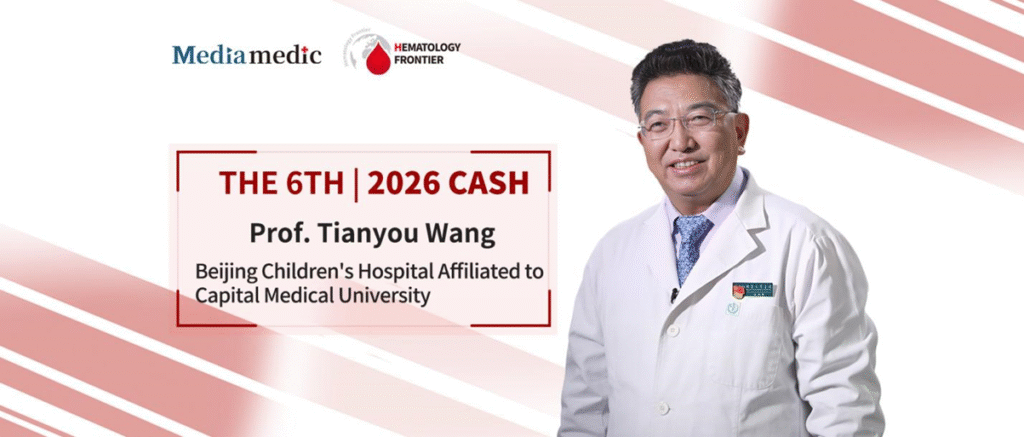
Editorial Note: With the dawn of the new year, Tianjin once again became a hub for academic exchange. From January 9 to 11, 2026, the 6th China Annual Conference on the Development of Hematology (CASH) was grandly held in Tianjin. Bringing together leading experts in hematology from China and abroad, the conference focused on disciplinary frontiers and national health strategies, fostering in-depth discussions on the latest research advances and future directions.Child health, as a central issue in public health, has drawn increasing attention, particularly regarding shifts in disease patterns and corresponding management strategies. Oncology Frontier – Hematology Frontier invited Professor Wang Tianyou, former Chair of the Pediatrics Branch of the Chinese Medical Association and professor at Beijing Children’s Hospital, for an in-depth interview centered on “Responding to Forty Years of Change in the Pediatric Disease Spectrum.” In this discussion, Professor Wang analyzed long-term trends in disease evolution, shared transformative clinical practices, and provided critical guidance for the future development of pediatrics in the new era.
Four Decades of Profound Transformation
The Era-Driven Restructuring of China’s Pediatric Disease Spectrum
Oncology Frontier – Hematology Frontier: As former Chair of the Pediatrics Branch of the Chinese Medical Association, how do you view the fundamental changes in China’s pediatric disease spectrum over the past 40 years? Which diseases have shown rising incidence or notable shifts, and what underlying causes and social factors may be driving these changes?
Prof. Wang Tianyou: Over nearly four decades since China’s reform and opening-up, the country has undergone dramatic economic transformation, accompanied by substantial improvements in living standards. These changes have profoundly reshaped the pediatric disease landscape.
In the past, childhood diseases were dominated by malnutrition and infectious diseases. Conditions such as anemia and rickets caused by nutritional deficiencies were extremely common, with large numbers of children affected by mild to severe malnutrition. Infectious diseases like measles had high incidence and mortality rates, largely due to underdeveloped preventive medicine, limited vaccine coverage, and inadequate infection control measures at that time.
With rapid socioeconomic development, this disease pattern has undergone a qualitative shift. Today, metabolic diseases driven by nutritional excess have become prominent. Childhood obesity rates continue to rise, accompanied by significant increases in cardiovascular disease, hypertension, and type 2 diabetes. Forty years ago, type 2 diabetes accounted for only about 10% of pediatric diabetes cases; today, it has risen to approximately 80%. The incidence of pediatric hypertension is also steadily increasing. If childhood obesity is not effectively controlled, these conditions will persist into adulthood, further exacerbating the burden of chronic diseases such as hypertension and stroke.
Neoplastic diseases in children have also shown an upward trend. Internationally, countries with higher socioeconomic development report pediatric cancer incidence rates of approximately 142 cases per million. In recent years, China’s incidence has gradually approached this level, rising from just over 100 cases per million to 128.68 per million. In economically developed coastal regions such as Shanghai, incidence has reached 137 cases per million, indicating a continuous increase in pediatric malignancies.
Mental health problems have become increasingly prominent. In the past, when multi-child families were common, pediatric psychological disorders were relatively rare. Today, with the predominance of single-child families, the number of children with psychological disorders has increased markedly. It is estimated that around 28 million children nationwide experience varying degrees of psychological problems, yet there are only about 10,000 pediatric mental health professionals—reflecting a severe shortage of resources. True child health can only be achieved by addressing both physical and mental well-being.
In addition, the prevalence of myopia has risen rapidly, particularly mild to moderate myopia among primary and secondary school students. The national myopia rate has reached 52%, and without effective intervention, it may rise to as high as 80% by 2050. Dental caries and scoliosis also pose growing risks. Scoliosis, in particular, can have long-term impacts on physical development and mental health. In the current education system, which is heavily examination-oriented, ensuring at least one hour of daily physical activity for children is often difficult, further aggravating these chronic conditions.
Encouragingly, advances in preventive medicine—especially vaccination—have dramatically reduced the incidence of vaccine-preventable infectious diseases, driving an overall shift in the pediatric disease spectrum toward chronic non-communicable diseases. Nevertheless, emerging viral infections remain a major challenge for pediatricians. Looking ahead, coordinated efforts among families, schools, society, and healthcare systems are required. Through comprehensive strategies such as nutritional guidance, psychological support, physical activity promotion, and early screening, we can safeguard child health and achieve sustainable development.
From Treatment to Management
Systematic Approaches to Addressing the Transition in Pediatric Disease Patterns
Oncology Frontier – Hematology Frontier: In response to the evolving disease spectrum, pediatric diagnosis and treatment have continuously advanced in both philosophy and technology—for example, precision immunotherapy and targeted therapy in pediatric hematologic malignancies, as well as the establishment of multicenter collaborative models. Drawing on your clinical experience, could you share the core solutions developed over the past 40 years to address these changes, and how they have improved pediatric health outcomes?
Prof. Wang Tianyou: In the face of profound shifts in the pediatric disease spectrum—particularly the rapid rise of chronic non-communicable and neoplastic diseases—both pediatric philosophy and clinical practice must evolve accordingly.
First, adherence to the principle of “prevention first” is fundamental. For all preventable diseases, society as a whole—including families, schools, and healthcare institutions—must be mobilized to form a coordinated prevention and control system. Second, pediatric care must move beyond disease treatment toward comprehensive health management, fostering scientifically sound lifestyles in children and shifting the focus upstream to prevention and health promotion.
Technological progress has brought transformative changes to pediatric care. Rapid advances in genetics, biology, and immunology have given rise to novel therapies that have dramatically improved outcomes for major pediatric diseases. Taking acute leukemia as an example, five-year survival rates in the early years of reform and opening-up ranged from only 20% to 70%. Today, in major urban centers, survival rates have reached approximately 90%. This progress is largely attributable to new therapeutic modalities, including targeted therapies, bispecific antibodies, and CAR-T cell immunotherapy. CAR-T therapy has not only achieved breakthroughs in relapsed/refractory acute lymphoblastic leukemia but has also expanded into lymphoma and brain gliomas, demonstrating enormous potential.
Clinical care models have also shifted from single-discipline approaches to multidisciplinary team (MDT) collaboration. For instance, in hepatoblastoma, treatment strategies in the past lacked coordination among specialties. Today, MDTs integrate expertise from internal medicine, surgery, interventional radiology, imaging, and pathology to conduct comprehensive evaluations and systematic treatment. As a result, five-year mortality rates have decreased from approximately 80% to around 20%. In the future, deeper integration of new technologies and drugs with MDT models will further improve cure rates and contribute to disease prevention.
The diagnosis and treatment of rare diseases similarly rely on cross-disciplinary collaboration. Purely clinical pathways are often insufficient to address their complexity; instead, close cooperation with genetics and biological sciences is essential to achieve precise diagnosis, effective intervention, and preventive strategies for severe hereditary diseases.
In summary, against the backdrop of accelerating changes in the disease spectrum, adherence to prevention-oriented strategies, advancement of health management, adoption of technological innovation, and strengthening of multidisciplinary collaboration constitute the core pathway for the development of pediatrics in China.
Technology Empowering the Future
AI and Precision Medicine Shaping a New Paradigm in Child Health
Oncology Frontier – Hematology Frontier: With the rising burden of chronic pediatric diseases and persistent regional disparities in healthcare resources, emerging technologies such as AI and genomic sequencing are reshaping pediatric practice. Over the next decade, what new trends do you anticipate in the pediatric disease spectrum? In response, which areas should be prioritized in policy support, healthcare resource optimization, and life-course health management?
Prof. Wang Tianyou: This is an excellent question. I believe it can be addressed from several perspectives.
First, at the level of disease prevention, the application of modern technologies—particularly artificial intelligence (AI) and advanced statistical methods—should be accelerated in pediatrics. Through risk prediction, early screening, and dynamic monitoring of controllable diseases, prevention can become more forward-looking and precise, enabling a shift from “passive treatment” to “active prevention.”
Second, AI should play a key role in enhancing primary healthcare capacity and promoting equitable resource distribution. AI-assisted training and clinical decision support systems can strengthen continuous education for physicians in remote and underserved areas, while providing standardized guidance during clinical practice. This will help achieve greater consistency in care quality across regions. In pediatric hematology, for example, a tiered guidance system has gradually formed, extending from national medical centers to regional hubs and基层 healthcare institutions. Through remote support and intelligent tools, standardized diagnostic and treatment pathways can be effectively implemented at the grassroots level.
In practice, long-term, systematic support programs led by central urban hospitals have significantly enhanced regional healthcare capacity. For instance, the National Children’s Medical Center has implemented a “dual-director system,” whereby subspecialty experts are stationed long-term in local hospitals to support discipline development. Under continuous guidance from central institutions, regional hospitals have evolved into provincial centers of excellence, further driving improvements across surrounding areas. This model has proven replicable and scalable across multiple specialties.
Third, advances in modern biology and genetics should be fully leveraged to achieve breakthroughs in diseases that were previously difficult to diagnose or treat. In hereditary and metabolic disorders, in particular, improvements in diagnostic techniques and therapeutic options have made early detection, early diagnosis, and early intervention key determinants of prognosis. AI is playing an increasingly important role in assisting the diagnosis and differential diagnosis of complex diseases, helping clinicians rapidly identify potential disease clues and improve diagnostic efficiency and accuracy.
It must be emphasized that while AI is a powerful tool for advancing medicine, it cannot replace physicians. Continuous deepening of medical knowledge and accumulation of clinical experience by physicians form the foundation upon which AI systems can be refined and optimized. Only through a model of human–machine collaboration and co-evolution can AI truly empower clinical practice, better assist clinicians in addressing complex medical challenges, and ultimately benefit patients.
Expert Profile

Wang Tianyou, MD, PhD Chief Physician, Second-Level Professor, Doctoral Supervisor Beijing Children’s Hospital
Recipient of the State Council Special Allowance Winner of the China Pediatric Physician Award and “National Master Physician” Honor Board Member, Chinese Medical Association Former Chair, Pediatrics Branch of the Chinese Medical Association Vice President, Pediatrics Branch of the Chinese Medical Doctor Association Chair, National Expert Committee on Pediatric Drug Use (National Health Commission) Chair, Pediatrics Branch, China Association for the Promotion of Medical Development Editor-in-Chief, Chinese Journal of Pediatrics Editor-in-Chief, Chinese Journal of Pediatric Hematology and Oncology Deputy Editor / Editorial Board Member of more than ten journals, including Chinese Journal of Pediatric Emergency Medicine and Chinese Journal of Practical Pediatrics