

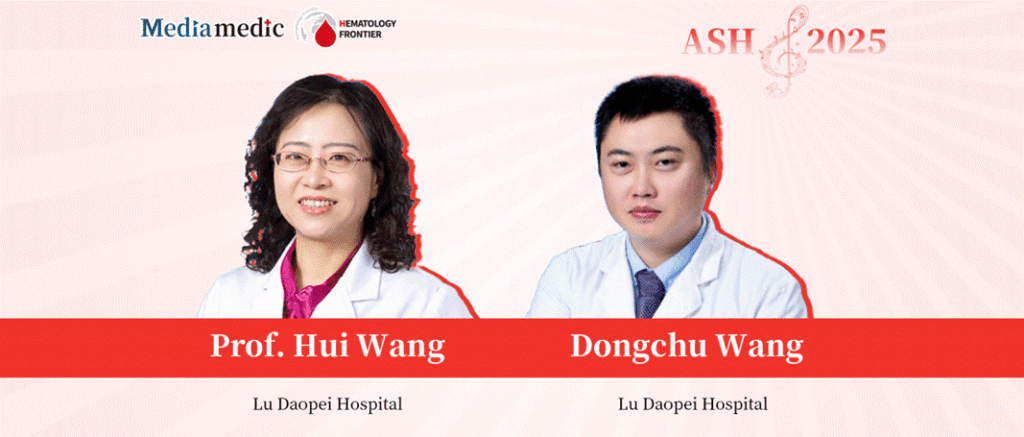
From December 6 to 10, 2025, the 67th Annual Meeting of the American Society of Hematology (ASH) was held in Orlando, USA. The meeting highlighted the latest advances in both clinical hematology and basic research, driving progress in the diagnosis and treatment of hematologic diseases as well as translational research.In this issue, we feature the research achievements of Professor Wang Hui’s team, covering cutting-edge technologies such as 16-color full-spectrum flow cytometry, a weighted cytokine scoring system, and other innovative approaches. These studies provide solid scientific evidence for early precise diagnosis, treatment response assessment, and timely clinical intervention, demonstrating the critical role of technological innovation in modern hematology. We warmly invite readers to engage in further discussion and exchange.01 | Detection of Minimal Residual Disease in T-ALL by 16-Color Full-Spectrum Flow Cytometry
Title:
Detection of minimal residual disease in T-cell acute lymphoblastic leukemia by 16-color full-spectrum flow cytometry
First Author: Hui Wang
Corresponding Author: Hui Wang
Background
Flow cytometric detection of minimal residual disease (MRD) in T-cell acute lymphoblastic leukemia (T-ALL) faces several major challenges:
High loss rates of early markers with broad coverage, such as TdT and CD99;
Frequent acquisition of mature immunophenotypic markers;
Significant immunophenotypic heterogeneity of mature lymphocytes—particularly interference from CD4⁺/CD8⁺ or CD4⁻/CD8⁻ T cells;
Increased diagnostic complexity due to the expanding use of CD7 CAR-T therapy, which alters antigen expression.
To address these issues, we designed a 16-color full-spectrum flow cytometry panel to overcome these limitations as comprehensively as possible.
Methods
Between February 28, 2024, and May 29, 2025, MRD monitoring using full-spectrum flow cytometry was performed in patients with T-ALL treated at Hebei Yanda Lu Daopei Hospital. A total of 1,025 patients underwent 1,570 MRD assessments (male:female = 768:257; median age 16 years, range 1–68).
The antibody panel included:
CD99 FITC / cCD3 PE / CD3 BV785 / CD48 PE-Cy7 / CD4 APC-Cy7 / CD5 APC-R700 / CD2 BV605 / CD7 APC / CD16 eFluor 450 / CD56 BV711 / TdT BV421 / CD45 V500 / CD34 PerCP-Cy5.5 / CD94 BV650 / CD8a BV570 / TCRγδ BV480.
A total of 612 patients had detectable genetic abnormalities. Ten MRD-positive and ten complete remission samples were selected for correlation analysis between conventional flow cytometry and full-spectrum flow cytometry. Data were analyzed using Kaluza 2.3.0, with statistical analysis performed in SPSS 17.0. Rates were compared using Fisher’s exact test, with P < 0.05 considered statistically significant.
Results
Full-spectrum flow cytometry showed excellent concordance with conventional flow cytometry (R² = 0.9945).
Among 1,570 tests, 155 positive results were identified from 103 patients. In MRD-positive patients, the male-to-female ratio was 79:24, with a median age of 21 years (range 4–68). Median tumor burden was 1.66% (range 0.002–94.15%). Among MRD-positive cases, 68 patients had detectable fusion genes or oncogenes; in patients with repeated testing, the highest tumor burden was used for analysis.
Among 52 CD7-negative patients after CD7 CAR-T therapy, 43 were MRD-negative and 9 were MRD-positive. In MRD-positive cases, loss or dim expression of markers was observed: cCD3-negative (2), partially positive (4); CD5-negative (2), CD5-dim (5); CD2-negative (6), CD2-dim or partially positive (1). Notably, none of the 52 CD7-negative patients showed simultaneous loss of cCD3, CD2, and CD5.
Antigen expression changes were observed during longitudinal MRD follow-up.
The relationship between genetics and immunophenotype was explored. CD45^dim/CD7^bright was identified as the optimal gating strategy, although NK cell interference must be excluded. MRD was most readily identifiable in patients with MLL::AF6 fusion, showing uniform expression of CD7^brightCD99^brightCD48⁻CD56⁻CD34⁺. This was followed by EVI1 abnormalities (100% CD7^brightCD99^brightCD48⁺CD56⁻CD34⁺) and CALM::AF10 fusion (100% CD7^brightCD99^brightCD48⁻CD34⁺, with 67% CD56 positivity). MRD detection may be more challenging in patients with PCM1::JAK2 fusion or certain cases with high WT1 expression.
Conclusion
The full-spectrum flow cytometry–based MRD detection strategy for T-ALL enables simultaneous assessment of more than four pan-lineage markers and theoretically meets the gating requirements for 98.51% of post–CAR-T MRD assessments, making it one of the most promising MRD detection approaches. While genetic alterations correlate with immunophenotypes to some extent, the ability of full-spectrum flow cytometry to incorporate extensive marker combinations allows maximal coverage across diverse genetic subtypes.
02 | Development and Validation of a Weighted Cytokine Scoring System for Immune Status Assessment Following CD19 CAR-T Therapy
Title:
Development and validation of a weighted cytokine scoring system for immune status assessment following CD19 CAR-T therapy
First Author: Dongchu Wang
Corresponding Author: Hui Wang
Background and Objectives
This study aimed to establish and validate a novel immune status assessment system based on multiplex cytokine profiling to objectively evaluate immune responses following CD19 CAR-T therapy and facilitate early identification of cytokine release syndrome (CRS). By quantifying the contributions of multiple cytokines and applying a formula-based algorithm, this system provides a simplified, rigorous, and rapid tool for managing complex cytokine data.
Methods
Samples were obtained from 111 patients with relapsed/refractory B-cell acute lymphoblastic leukemia (B-ALL) who received CD19 CAR-T therapy at Lu Daopei Hospital starting in March 2020. The cohort included a training set (n = 34) for model development and a validation set (n = 77) for clinical concordance testing.
In the training set, 24 cytokines (including IFN-γ, IL-2, IL-6, IL-10, TNFα, GM-CSF, Granzyme B, ST-2, and others) were serially measured at six time points: pre-treatment (day 0) and days 4, 7, 14, 21, and 28 post-infusion. In the validation set, cytokine profiling was performed on days 0 and 7.
Results
Cytokine levels peaked 7–10 days after CAR-T infusion and gradually declined as tumor clearance progressed and CAR-T cell–tumor interactions weakened. This decline paralleled reduced expansion of CAR-T cells, CD3⁺ T cells, and CD8⁺ T cells, with cytokine concentrations returning close to baseline by approximately day 30.
A weighted cytokine scoring system was developed to assess immune status. The 24 cytokines were classified into four weight categories based on their contribution to CRS prediction:
Class I (weight 2.0): IFN-γ, IL-2, IL-6, IL-10, ST-2, IL-8, GM-CSF
Class II (weight 1.0): IL-2RA, IL-17F, REG3a, IL-1β, MCP-1, TNFRI
Class III (weight 0.5): IL-4, IL-5, IL-22, IL-15, IL-12p70
Class IV (weight –1.0): Elafin, TNFα, Granzyme B
When a cytokine’s peak value exceeded three times the predefined threshold, it contributed its weighted score. Total scores were calculated by summation and used to stratify CRS severity:
≤8 points: CRS grade 0–1
8 and <18 points: CRS grade 2
≥18 points: CRS grade 3–4
Clinical validation demonstrated an overall sensitivity of 89.61%, specificity of 96%, PPV of 95.83%, and NPV of 90%. Importantly, in distinguishing CRS grade 0–1 (outpatient-manageable) from CRS ≥2 (requiring hospitalization per ASTCT criteria), the system achieved even higher performance, underscoring its value in guiding critical clinical decisions.
Conclusion
This standardized cytokine scoring system provides an objective and efficient tool for immune monitoring and early intervention, offering substantial clinical decision support for cellular immunotherapy.
Expert Profiles

Hui Wang
Lu Daopei Hospital
Vice President, Beijing Lu Daopei Institute of Hematology
Deputy Director, Department of Clinical Laboratory (Vice-President level)
Editorial Board Member, Chinese Journal of Laboratory Medicine
Young Editorial Board Member, Chinese Journal of Hematology
Chair, Flow Cytometric Diagnostics Committee, Chinese Society of Integrated Traditional and Western Medicine
Vice President, Beijing Society of Laboratory Medicine
Holds leadership positions in more than 20 academic societies
Professor Wang has worked in flow cytometry for 24 years, independently signing off on millions of clinical reports. She holds 10 Chinese invention patents and 3 U.S. patents, has led the drafting of 6 expert consensuses as first author/corresponding author, and contributed to 11 additional industry standards. She has published over 60 SCI and core journal articles and contributed to nearly 100 academic publications.

Dongchu Wang
Lu Daopei Hospital
MSc, Assistant Researcher
Member, Flow Cytometric Diagnostics Committee, Chinese Society of Integrated Traditional and Western Medicine
Young Committee Member, Beijing Society of Integrated Traditional and Western Medicine
Mr. Wang has presented as first author at multiple international conferences, including ASH, EHA, ICCS, ISLH, and EBMT. He received his undergraduate and master’s degrees from the University of Greenwich (UK) in Biomedical Science and Biotechnology. Since joining Lu Daopei Hospital in 2017, his work has focused on laboratory diagnostics and immune monitoring in cellular immunotherapy, including CAR-T, TCR-T, CAR-NK, and NK/CIK therapies, with recent emphasis on high-throughput cytokine analysis using CBA-based flow cytometry.

