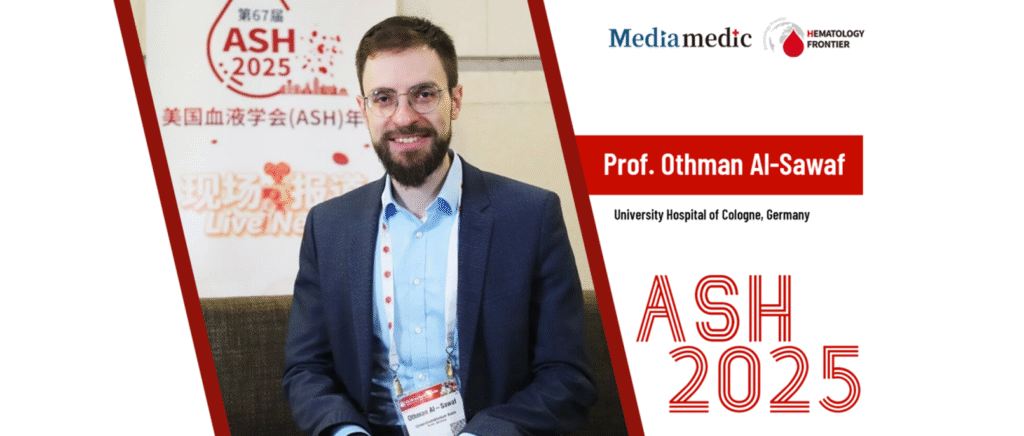
The widespread adoption of targeted therapies has significantly improved long-term outcomes for patients with chronic lymphocytic leukemia (CLL). However, a critical question has remained unanswered: Is fixed-duration therapy as effective as continuous treatment? Until now, no prospective head-to-head evidence had directly compared these two strategies.At the Plenary Scientific Session of the 2025 American Society of Hematology (ASH) Annual Meeting, Professor Othman Al-Sawaf from University Hospital Cologne, Germany, presented the interim analysis of the international randomized phase III CLL17 trial. This landmark study is the first to prospectively compare fixed-duration therapy with continuous BTK inhibitor–based therapy in previously untreated CLL patients, providing pivotal evidence to guide optimization of frontline treatment strategies.
During the meeting, Oncology Frontier – Hematology Frontier invited Professor Al-Sawaf for an in-depth discussion of the study’s background, key findings, and clinical implications.
Oncology Frontier – Hematology Frontier:
You presented the results of the CLL17 trial at ASH, comparing fixed-duration treatment with continuous targeted therapy in previously untreated CLL patients. Could you briefly introduce the study background and key findings? How do these results reshape our understanding of CLL treatment?
Professor Othman Al-Sawaf:
In CLL, two fundamentally different therapeutic strategies exist: fixed-duration therapy and continuous therapy. Both approaches were originally developed through comparisons with chemotherapy, rather than with each other. Until now, we lacked direct, prospective evidence comparing these two paradigms head-to-head.
To address this unmet need, we designed the CLL17 trial, in which treatment-naïve CLL patients were randomly assigned to either:
- Fixed-duration therapy:
- Venetoclax plus obinutuzumab (VO), or
- Venetoclax plus ibrutinib (VI); or
- Continuous therapy:
- Ibrutinib monotherapy (indefinite BTK inhibitor treatment).
The primary objective of the study was to evaluate progression-free survival (PFS) and to determine whether fixed-duration regimens are non-inferior to continuous therapy.
The interim analysis demonstrates that fixed-duration treatment is indeed non-inferior to continuous BTK inhibition, fundamentally challenging the assumption that lifelong therapy is required to achieve durable disease control in CLL.
Oncology Frontier – Hematology Frontier:
The fixed-duration venetoclax plus obinutuzumab (VO) regimen showed non-inferior PFS compared with continuous ibrutinib. What impact do you think this finding will have on future CLL treatment strategies? What are the advantages and challenges of VO compared with continuous therapy in clinical practice?
Professor Othman Al-Sawaf:
The interim results clearly confirm that fixed-duration therapy meets the non-inferiority criterion compared with continuous treatment. In previously untreated CLL patients, both fixed-duration regimens—VO and VI—demonstrated comparable clinical efficacy to continuous ibrutinib monotherapy.
These findings strongly support the clinical feasibility of time-limited treatment. For the majority of treatment-naïve CLL patients, effective disease control can be achieved without the need for indefinite therapy.
From a practical standpoint, fixed-duration therapy offers several advantages: predictable treatment duration, reduced cumulative toxicity, improved quality of life, and potential cost savings. That said, careful patient monitoring and appropriate management of tumor lysis risk—particularly with venetoclax-based regimens—remain essential components of clinical implementation.
Oncology Frontier – Hematology Frontier:
You reported that fixed-duration therapy achieved significantly higher rates of undetectable minimal residual disease (uMRD) than continuous therapy. Could you elaborate on the clinical significance of this finding, particularly with respect to long-term treatment-free survival?
Professor Othman Al-Sawaf:
Minimal residual disease (MRD) is a highly informative secondary endpoint, as it reflects the depth of response achieved with therapy.
In the CLL17 trial, only fixed-duration regimens were able to achieve deep MRD negativity in at least 50% of patients, whereas continuous monotherapy did not reach this level of response. This is a critical distinction.
Undetectable MRD is a prerequisite for successful fixed-duration therapy, as only patients who achieve deep MRD negativity can discontinue treatment while maintaining durable disease control. In this sense, MRD negativity enables treatment-free remission, which represents a major goal for patients and clinicians alike.
While these findings are clinically meaningful, the relationship between MRD status and long-term overall survival will need to be confirmed with longer follow-up.
Oncology Frontier – Hematology Frontier:
Your subgroup analyses showed differences in efficacy among patients with IGHV mutations and those with del(17p)/TP53 aberrations. How should these findings influence treatment selection? Do you foresee a more personalized approach based on molecular characteristics?
Professor Othman Al-Sawaf:
Although the subgroup analyses are exploratory, they carry important clinical implications.
For patients with unmutated IGHV—who comprised approximately 55% of the study population—fixed-duration therapy remained non-inferior to continuous treatment. This is particularly noteworthy, as unmutated IGHV is associated with intermediate-to-high risk disease, earlier relapse, and has historically prompted clinicians to favor continuous therapy.
Our data suggest that even in this higher-risk subgroup, fixed-duration regimens can deliver efficacy comparable to continuous therapy, positioning them as a viable and potentially preferred option.
In contrast, data for patients with TP53 aberrations remain immature, as this subgroup represented only about 8% of trial participants. While the fixed-duration VI regimen showed a trend toward improved outcomes compared with VO in this setting, confidence intervals are wide, and longer follow-up is required before drawing firm conclusions.
Nevertheless, these findings emphasize the importance of routine IGHV and TP53 testing prior to treatment initiation, as molecular profiling will increasingly guide individualized treatment selection in CLL.

Expert Profile
Othman Al-Sawaf, MD
University Hospital Cologne, Cologne, Germany
Professor Al-Sawaf is a hematologist and medical oncologist at the University Hospital Cologne and a study physician with the German CLL Study Group (GCLLSG).
He received his medical degree from RWTH Aachen University and joined the Department of Internal Medicine I under Professor Michael Hallek at the University Hospital of Cologne in 2016. In 2020, he also served as a visiting scientist in the laboratory of Professor Charles Swanton at the Francis Crick Institute in London.
Professor Al-Sawaf is a coordinating physician and principal investigator in numerous national and international phase I–III clinical trials. His research interests include cancer evolution, tumor metabolism, and computational oncology, with a focus on developing innovative, data-driven treatment strategies in clinical hematology and oncology.