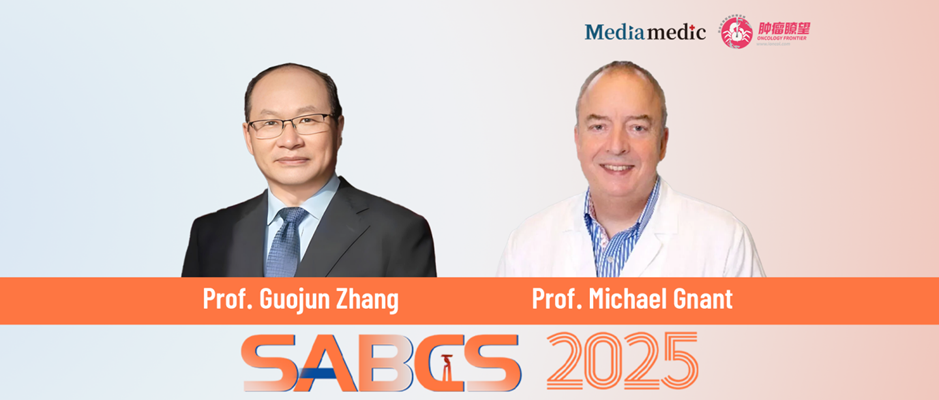
Editor’s note: For patients with HER2-positive breast cancer, neoadjuvant treatment strategies are rapidly evolving—from traditional dual HER2 blockade to the fast-emerging era of antibody–drug conjugates (ADCs). Recently, Chinese-developed anti-HER2 ADCs have demonstrated impressive efficacy in early clinical trials, bringing new momentum to the global treatment landscape. Oncology Frontier invited Professor Michael Gnant, President of the SGBCC Congress and Professor at the Comprehensive Cancer Center of the Medical University of Vienna, to engage in an in-depth dialogue with Professor Zhang Guojun, Vice Chairman of the Breast Cancer Committee of the Chinese Anti-Cancer Association and President of Yunnan Cancer Hospital. Their discussion focused on opportunities and challenges in neoadjuvant therapy for HER2-positive breast cancer, as well as the breakthrough data of China’s original bispecific ADC TQB2102.
From historical milestones to a new era: NeoSphere to DESTINY-Breast11 and the rise of ADCs
Professor Zhang Guojun noted that neoadjuvant therapy for HER2-positive breast cancer has achieved remarkable progress over the past decade. The landmark NeoSphere trial established dual HER2 blockade with trastuzumab and pertuzumab as the standard of care, while ADCs are now reshaping the treatment paradigm. He asked Professor Gnant how he views this evolution.
Professor Michael Gnant responded that this progression follows a clear trajectory. More than a decade ago, NeoSphere demonstrated that trastuzumab combined with pertuzumab and chemotherapy could achieve very high pathological complete response (pCR) rates, firmly establishing dual HER2 blockade as the neoadjuvant standard. However, dual HER2 therapy may be associated with long-term adverse effects, particularly potential cardiotoxicity, prompting the need to explore novel strategies.
As research advanced, ADCs entered the neoadjuvant arena, though not without setbacks. The KRISTINE study showed that T-DM1-based regimens resulted in lower pCR rates than the control arm, representing an early disappointment for ADCs in this setting. A true turning point emerged at the ESMO Congress in October, when the DESTINY-Breast11 trial demonstrated that T-DXd significantly improved pCR rates compared with ddAC-THP, marking the official advent of the ADC era in neoadjuvant treatment for HER2-positive breast cancer.
The rise of Chinese innovation: homegrown ADCs on the global stage
Professor Zhang highlighted that 2025 could be regarded as the “first year of ADCs” in neoadjuvant therapy for HER2-positive breast cancer. Beyond T-DXd, Chinese-developed anti-HER2 ADCs have also shown encouraging progress. Two phase II studies led by Professor Shao Zhiming’s team—the FASCINATE-N study evaluating SHR-A1811 and the TQB2102-II-01 study assessing TQB2102—were both published in top international journals in 2025, adding new potential options in the ADC era.
Professor Gnant agreed that these developments are highly exciting. He noted particular interest in the data for TQB2102. As the world’s first bispecific HER2 ADC to demonstrate success in neoadjuvant breast cancer, its phase II study showed consistently strong pCR rates across all dose-exploration cohorts, ranging from approximately 57.7% to 76.9%. Notably, cohort 2, receiving 6.0 mg/kg for eight cycles, achieved a pCR rate as high as 76.9%, providing robust evidence to support future clinical application.
Focusing on breakthrough data: bispecific ADC TQB2102 brings new hope
Professor Zhang emphasized that the pCR rate achieved with TQB2102, particularly the approximately 77% rate, represents one of the highest pCR figures observed to date in the neoadjuvant setting. Although these results are from a phase II trial, they offer strong support for future clinical use, regulatory evaluation, and the initiation of phase III studies.
He further noted that in HER2-positive and triple-negative breast cancer, pCR achieved with neoadjuvant therapy is strongly correlated with long-term outcomes such as event-free survival and overall survival. Therefore, achieving such a high pCR rate preoperatively provides reason for optimism that a substantial proportion of patients may experience long-term survival benefits, potentially even higher cure rates.
Professor Gnant fully concurred, citing multiple meta-analyses that have confirmed the strong and statistically reliable association between pCR and improved EFS and OS in HER2-positive and triple-negative breast cancer. He stated that the pCR data demonstrated by TQB2102 are indeed impressive and highly promising, while emphasizing that confirmation in phase III trials will be essential, which he looks forward to.
Understanding the unique mechanism: potential advantages of bispecific ADCs
Professor Zhang explained that the success of TQB2102 is closely linked to its unique mechanism of action. As a bispecific ADC, it simultaneously targets two distinct epitopes of the HER2 protein. This design not only blocks HER2 homo- and heterodimerization to inhibit downstream signaling pathways, but also enhances drug internalization to deliver cytotoxic payloads more effectively.
Compared with conventional ADCs such as T-DM1 or T-DXd, this bispecific mechanism may confer several potential advantages. First, binding to two epitopes may better address tumor heterogeneity. Second, it may help overcome resistance mechanisms. Third, it may enhance drug uptake by tumor cells, thereby improving efficacy. In addition, safety data suggest relatively lower rates of hematologic toxicity, diarrhea, and interstitial lung disease compared with some existing ADCs.
Looking ahead: from Chinese evidence to global validation
Professor Gnant stated that the phase II success of TQB2102 is undoubtedly a major milestone in Chinese drug development. However, to truly change clinical practice, the critical next step will be phase III trials. He emphasized the importance of confirmatory head-to-head studies against current standard regimens, such as THP, to clearly define efficacy and safety advantages.
Professor Zhang agreed and outlined future plans. TQB2102 is currently undergoing comprehensive development in breast cancer, including a phase III neoadjuvant trial (TQB2102-III-05), as well as phase III studies in first-line (TQB2102-III-06), second-line (TQB2102-III-02), and HER2-low disease (TQB2102-III-01). This extensive program highlights the drug’s significant potential across both early- and late-stage breast cancer.
He expressed hope that under the leadership of internationally and domestically renowned experts such as Professor Gnant and Professor Shao Zhiming, global multicenter phase III trials could be conducted, allowing this Chinese innovation to benefit patients with HER2-positive breast cancer worldwide.
Professor Gnant concluded that China’s rapid progress in innovative drug development, particularly in the ADC field, is truly remarkable. From ASCO and SABCS to ESMO, Chinese institutions and investigators are gaining increasing recognition and respect on the global stage. The early data for TQB2102 are highly promising. He emphasized that true innovation ultimately needs to be global, and he welcomed the international development plans for TQB2102. Through openness, collaboration, and international clinical research, he believes that China-originated innovations can provide new and more effective therapeutic options for patients worldwide.
Professor Zhang closed by thanking Professor Gnant for his insightful perspectives and strong support, expressing shared anticipation that TQB2102 will succeed in upcoming phase III studies and soon benefit patients around the world.


Professor Zhang Guojun MD, Professor, Chief Physician, PhD Supervisor President, Yunnan Cancer Hospital (Peking University Cancer Hospital Yunnan Hospital, Third Affiliated Hospital of Kunming Medical University)

Professor Michael Gnant Professor of Surgery Comprehensive Cancer Center Medical University of Vienna, Austria