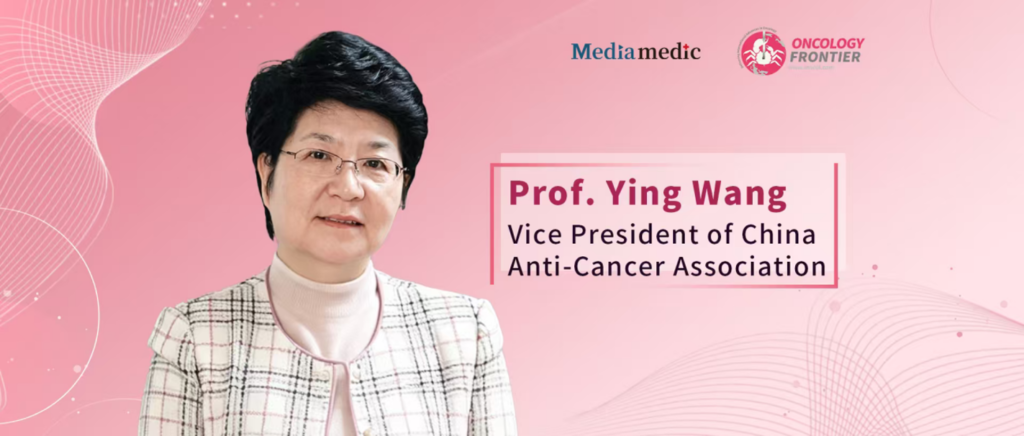
Editor's Note: Breast cancer has become the most commonly diagnosed malignancy among women worldwide. In recent years, China has continued to explore new approaches to breast cancer screening, clinical diagnosis and treatment, rehabilitation management, and public health education, accumulating extensive experience and steadily improving its overall prevention and treatment capabilities. Recently, the 23rd World Breast Health Congress was held in Tianjin from May 8 to 10, 2026. During the congress, Oncology Frontier interviewed Prof. Ying Wang, Vice President of the Chinese Anti-Cancer Association (CACA) and Executive Chair of the Congress, who shared her perspectives on the international significance of the congress, pathways for translating new concepts into practice, psychological support for young patients, and talent development, offering insights into the progress and breakthroughs of China's breast health initiatives.Oncology Frontier: This congress is jointly organized by the Society for Breast Health (SIS) and the Chinese Anti-Cancer Association (CACA). What image of China’s breast health development do you most hope to present to the international community? Looking ahead, what areas of continued collaboration and what mechanisms for sustained cooperation could CACA and SIS establish?
Prof. Ying Wang: SIS was established in 1976 and was initiated by European and American countries. It has considerable influence in the global fields of breast cancer prevention and treatment and breast health. Its board members and member countries include leading experts and renowned medical institutions in these fields.
CACA has maintained a long-standing collaboration with SIS. Academician Xishan Hao, myself, and Director Hong Liu have all been elected as SIS board members. We actively competed to host the 23rd World Breast Health Congress in France last year and successfully secured the opportunity to host it. This received strong recognition from SIS leadership and all of its board members. In itself, this represents international recognition of the development of breast cancer prevention and treatment in China.
This congress was a truly international academic event, featuring one main venue and ten parallel sessions, with academic content comprehensively covering breast cancer prevention, screening, diagnosis, treatment, and basic research.
During the congress, international delegates spoke highly of the academic program, venue organization, conference materials, and other aspects of the event, fully recognizing the organizational capabilities of CACA as the host organization, as well as those of Tianjin Medical University Cancer Institute and Hospital and the other co-organizing institutions.
The successful organization of this congress not only provided Chinese breast health experts with an opportunity to engage directly with leading international specialists, but also showcased China’s academic achievements, clinical capabilities, and organizational expertise in breast cancer prevention and treatment to the international community. It represents an important opportunity to further enhance the global influence of China’s breast health initiatives.
Looking ahead, CACA and SIS will further deepen collaboration across multiple dimensions and establish regular mechanisms for academic exchange. Through mutual learning and shared experience, we hope to work together to advance global breast health.
Oncology Frontier: The congress has included multiple sessions and initiatives that demonstrate how breast health is expanding toward broader population health management. In your view, how can the new concepts, consensus, and technologies emerging from international congresses be further translated into breast health services that can be perceived by the public, benefit patients, and be implemented at the grassroots level?
Prof. Ying Wang: The academic content of this congress has focused not only on the clinical treatment of breast cancer, but also on pathology, imaging, basic research, prevention, and screening.
During the breast cancer prevention and screening session, experts from China and France shared the current status of breast cancer screening and treatment in their respective countries. Although the two countries share similarities in their screening strategies, there are also differences in specific approaches. These exchanges provided valuable opportunities for both sides to learn from each other and further optimize screening strategies.
The opening ceremony and main-session presentations will be livestreamed throughout the day. The purpose is to enable all audiences—including clinical physicians, breast cancer patients and their families, as well as the general public—to understand the current state of breast cancer prevention and treatment, learn approaches that may be beneficial to them, acquire scientific knowledge about early detection and early treatment, and understand how to receive standardized treatment after diagnosis. In this way, we hope to establish a basic understanding of breast cancer prevention and treatment among the public.
In fact, CACA organizes a National Cancer Prevention and Control Awareness Week every year, along with dedicated breast cancer educational campaigns. As these public education initiatives continue to expand, public awareness of health and cancer prevention has improved substantially. At present, the early diagnosis rate of breast cancer in China has reached approximately 60%.
Early detection and early treatment are key to improving survival and reducing mortality among patients with breast cancer. Data show that the 5-year cure rate can exceed 90% for patients with stage I breast cancer, is approximately 80% for those with stage II disease, and is only around 20% for patients with stage IV disease.
Early detection and treatment can also substantially reduce patients’ physical suffering and financial burden. It is therefore an important public health initiative with multiple benefits. Moving forward, we will continue to strengthen public education and promote wider adoption of breast cancer screening, so that more patients can receive timely and standardized treatment at an early stage of the disease.
Oncology Frontier: At this congress, you shared your research on common psychological challenges and support strategies for young women with breast cancer in China. Based on your research and clinical experience, what psychological issues are particularly prominent among young patients with breast cancer? What role does this congress play in developing young physicians who can combine high-quality cancer treatment with humanistic care?
Prof. Ying Wang: In recent years, the incidence of breast cancer among young women in China has continued to increase, and mortality among younger patients is relatively higher than among older patients. This is partly because younger women generally have higher levels of endogenous hormones, while their tumors may have more aggressive biological characteristics and progress more rapidly.
Compared with older patients, young women with breast cancer often face more complex and substantial psychological pressures. As central members of their families, many are mothers of young children while also bearing responsibility for caring for aging parents. They may also serve as important financial and emotional pillars of their families and key professionals in their workplaces.
After being diagnosed with breast cancer, they must not only confront the threat posed by the disease itself, but also worry about how treatment may affect family life and career development, as well as whether they will be able to return to work after treatment.
In addition, some patients may be unable to preserve their breasts because of treatment requirements. This can have a profound impact on their sense of identity and femininity and, in some cases, may contribute to difficulties within family relationships, further increasing their psychological burden.
Therefore, during the treatment of young patients with breast cancer, equal attention must be given to disease management and psychological support. Clinicians should fully respect patients’ individual preferences and develop personalized treatment plans. While ensuring oncologic efficacy, they should make every effort to address patients’ quality-of-life needs.
It is encouraging that, with continuous advances in medical technology and the growing availability of effective treatments, the overall 5-year cure rate for breast cancer in China has now exceeded 80%. With systematic and standardized treatment, young patients can also achieve high cure rates.
The first Chinese public education film on cancer prevention and control, “Rebirth: Facing Cancer,” produced under the guidance of CACA, includes a breast cancer segment featuring the real treatment experiences of several young patients. Through these stories, the film conveys the message of confronting cancer scientifically and living positively, providing psychological and emotional support to patients.
Prof. Ying Wang