
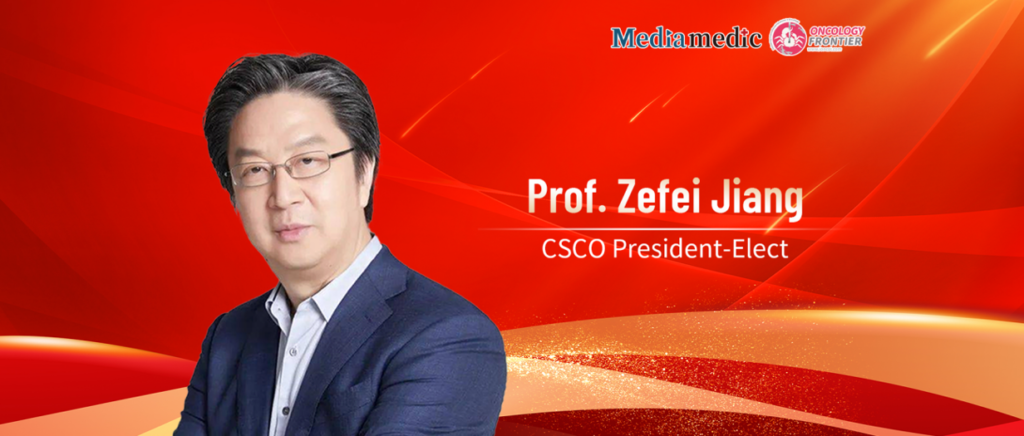
Editor's Note: The 2026 East China Breast Cancer Salon was held in Nanjing on October 10–11 under the theme “Nine Decades of Compassion and Dedication: Passing the Torch of Medical Excellence.” Bringing together multidisciplinary experts and scholars in breast cancer from China and abroad, the meeting featured in-depth discussions on key topics, including anti-HER2 therapy, neoadjuvant treatment, oncoplastic surgery, and precision radiotherapy. It provided a platform for academic exchange, intellectual dialogue, and collaborative advancement among breast cancer professionals across East China and throughout the country. During the meeting, Oncology Frontier, in collaboration with CCMTV, conducted an in-depth interview with Professor Zefei Jiang, President-Elect of the Chinese Society of Clinical Oncology (CSCO). He shared his expert perspectives on the value of the meeting, its key highlights, and international collaboration.I. Building Regional Academic Platforms to Promote Consistency in Diagnosis and Treatment
Oncology Frontier: This year’s East China Breast Cancer Salon has brought together leading scholars from China and abroad to explore cutting-edge developments. What do you consider its core academic value, and what are your expectations for promoting regional academic exchange?
Professor Zefei Jiang: The value of this year’s East China Breast Cancer Salon lies not only in disseminating published research findings, but also in encouraging scholars to share their independent thinking and perspectives. The speakers did not simply reiterate research results. Instead, they engaged in in-depth discussions across multiple areas of breast cancer diagnosis and treatment, combining practical insights into clinical techniques with critical exploration of treatment strategies. The extensive interaction throughout the meeting demonstrated how academic exchange can drive progress in the field.
Professor Yongmei Yin, Chair of the CSCO Breast Cancer Expert Committee, took the lead in organizing this salon. I believe this meeting follows the same vision as the Northern China Breast Cancer Salon, embracing the shared academic philosophy of bringing together perspectives from “east, west, north, and south; men and women, young and old; past and present; and China and the wider world.” In doing so, it contributes to the development of breast cancer care across regions.
We also hope that more scholars will organize regional academic salons in the future, engaging in practical discussions about how advances in the field affect clinical practice and ensuring that academic achievements genuinely benefit patient care.
Oncology Frontier: Differences in the quality of diagnosis and treatment persist across regions. How can areas with concentrated medical resources take a leading role in ensuring that cutting-edge advances reach a broader population?
Professor Zefei Jiang: Achieving consistency in diagnosis and treatment is a shared goal across the entire healthcare sector. After years of efforts to disseminate best practices, we have made substantial progress in balancing the quality of care across different regions of China. However, differences remain, and these are often attributable not simply to geographical disparities but also to differences in the knowledge, understanding, and clinical judgment of individual institutions and physicians.
Through outreach, field visits, and guidance at grassroots healthcare institutions, we have found that many primary-level physicians strictly follow clinical guidelines, actively keep up with updates, raise relevant clinical questions, and proactively seek guidance from higher-level hospitals when dealing with challenging cases.
By contrast, some physicians at large tertiary hospitals may fall behind developments in the field if they neglect academic exchange and rely excessively on personal clinical experience. For example, they may proceed directly to surgery without conducting an adequate preoperative assessment or establishing the molecular subtype. In advanced disease, they may also pursue new drugs indiscriminately, falling into the trap of “finding patients for a drug” rather than developing a rational, comprehensive treatment pathway tailored to the patient.
In short, standardized care pathways must cover the entire course of diagnosis and treatment, including the timing of surgery, radiotherapy strategies, drug combinations, maintenance therapy, and management after disease progression. Regions with concentrated medical resources should take the lead in helping the entire profession learn about cutting-edge developments and continuously optimize clinical pathways, ultimately benefiting a wider population of patients.
II. Highlighting Practical Advances and Demonstrating the Value of Chinese Innovation
Oncology Frontier: Your keynote presentation at this meeting was entitled “Innovations in Anti-HER2 Therapy and China’s Contributions.” Could you discuss China’s achievements in anti-HER2 therapy, the impact of these innovations on the global treatment landscape, and the areas that require further development?
Professor Zefei Jiang: Looking back over more than two decades, China’s progress in anti-HER2 therapy has evolved from following international developments, to participating in research alongside international colleagues, and eventually to making original contributions of our own.
More than 20 years ago, only one anti-HER2 agent was available domestically. Clinical practice largely followed international treatment standards, and access to these medicines was limited. Around a decade ago, we began participating more extensively in international multicenter studies, gradually fostering the emergence and development of original research from China.
Today, Chinese investigators can take leading roles in international research projects, contribute substantial numbers of patients, participate in study design, and help publish research findings. At the same time, domestically developed products now cover the full treatment spectrum, from preoperative neoadjuvant therapy and postoperative adjuvant therapy to multiple lines of treatment for advanced disease, developing alongside imported products.
Currently, more than 70% of the recommendations in the CSCO BC Guidelines are supported by evidence from international or domestic studies involving Chinese investigators. Our work in this field is no longer limited to following international standards. Instead, we are optimizing treatment strategies and care models based on local clinical needs to deliver tangible benefits to patients.
When discussing the impact of Chinese innovation on the global treatment landscape, however, we should remain pragmatic. In recent years, Chinese researchers have increasingly made their voices heard at major international academic conferences, including ASCO and ESMO, and advances in anti-HER2 therapy are an important part of this contribution. Nevertheless, changing international clinical practice in a meaningful way will take considerable time. On the one hand, some domestically developed products have yet to achieve full access to international markets. On the other, most patients enrolled in Chinese studies are from China, and more research with the potential to shape global practice is still needed.
Our enduring responsibility is to build on clinical practice in China, develop solutions that address Chinese patients’ needs, and ensure that more patients in China benefit from these advances. Going forward, we will steadily advance the international translation of domestic innovations and expand global multicenter research collaborations. We will also work with research teams in Beijing, Guangzhou, Shandong, and other regions to strengthen data governance and explore optimal treatment pathways for comparable patient populations receiving different treatment approaches. These efforts will further promote standardized care and help us move toward the vision articulated by the CSCO Council: enabling Chinese physicians to use solutions developed in China and ensuring that China’s contributions are heard around the world.
Oncology Frontier: This meeting included multidisciplinary team (MDT) case discussions grounded in real-world clinical practice in China. What do you consider the greatest challenge to implementing the MDT model effectively in routine clinical care?
Professor Zefei Jiang: MDT is an established model of care. Since its introduction in China two or three decades ago, it has been widely adopted across many specialties and has improved outcomes for a large number of patients. Nevertheless, misconceptions remain in its implementation. Some MDT meetings become merely procedural: participants express their individual opinions without reaching a final decision, or a single expert dominates the discussion, preventing the development of a genuine multidisciplinary consensus.
In my view, a high-quality MDT discussion should allow everyone to express their views while ultimately reaching a clear conclusion. The guiding principle should be that substance matters more than form. When consensus is reached, a treatment plan should be established and implemented. When disagreements remain, participants should use evidence-based arguments to evaluate the potential benefits of different approaches and work together to identify the optimal treatment pathway.
Under the guidance of the CSCO Breast Cancer Expert Committee, extensive peer-to-peer MDT outreach and exchange activities are now being conducted across the field. We are also promoting regular professional exchange visits, using real inpatient cases to review and optimize treatment decisions and jointly resolve clinical challenges. These activities go beyond presentations based on hypothetical cases, focusing instead on actual clinical practice and helping improve the capabilities of teams at all levels of the healthcare system.
III. Deepening Domestic and International Exchange to Amplify China’s Academic Voice
Oncology Frontier: As innovative breast cancer research continues to emerge in China, how do you assess the country’s international academic standing? What are your expectations for young and mid-career physicians participating in clinical research and contributing to international academic discussions?
Professor Zefei Jiang: After years of accumulated experience and development, the overall standards of diagnosis and treatment at China’s leading breast cancer centers have reached an internationally advanced level. Major medical centers in regions such as Shanghai, Guangzhou, and Beijing are now at the forefront internationally in both clinical capabilities and patient volumes.
From the perspective of academic development, we hope to conduct more high-quality collaborative research both within China and internationally, establishing a mutually beneficial model of academic exchange. International projects should involve more Chinese investigators, while research projects initiated in China should also attract greater participation from international experts.
The professional development of young and mid-career physicians requires a gradual approach and sustained accumulation of experience. Young physicians can begin by participating in research projects under the guidance of senior colleagues, gaining experience and learning research methods. As their capabilities mature, they can start with real-world studies and smaller research projects, gradually progress to large Phase III trials, and ultimately take independent responsibility for research projects.
Throughout this process, they must uphold scientific rigor and research integrity, remain objective, and work diligently. Research should not be limited to exploring novel targets or mechanisms. Studies addressing practical clinical needs, such as optimizing treatment strategies and managing treatment-related adverse events, can also deliver substantial clinical value.
I hope young and mid-career physicians will remain grounded in clinical practice, focus on real-world problems, and gradually produce high-quality research that improves clinical care and ultimately informs clinical guidelines.
Oncology Frontier: You mentioned CSCO’s plans for future international academic exchange, including a “China’s Voice” session at next year’s St. Gallen meeting. Could you share more details about these plans and your outlook for future international collaboration?
Professor Zefei Jiang: Promoting international academic exchange has been a consistent priority for successive CSCO leadership teams. We remain committed to ensuring that China’s voice is heard on an increasing number of international platforms.
For next year’s St. Gallen International Breast Cancer Conference (SGBCC), we have confirmed a dedicated “China’s Voice” session featuring interactive exchanges between Chinese and international experts.
In April 2027, we will invite senior SGBCC experts to China to attend the National Breast Cancer Conference in Beijing, where we will also organize a joint academic session. We hope to bring together experts from around the world for in-depth discussions.
In addition, joint sessions with ASCO, ESMO, and CSCO have been confirmed for 2027. At next year’s CSCO Annual Meeting, we will continue to invite experts from ASCO and ESMO to participate in a joint ASCO–ESMO–CSCO session.
Combining “bringing international experts in” with “taking Chinese expertise abroad” is both an important pathway and an inevitable trend in academic collaboration and the internationalization of professional societies. We will continue to advance these efforts steadily and progressively strengthen the international influence of research from China.