

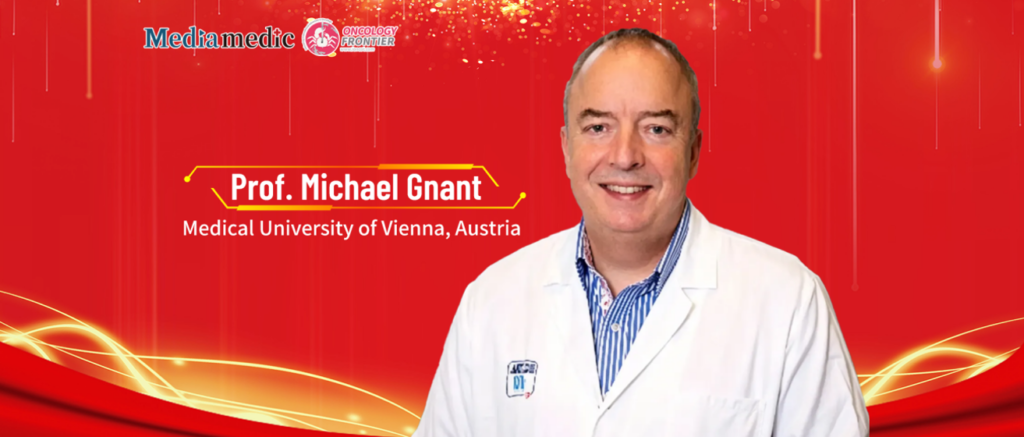
Editor's Note: As neoadjuvant systemic therapy continues to gain traction in clinical breast cancer care, the principles and strategies guiding breast surgery are undergoing a comprehensive transformation. Surgery is no longer an isolated local intervention. Instead, it is closely integrated with systemic treatment, serving as a pivotal component in striking a dynamic balance between precision de-escalation and ensuring curative outcomes. How can clinicians define the appropriate boundaries of surgical de-escalation? What criteria must a de-escalation strategy meet to progress from clinical trials into international guidelines? And in which areas should China-Europe collaboration in breast cancer care focus its efforts? On October 10–11, the 2026 East China Breast Cancer Salon was held in Nanjing under the theme “Nine Decades of Compassion and Dedication: Passing the Torch of Medical Excellence.” During the meeting, Oncology Frontier interviewed Professor Michael Gnant of the Medical University of Vienna, Austria, to explore the fundamental value of surgical decision-making in the era of neoadjuvant therapy, the key evidence required to translate de-escalation strategies into clinical guidelines, and promising directions for research collaboration between China and Europe in breast surgery.01
Oncology Frontier: Your presentation at this conference focuses on “Surgical Considerations in the Context of Neoadjuvant Systemic Therapy.” As neoadjuvant therapy is increasingly applied in breast cancer clinical practice, the concepts and strategies of surgical management continue to evolve. From a surgeon’s perspective, what is the core significance of neoadjuvant therapy in shaping surgical decision-making? Between surgical de-escalation and ensuring long-term outcomes, what key issues remain unresolved?
Professor Michael Gnant: Neoadjuvant systemic therapy is one of the major driving forces behind advances in modern breast surgery. It not only makes surgery possible for patients whose disease was initially inoperable, but also facilitates a shift from mastectomy toward breast-conserving therapy. We are making steady progress toward narrowing the indications for mastectomy.
Furthermore, tumor response patterns observed during neoadjuvant treatment provide important guidance for postoperative treatment planning. In at least some breast cancer subtypes, pathological complete response (pCR) is a highly valuable prognostic indicator.
Nevertheless, several controversies in this field still require further investigation. These include how to optimally apply surgical de-escalation principles to luminal breast cancer and whether established strategies for de-escalating axillary surgery are equally applicable to patients who have received neoadjuvant systemic therapy.
02
Oncology Frontier: As Chair of the St. Gallen International Breast Cancer Consensus Conference, you have played an important role in shaping international breast cancer treatment recommendations. When considering de-escalation strategies such as breast-conserving surgery, omission of axillary lymph node dissection, and precision radiotherapy after neoadjuvant therapy, how should we determine whether a strategy can advance from de-escalation within clinical trials to becoming an accepted international standard? Which key indicators should be considered?
Professor Michael Gnant: Ultimately, overall survival remains the most fundamental endpoint. In early-stage breast cancer, improved overall survival often means that clinical cure has been achieved.
In addition, the breast conservation rate is an important measure of outcomes in breast surgery. Minimizing adverse effects associated with both locoregional and systemic treatment, while continuously improving patients’ quality of life, are also essential considerations in clinical decision-making.
03
Oncology Frontier: You have actively promoted collaboration with the Chinese breast cancer research community. In your view, which areas should be prioritized in China-Europe collaboration on clinical research in breast cancer surgery? What aspects of the academic presentations by Chinese colleagues at this East China Breast Cancer Salon are of particular interest to you, and what do you hope to see?
Professor Michael Gnant: In recent years, China has made substantial progress in both breast cancer research and the quality of clinical care. Supported by high-level academic institutions and specialized breast disease centers across the country, China has significantly improved the quality of its research output and its standards of patient care.
The expansion of early detection programs, the development of clinical guideline frameworks, and the improvement of quality control mechanisms have collectively strengthened China’s influence in the global breast cancer research community. Leading academic organizations, including the Chinese Society of Clinical Oncology Breast Cancer Committee (CSCO-BC) and the Chinese Anti-Cancer Association Breast Cancer Committee (CACA-CBCS), have played a particularly important role in this progress.
Looking ahead, I believe the next step is to expand international collaborative initiatives. Cooperation should not be limited to industry partnerships; it is equally important to establish a robust network for in-depth collaboration in academic research and clinical trials.