aploidentical hematopoietic stem cell transplantation (haplo-HSCT) has become an important curative approach for acute leukemia. However, post-transplant outcomes remain highly heterogeneous, and key determinants as well as optimal donor strategies are not yet fully defined. At the same time, for non–Down syndrome acute megakaryoblastic leukemia (non-DS-AMKL), a rare subtype, evidence guiding optimal transplant strategies remains particularly limited.
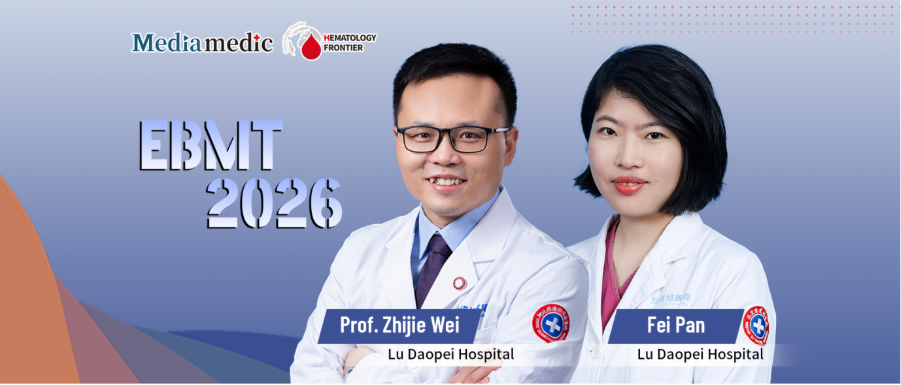
At the 52nd EBMT Annual Meeting held in Madrid, Spain (March 22–25, 2026), two studies from the team led by Prof. Zhijie Wei at Lu Daopei Hospital were presented as posters. These studies explored (1) determinants of GVHD and survival after haplo-HSCT in AML, and (2) long-term outcomes of haplo-HSCT versus matched unrelated donor transplantation in non-DS-AMKL.
This article features an overview of both studies by first author Dr. Fei Pan.
Study 1
Title
Determinants of GVHD and Survival After Haploidentical Hematopoietic Stem Cell Transplantation for Acute Myeloid Leukemia: A Single-Center Analysis of 169 Patients
First Author: Fei Pan Corresponding Author: Zhijie Wei
Background
Haploidentical HSCT, including haplo-cord HSCT (haploidentical transplantation combined with third-party unrelated cord blood), is widely used as a curative strategy for AML. However, even with intensified myeloablative conditioning regimens based on BU+MEL/TT, outcomes remain heterogeneous.
Identifying independent determinants of GVHD, viral reactivation, and long-term survival is essential for optimizing transplant strategies and improving patient outcomes.
Methods
This retrospective study included 169 consecutive AML patients who underwent first haplo-HSCT at a single center between 2016 and 2021.
All patients received uniform Bu/Cy-based myeloablative conditioning and standardized GVHD prophylaxis. Among them, 76.3% underwent haplo-cord HSCT, while 23.7% received haplo-HSCT alone.
Multivariable Cox regression and competing risk models were used to evaluate the independent impact of disease status, HLA matching, donor source (with or without cord blood), conditioning intensity (BU+MEL/TT-based), and cell doses (CD34⁺, CD3⁺) on survival, GVHD, relapse, and viral reactivation (CMV/EBV).
Results
The median follow-up was 3.4 years (range, 0.1–10.9).
Multivariable analysis identified disease status at transplantation as the most important determinant of outcome. Compared with patients transplanted in first complete remission (CR1), those transplanted with non-remission/partial remission (NR/PR) had significantly worse overall survival (OS) (HR 5.58 [95% CI: 2.17–14.3], P < 0.001), shorter leukemia-free survival (LFS) (HR 5.45 [95% CI: 2.12–13.9], P < 0.001), and a higher risk of non-relapse mortality (NRM) (HR 4.67 [95% CI: 1.53–14.3], P = 0.007).
HLA matching (5/10 vs. ≥6/10), donor source (with or without cord blood), and patient age were not independently associated with long-term survival.
Regarding GVHD, intensified BU+MEL/TT-based conditioning was independently associated with a reduced risk of acute GVHD, significantly lowering the incidence of grade II–IV (HR 0.32 [95% CI: 0.14–0.74], P = 0.008) and grade III–IV aGVHD (HR 0.26 [95% CI: 0.08–0.82], P = 0.022).
NR/PR disease status significantly increased the risk of severe aGVHD (HR 5.11 [95% CI: 1.08–24.0], P = 0.039).
Additionally, the use of third-party unrelated cord blood (HR 0.38 [95% CI: 0.16–0.92], P = 0.031) and higher infused CD34⁺ cell doses (>9 × 10⁶/kg) (HR 0.52 [95% CI: 0.28–0.97], P = 0.038) were associated with a lower incidence of grade II–IV aGVHD.
No transplant-related variables were independently associated with CMV or EBV viremia.
Conclusion
Transplantation in complete remission remains the most critical determinant of survival in AML patients undergoing haplo-HSCT.
Intensified BU+MEL/TT-based conditioning, higher CD34⁺ cell doses, and haplo-cord transplantation appear to provide protective effects against acute GVHD and show a favorable trend toward improved survival.
These findings offer clinically relevant evidence to guide risk-adapted optimization strategies for haploidentical transplantation.
Study 2
Title
Long-Term Outcomes of Haploidentical and Matched Unrelated Donor Hematopoietic Stem Cell Transplantation in Complete Remission Non-DS-AMKL: A Single-Center Cohort Study
First Author: Fei Pan Corresponding Author: Zhijie Wei
Background
Non–Down syndrome acute megakaryoblastic leukemia (non-DS-AMKL) is a rare pediatric AML subtype, and evidence guiding optimal transplant strategies is limited.
Haplo-HSCT expands donor availability, but its comparative efficacy and safety versus matched unrelated donor transplantation (MUD-HSCT) in patients in complete remission remain unclear.
Methods
This retrospective study included 63 pediatric patients with non-DS-AMKL who underwent allo-HSCT between July 2016 and January 2025 at a single center.
All patients were transplanted in complete remission, including 51 who received haplo-HSCT and 12 who received MUD-HSCT.
Clinical characteristics, engraftment, GVHD incidence, viral reactivation, relapse, transplant-related mortality (TRM), and survival outcomes were compared between groups.
Multivariable Cox proportional hazards models were used to assess OS and LFS, and Fine–Gray competing risk models were used to evaluate relapse and NRM.
Results
At a median follow-up of 30.8 months (range, 2.0–105.3), the 5-year OS was 65.8% in the haplo-HSCT group and 58.3% in the MUD-HSCT group (P = 0.40). The 5-year LFS was 65.1% and 58.3%, respectively (P = 0.40).
The 5-year cumulative relapse incidence was 20.1% in the haplo-HSCT group and 25.0% in the MUD-HSCT group (P = 0.64), while 5-year NRM was 22.8% and 25.0%, respectively (P = 0.73).
All patients achieved neutrophil engraftment. Platelet engraftment rates were 94.1% in the haplo-HSCT group and 100% in the MUD-HSCT group (P = 1.00).
The incidence of grade III–IV acute GVHD and severe chronic GVHD was higher in the haplo-HSCT group, but the differences were not statistically significant (all P > 0.05).
Multivariable analysis identified complex cytogenetics as the only consistent adverse prognostic factor, significantly worsening OS (HR 2.79 [95% CI: 1.14–6.87], P = 0.03), LFS (HR 2.88 [95% CI: 1.18–7.08], P = 0.02), and relapse risk (HR 4.05 [95% CI: 1.03–15.99], P = 0.05).
A melphalan–busulfan (MEL-BU)–based conditioning regimen significantly reduced relapse risk (HR 0.27 [95% CI: 0.08–0.96], P = 0.04).
Higher CD34⁺ cell doses (>8 × 10⁶/kg) showed a trend toward improved OS and LFS (both P = 0.05), although further validation is required.
Donor type (haplo vs. MUD), fusion gene status, CD3⁺ cell dose, and age had no significant impact on OS, LFS, relapse, or NRM.
Conclusion
Among pediatric patients with non-DS-AMKL undergoing allo-HSCT in complete remission, haplo-HSCT achieved comparable long-term outcomes to MUD-HSCT, with similar relapse risk and survival rates.
Complex cytogenetics remains an independent adverse prognostic factor.
These findings support haplo-HSCT as a practical and effective alternative when a matched unrelated donor is unavailable or when urgent transplantation is required.
Expert Profiles

Zhijie Wei, MD Director, Department of Hematopoietic Stem Cell Transplantation, Lu Daopei Hospital
Prof. Wei has performed more than 1,000 hematopoietic stem cell transplants for various hematologic diseases, including acute and chronic leukemia, aplastic anemia, MDS, thalassemia, and PNH. He has extensive experience in salvage transplantation for relapsed/refractory AML and in managing post-transplant complications such as GVHD, TMA, and infections.

Fei Pan, MD, MSc Attending Physician, Department of Hematopoietic Stem Cell Transplantation, Lu Daopei Hospital
Dr. Pan specializes in allogeneic stem cell transplantation for both malignant and non-malignant hematologic diseases, including acute leukemia, CML, aplastic anemia, MDS, and PNH. She has extensive experience in managing both early and late transplant-related complications and has presented his work at multiple hematology conferences.