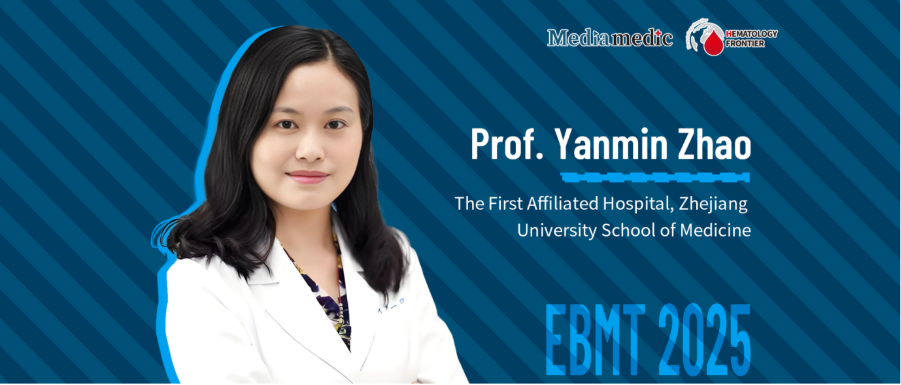
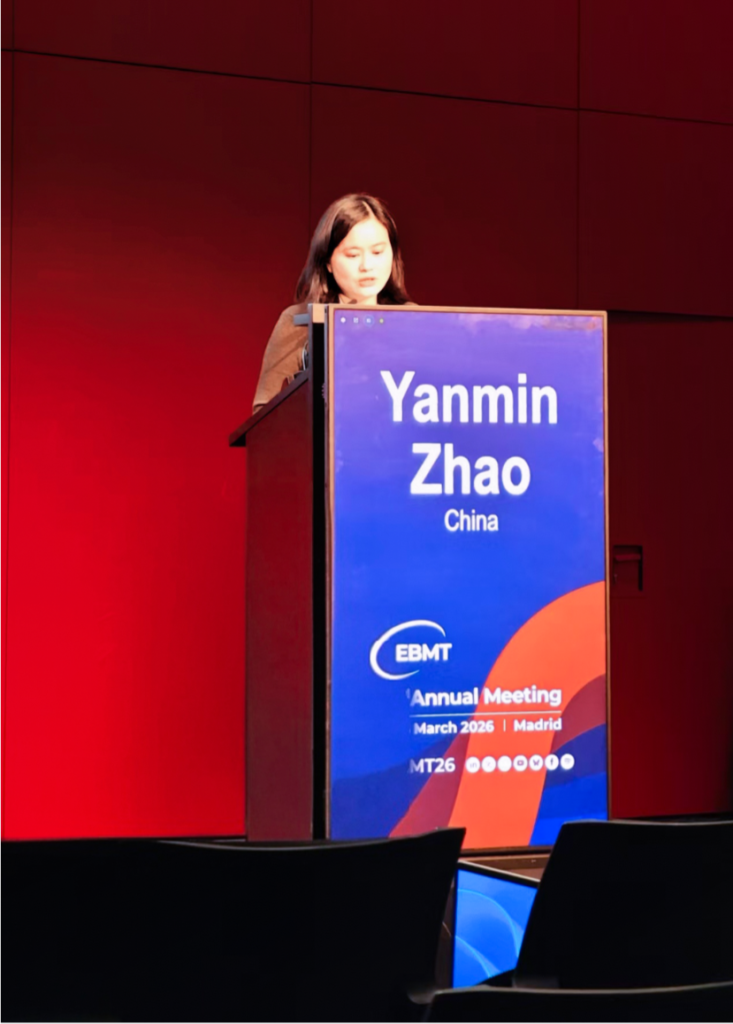
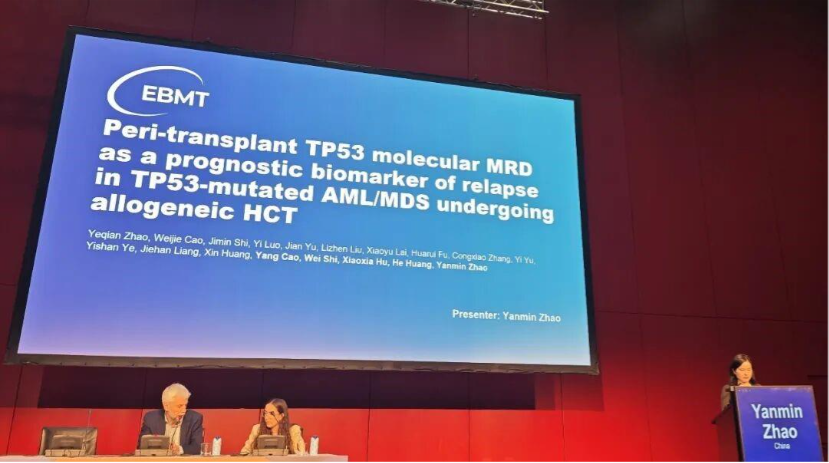
From March 22 to 25, 2026, the 52nd Annual Meeting of the European Society for Blood and Marrow Transplantation (EBMT) was held in Madrid, Spain. As one of the most influential conferences in the field, the meeting brought together thousands of experts worldwide to discuss the latest advances in transplantation and cellular therapy. During the conference, Professor Yanmin Zhao from the First Affiliated Hospital, Zhejiang University School of Medicine presented an oral report entitled “TP53 Variant Allele Frequency as a Genetic MRD Marker Predicts Post-Transplant Relapse and Guides Subtype-Specific Therapy in TP53-Mutated AML/MDS.” This work provides important evidence for optimizing clinical strategies.
Oncology Frontier – Hematology Frontier invited Professor Zhao for an in-depth interview to discuss the key findings of this study and their implications for clinical practice and future research.
Rationale for Using TP53 Variant Allele Frequency as an MRD Marker
Oncology Frontier – Hematology Frontier: TP53-mutated AML/MDS is widely recognized as a high-risk group. What clinical observations led your team to focus on TP53 variant allele frequency (VAF) as a measurable residual disease (MRD) marker, particularly in the pre- and post-transplant setting? What was the rationale for selecting VAF?
Professor Yanmin Zhao: Patients with TP53-mutated acute myeloid leukemia (AML) and myelodysplastic syndromes (MDS) generally have a poor prognosis. Even after undergoing allogeneic hematopoietic stem cell transplantation, these patients continue to experience high relapse rates. However, there is currently a lack of highly sensitive and reliable MRD markers for TP53-mutated myeloid malignancies.
Previous studies have demonstrated that molecular MRD monitoring based on specific genetic alterations—such as NPM1 mutations or core-binding factor (CBF) fusion genes—has well-established prognostic value in corresponding AML subtypes and can guide treatment decisions. In contrast, whether TP53 variant allele frequency can serve as a molecular MRD marker for predicting post-transplant outcomes has not been systematically investigated.
Accordingly, our study aimed to determine whether dynamic monitoring of TP53 mutation VAF could serve as an effective MRD marker to predict relapse risk after transplantation, and whether this molecular parameter could inform post-transplant therapeutic strategies.
Clinical Implications: Stratification and Individualized Treatment Pathways
Oncology Frontier – Hematology Frontier: Your study established prognostic thresholds for VAF before and after transplantation and revealed differences in MRD clearance benefits across AML, MDS/AML, and MDS subtypes. Could you elaborate on how MRD dynamics and disease subtypes can guide individualized treatment strategies?
Professor Yanmin Zhao: In this study, patients were stratified based on disease subtype—AML, MDS/AML with ≥10% blasts, and MDS with <10% blasts—as well as pre-transplant genetic MRD thresholds defined by VAF levels (≤0.01%, 0.01–0.1%, and >0.1%).
We found that patients with VAF >0.1% had significantly worse outcomes compared with the other groups. Importantly, if pre-transplant molecular MRD could be reduced to below 0.1% through treatment, prognosis improved substantially. However, in patients with low blast burden MDS (<10%), the presence or level of molecular MRD before transplantation did not significantly affect outcomes.
These findings highlight the importance of tailoring treatment strategies according to disease subtype. For patients with low tumor burden MDS, pursuing MRD negativity through intensified therapy may be unnecessary; instead, early progression to transplantation should be prioritized. In contrast, for patients with high tumor burden TP53-mutated myeloid malignancies, pre-transplant interventions—such as intensive chemotherapy or hypomethylating agents—should aim to achieve deep molecular remission in order to reduce the risk of post-transplant relapse.
In addition, for patients with persistent molecular MRD prior to transplantation, incorporating decitabine into the conditioning regimen may further reduce TP53-mutated clonal burden and potentially decrease relapse risk. However, this hypothesis requires validation in prospective clinical trials.
Future Directions: Precision Medicine in Transplantation
Oncology Frontier – Hematology Frontier: Precision medicine is increasingly influencing the field of transplantation. What are your team’s future research priorities, and what emerging trends in genetics-guided transplant decision-making deserve particular attention?
Professor Yanmin Zhao: Our future research will focus on further optimizing transplantation strategies in high-risk AML and MDS based on genetic stratification. This includes refining conditioning regimens, donor selection strategies, and post-transplant interventions for relapse prevention.
At the level of genetic monitoring, this year’s EBMT meeting highlighted the growing importance of deep molecular MRD assessment. For example, in FLT3-ITD–mutated leukemia, conventional MRD detection methods—such as flow cytometry or capillary electrophoresis—have notable limitations. In contrast, combining PCR with next-generation sequencing allows for more sensitive and specific detection through deep sequencing approaches.
Such high-sensitivity MRD data can inform critical clinical decisions, including whether to initiate FLT3 inhibitor maintenance therapy after transplantation and how to select between myeloablative and reduced-intensity conditioning regimens.
Looking ahead, a key question remains whether PCR-NGS–based deep sequencing can guide the timing of transplantation in patients with FLT3 mutations—specifically, whether transplantation should be performed upfront or deferred. We anticipate that continued advances in precision medicine will further integrate into clinical practice, ultimately enabling more individualized treatment strategies and improving long-term outcomes.
Expert Profile

Yanmin Zhao, MD, PhD Chief Physician, Doctoral Supervisor, Distinguished Researcher Deputy Director, Hematopoietic Stem Cell Transplantation Center The First Affiliated Hospital, Zhejiang University School of Medicine
Professor Zhao is an active member of the Young Hematology Group of the Chinese Medical Association and serves on the Committee of Hematopoietic Stem Cell Transplantation and Cellular Therapy of the Chinese Medical Education Association. She is also Vice Chair of the Youth Committee of the Zhejiang Hematology Society and a recognized young scholar of the Zhejiang Immunology Society.
She has led multiple projects funded by the National Natural Science Foundation of China and is a key contributor to national research programs. She has published over 40 SCI-indexed papers as first or corresponding author in leading journals, including Blood, Journal of Hematology & Oncology, JAMA Network Open, and Leukemia, and serves on the editorial board of Cell Transplantation.
Professor Zhao has delivered oral presentations at major international conferences, including ASH, EHA, EBMT, and APBMT, and has received prestigious awards, including the First Prize of the Zhejiang Provincial Science and Technology Progress Award and the Second Prize of the National Science and Technology Progress Award.