
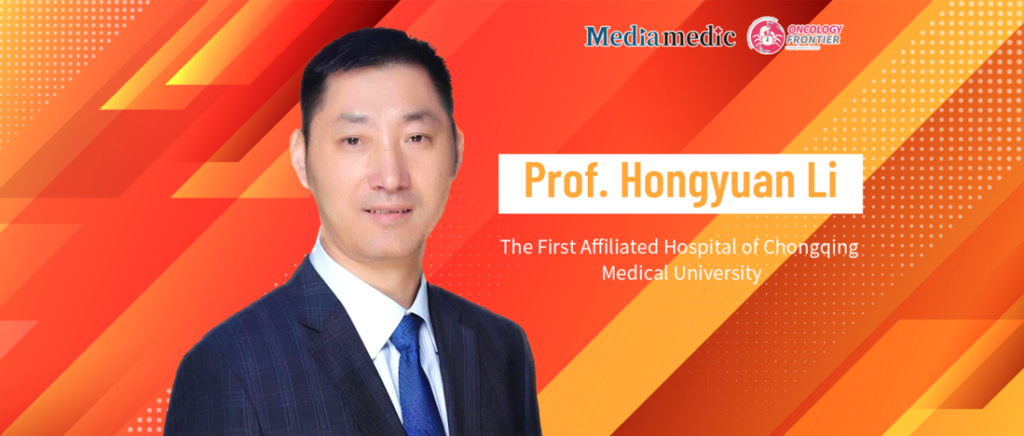
Editor’s Note: The 15th Sino-French Breast Reconstruction Congress and the 13th Sino-French Breast Cancer Academic Conference recently concluded successfully in Chongqing, China. During the meeting, Oncology Frontier conducted an exclusive interview with Professor Hongyuan Li from the First Affiliated Hospital of Chongqing Medical University (hereafter referred to as CQMU First Hospital), one of the conference’s principal organizers. In the interview, Professor Li shared his insights into the innovative considerations behind this year’s conference design, the reproducible experience of CQMU First Hospital in promoting technical standardization and multidisciplinary talent development, as well as the institution’s “Chongqing Experience” in individualized oncoplastic breast surgery and de-escalation treatment strategies.01
Oncology Frontier: As one of the key organizers of the 15th Sino-French Breast Reconstruction Congress and the 13th Sino-French Breast Cancer Academic Conference, could you share the special considerations behind this year’s program design compared with previous editions? In terms of promoting integration between Chinese and French breast surgery concepts, what key messages did you most hope to convey to your Chinese colleagues?
Professor Hongyuan Li: We devoted considerable thought to the overall design of the conference agenda. During the two-day 15th Sino-French Breast Reconstruction Congress, live surgical demonstrations were scheduled in the mornings, while afternoon sessions featured academic lectures and case discussions led by Chinese and French breast surgery experts.
This year’s meeting also had several distinctive features.
First, we adopted a synchronized triple-screen live broadcast format, with procedures performed simultaneously in three operating rooms. The purpose of this arrangement was to allow more participating surgeons to observe and learn a broader range of surgical techniques, thereby disseminating contemporary mainstream breast surgical approaches more widely among colleagues.
Second, we established a dedicated session entitled “East-West Dialogue: Oncoplastic Breast Surgery and Breast Reconstruction.” Oncoplastic breast surgery encompasses two major approaches: volume displacement and volume replacement techniques.
For volume displacement procedures, we demonstrated the tennis-racquet oncoplastic technique and presented the Grisotti flap technique for patients undergoing central breast-conserving surgery. These procedures carry significant practical value, particularly for young and mid-career surgeons as well as physicians working in primary hospitals.
Regarding volume replacement techniques, I demonstrated the lateral thoracic artery perforator flap (LTAP/OPS) technique and intercostal artery perforator flap procedures. Professor Fabien Reyal from France performed live demonstrations of intercostal perforator flap and anterior chest wall perforator flap surgeries. During these sessions, our French colleagues emphasized the technical nuances and critical operative considerations associated with each approach.
For tumors located in the upper quadrants with multifocal disease or in the lower quadrants, traditional surgery often results in breast deformity. However, perforator flap and volume replacement techniques can help restore natural breast contour following tumor resection.
In the field of minimally invasive surgery, we invited Professor Shicheng Su and Professor Ning Liao to demonstrate endoscopic breast reconstruction and robotic-assisted breast-conserving surgery, respectively. Through these demonstrations, we hoped to communicate an important message: minimally invasive techniques can offer more patients opportunities for breast conservation and breast reconstruction, while providing more concealed incisions and potentially improved cosmetic outcomes.
Regarding conventional procedures, we continue to invite Professor Jiong Wu each year for live surgical demonstrations. This year, he presented expander-to-implant exchange surgery, which also carries substantial value for clinical practice.
In addition, there remains a large population of women in China who undergo mastectomy without access to breast reconstruction. At this year’s conference, we showcased fat grafting techniques to our colleagues. French expert Professor Nicolas Leymarie performed a highly challenging and innovative delayed breast reconstruction procedure using autologous fat grafting following breast cancer surgery. I believe mastery of this technique is especially important for Chinese surgeons.
Meanwhile, Professor Yuanyuan Wang from Sun Yat-sen Memorial Hospital of Sun Yat-sen University shared her experience with immediate fat grafting in breast-conserving surgery.
Collectively, these presentations conveyed a central philosophy: we should comprehensively integrate diverse surgical techniques to help patients achieve breast conservation or breast reconstruction, ultimately improving quality of life for women with breast cancer in China.
02
Oncology Frontier: The program of the 15th Sino-French Breast Reconstruction Congress included not only lectures by leading French experts such as Professor Fabien Reyal and Professor Nicolas Leymarie, but also hands-on collaborative surgical demonstrations between Chinese and international specialists. You have accumulated extensive experience promoting this immersive “from operating room to podium” model of international exchange. Could you share the reproducible experiences of CQMU First Hospital in technical standardization and talent development?
Professor Hongyuan Li: CQMU First Hospital has indeed accumulated profound experience in Sino-French academic collaboration. Under the leadership and strong support of Professor Guosheng Ren, we have continuously advanced multiple Sino-French exchange initiatives over the years.
One particularly important measure was our long-term effort to send physicians at different career stages to major oncology and reconstructive surgery centers in France for systematic training. This played a pivotal role in both disciplinary development and talent cultivation.
Through these in-depth exchanges, our surgeons gained a much more comprehensive understanding of oncoplastic surgical management.
In practical terms of talent development, we have consistently adhered to the traditional mentorship model in which senior surgeons pass down mature technical standards and surgical experience to junior colleagues, ensuring intergenerational continuity of expertise.
At the same time, we continue to send young physicians to leading international institutions, including Gustave Roussy Institute (IGR) and Institut Curie in France, for specialized training. These opportunities not only expose young surgeons directly to cutting-edge international concepts and advanced technologies, but also ensure the sustainable development of our talent pipeline and continuous refinement of the team’s overall technical capabilities.
03
Oncology Frontier: At the 13th Sino-French Breast Cancer Academic Conference, you delivered a presentation entitled “Individualized Oncoplastic Breast Surgery and De-escalation Strategies: The Chongqing Experience.” In the context of the current focus on treatment de-escalation in breast cancer, how has CQMU First Hospital implemented surgical optimization and individualized treatment design to achieve “less invasive procedures with superior cosmetic outcomes” while maintaining oncologic safety?
Professor Hongyuan Li: The evolution of breast surgery has progressed from the Halsted radical mastectomy of the late 19th century to modern approaches such as breast-conserving surgery, oncoplastic surgery, and immediate breast reconstruction.
At CQMU First Hospital, our systematic understanding of this important transformation began in the early 2000s. In my presentation at the 13th Sino-French Breast Cancer Academic Conference, I comprehensively reviewed the evolution of breast surgery concepts and practices at our institution from 2004 to 2026.
I deeply believe that this process reflects not only the evolution of our own surgical philosophy, but also a collective journey shared with colleagues across China in advancing breast surgical practice.
Looking back at our exploration in breast reconstruction, we initially began with implant-based reconstruction, then progressively advanced to autologous tissue reconstruction and DIEP free flap transplantation. The development of these techniques greatly benefited from our close exchanges with French colleagues.
Furthermore, our institutional study involving patients who underwent immediate implant-based reconstruction, with a median follow-up of 90 months, demonstrated disease-free survival rates approaching 90%. These encouraging data further strengthened our confidence in advancing these techniques.
Building upon this foundation, CQMU First Hospital also conducted a highly significant clinical study—the world’s first prospective randomized controlled trial evaluating the oncologic safety of immediate autologous fat grafting (IAFG) in breast-conserving surgery.
The study enrolled 360 Chinese women, with a median follow-up duration of 62.8 months. The results confirmed that immediate fat grafting not only created additional opportunities for breast conservation while improving breast appearance and quality of life, but also demonstrated solid oncologic safety supported by high-level evidence.
In promoting the philosophy of oncoplastic breast conservation, we have increasingly recognized that the goal of surgery extends beyond tumor removal alone. Rather, surgeons should strive to maximize opportunities for breast preservation through professional expertise and individualized planning.
The fundamental purpose of individualized oncoplastic design and de-escalation strategies is to maximize the success rate of breast conservation.
At our institution, the principles of individualized management are clearly stratified:
- When patients are suitable candidates for direct breast conservation, standard breast-conserving surgery is prioritized.
- When direct breast conservation is not initially feasible, oncoplastic techniques are employed to create conditions that allow breast preservation.
- Only when breast conservation is truly impossible do we proceed to breast reconstruction.
This represents the individualized and de-escalated treatment strategy that we consistently implement in our clinical practice.
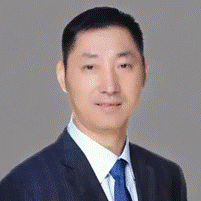
Professor Hongyuan Li

