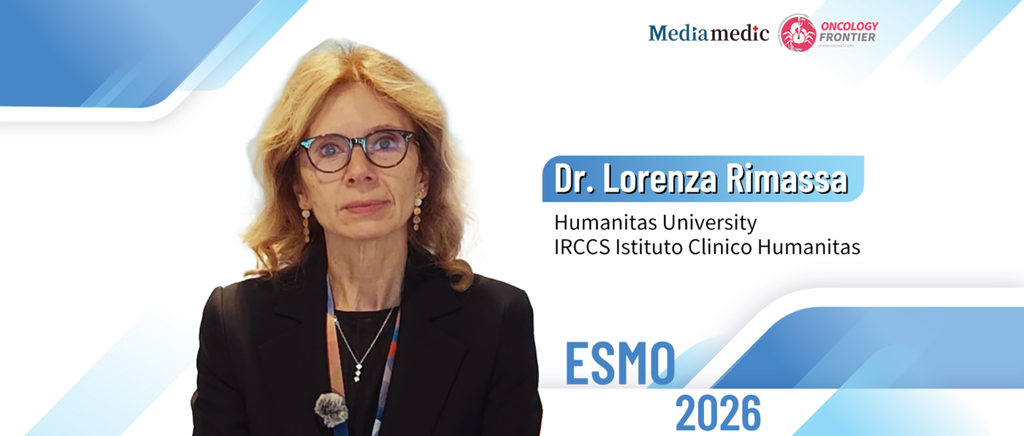
Editor's Note: The 2026 European Society for Medical Oncology (ESMO) Congress was held in Spain, bringing together leading oncology experts and researchers from around the world to share major updates in hepatobiliary oncology and offer new perspectives on the clinical management of hepatocellular carcinoma (HCC). The HIMALAYA study established the important role of the STRIDE regimen in the first-line treatment of advanced HCC. At this year's congress, Professor Lorenza Rimassa of Humanitas University and Humanitas Research Hospital, Italy, presented seven-year long-term overall survival data from the study, further advancing our understanding of long-term survival in advanced liver cancer. Oncology Frontier invited Professor Rimassa for an in-depth interview to discuss these important new findings, the value of tumor response measures in predicting long-term survival, and the implications of the STRIDE regimen for clinical decision-making. She also shared insights into other promising developments presented at the congress, bringing the latest international perspectives to clinicians in China.Oncology Frontier: You presented the seven-year overall survival (OS) data from the HIMALAYA trial, together with an analysis of OS stratified by tumor response. Compared with the results reported at earlier follow-up time points, what new insights do these long-term data offer?
Professor Lorenza Rimassa: HIMALAYA is a Phase III trial that compared the STRIDE regimen—one single priming dose of tremelimumab followed by durvalumab—with sorafenib as first-line treatment for patients with advanced or unresectable HCC. The primary endpoint was OS for STRIDE versus sorafenib. The trial also included a durvalumab monotherapy arm, which was evaluated for non-inferiority versus sorafenib. The trial met its primary endpoint: STRIDE achieved longer OS than sorafenib and is now one of the standard first-line treatment options for patients with advanced HCC.
We had previously reported OS analyses from this study. At ESMO 2026, we presented the results of the seven-year OS analysis. These represent the longest follow-up data available from a trial in advanced or unresectable HCC. We observed that 14% of patients in the STRIDE arm were still alive at seven years. When patients who achieved an objective response and those whose disease remained stable—that is, patients who achieved disease control—were analyzed together, the seven-year survival rate was 20%.
These findings are unprecedented in HCC. Historically, the five-year survival rate among patients with advanced HCC was only 5%. We are now seeing that 14% of patients can survive for seven years. This is a highly meaningful result, suggesting that long-term survival is possible even for patients with advanced HCC.
Oncology Frontier: In this analysis, you examined the relationship between different tumor response measures and long-term OS. Based on the findings, which measures of tumor response are most useful in clinical practice for predicting whether patients receiving the STRIDE regimen are likely to achieve durable long-term survival?
Professor Lorenza Rimassa: In this seven-year OS analysis, we confirmed that 14% of patients overall were still alive at seven years. We then assessed the probability of seven-year survival according to tumor response and disease status, including disease control and stable disease. The analysis showed that patients who achieved disease control had the highest probability of surviving to seven years. This group included both patients who achieved an objective response and those whose disease remained stable. Specifically, 20% of patients who achieved disease control were still alive at seven years, as I mentioned earlier. Therefore, disease control is an indicator associated with a higher probability of seven-year survival, compared with the 14% seven-year survival rate in the overall STRIDE cohort.
Oncology Frontier: These seven-year survival data represent one of the longest follow-up periods reported in a Phase III trial of first-line immunotherapy for unresectable HCC. What implications do the findings have for patient selection and clinical treatment decisions in this setting?
Professor Lorenza Rimassa: Several first-line treatment options are available for patients with advanced HCC. The STRIDE regimen and this seven-year OS analysis demonstrate that some patients can achieve disease control and long-term survival—an unprecedented result, with some patients still alive seven years after treatment initiation. The study also indicates that the regimen has a favorable safety profile. Following the initial analysis and the five-year OS analysis, we did not identify any new serious adverse events.
In addition, the study showed that the survival benefit with STRIDE was maintained regardless of whether patients had a baseline ALBI grade of 1 or grade 2 or 3. All patients enrolled in the study had Child-Pugh A liver function at baseline.
Therefore, in my view, for patients whose treatment goals are disease control and prolonged survival, STRIDE is a preferred option based on the data currently available. It is the only treatment regimen with such long-term follow-up demonstrating that some patients can remain alive for as long as seven years. This also means that, even in advanced HCC, prolonging survival and achieving long-term survival can be realistic treatment goals.
Oncology Frontier: Which presentation at this year’s congress made the strongest impression on you, and what were its key highlights?
Professor Lorenza Rimassa: I was particularly impressed by the results of a Phase I/II study of a novel bispecific antibody in patients with previously treated HCC. The study was conducted primarily in Asia and evaluated BGB-B2033, a bispecific antibody targeting GPC3 and 4-1BB. Among patients with advanced HCC who had received multiple prior lines of therapy, the study reported an objective response rate (ORR) of 36%, with a favorable safety profile. Based on these data, a global Phase III study in previously treated patients with HCC is planned to start soon.

Interviewee: Professor Lorenza Rimassa