
Professor Lin Wu: Updated Results from a Phase II Study of Tivunatamig Plus Chemotherapy as First-Line Treatment for Advanced NSCLC
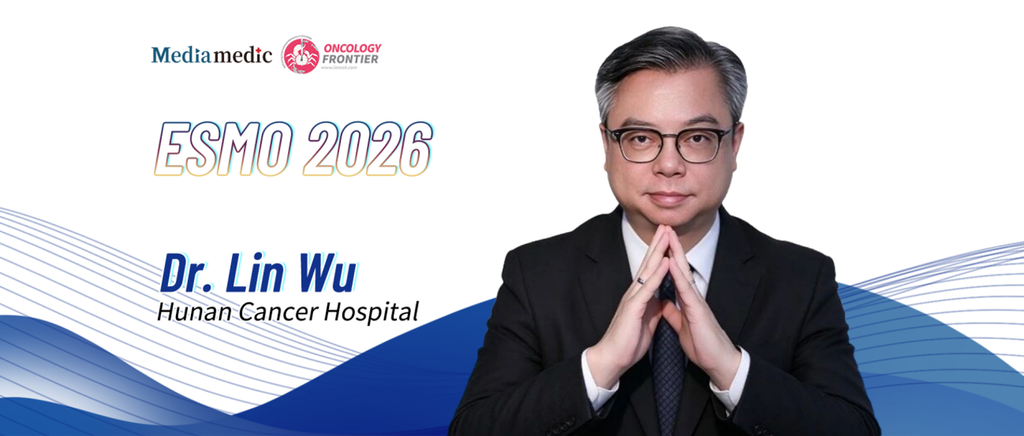
The highly anticipated 2026 Congress of the European Society for Medical Oncology (ESMO) was held in Madrid, Spain, from October 23 to 27, 2026. As one of the most influential academic meetings in global oncology, this year's congress brought together leading experts and scholars from around the world to present cutting-edge advances and explore the future of cancer diagnosis and treatment.At this year’s congress, Professor Lin Wu’s team from Hunan Cancer Hospital presented updated results from a phase II clinical study of the PD-1/VEGF bispecific antibody tivunatamig (PF-08634404/SSGJ-707) in combination with chemotherapy for advanced non-small cell lung cancer (NSCLC). Oncology Frontier invited Professor Wu to provide an in-depth analysis of the findings.
Study Overview
Abstract No.: 2660P
Original Title: Phase 2 trial of the PD-1/VEGF bispecific antibody, PF-08634404 (SSGJ-707), plus chemotherapy (chemo) in advanced NSCLC: Updated results
Chinese Title: Updated Results from a Phase II Clinical Study of the PD-1/VEGF Bispecific Antibody Tivunatamig (PF-08634404/SSGJ-707) Plus Chemotherapy for Advanced Non-Small Cell Lung Cancer
Presenter: Professor Lin Wu (Hunan Cancer Hospital)
Background
Tivunatamig (PF-08634404/SSGJ-707, hereafter PF’4404) is a fully human IgG4 bispecific antibody that simultaneously targets PD-1 and VEGF. Results from an earlier study (NCT06412471) showed that tivunatamig in combination with platinum-based chemotherapy demonstrated promising antitumor activity and a manageable safety profile as first-line treatment for NSCLC, regardless of PD-L1 expression level. This presentation provides updated long-term follow-up data on tivunatamig plus chemotherapy as first-line treatment for advanced NSCLC.
Methods
This open-label, randomized phase II clinical trial was designed to evaluate the efficacy and safety of tivunatamig or tislelizumab in combination with platinum-based chemotherapy as first-line treatment for NSCLC.
The study consisted of two parts:
- Part 1 enrolled patients with previously untreated advanced non-squamous NSCLC (nsq-NSCLC), who were randomized to receive tivunatamig (5, 10, or 20 mg/kg, Q3W) or tislelizumab, each in combination with carboplatin and pemetrexed.
- Part 2 enrolled patients with previously untreated advanced squamous NSCLC (sq-NSCLC). Cohort A evaluated different dosing regimens of tivunatamig (5 or 10 mg/kg, Q3W) in combination with carboplatin and paclitaxel. Cohort B compared different treatment regimens involving tivunatamig or tislelizumab in combination with chemotherapy.
The primary endpoints were patient safety and preliminary antitumor activity. Efficacy analyses were based on data from the recommended phase III dose (10 mg/kg, Q3W), whereas safety and circulating tumor DNA (ctDNA) analyses included all patients treated at different dose levels.
Results
As of August 6, 2026, a total of 122 patients with nsq-NSCLC and 139 patients with sq-NSCLC had been enrolled and treated with tivunatamig or tislelizumab in combination with chemotherapy.
Efficacy: The median follow-up was 16.2 months in the tivunatamig (10 mg/kg, Q3W) plus chemotherapy group and 18.6 months in the tislelizumab plus chemotherapy group.
Among patients with nsq-NSCLC, the confirmed objective response rate (cORR) was 77.5% with tivunatamig (10 mg/kg, Q3W) plus chemotherapy, compared with 44.7% with tislelizumab plus chemotherapy. The median progression-free survival (mPFS) was 13.8 months and 9.7 months, respectively.
Among patients with sq-NSCLC, the cORR was 80.7% with tivunatamig (10 mg/kg, Q3W) plus carboplatin and paclitaxel, compared with 67.7% with tislelizumab plus chemotherapy. The corresponding mPFS was 13.6 months and 8.3 months, respectively.
Safety: The incidence of grade ≥3 treatment-related adverse events (TRAEs) was 55.8% in the tivunatamig plus chemotherapy group and 49.3% in the tislelizumab plus chemotherapy group. In the tivunatamig (10 mg/kg, Q3W) plus chemotherapy dose group, the incidence of grade ≥3 TRAEs was 59.0%, with comparable safety profiles between patients with nsq-NSCLC and sq-NSCLC. The most common TRAEs were anemia (55%), decreased white blood cell count (43%), and decreased neutrophil count (40%).
In this dose group, the incidence of VEGF-related adverse events (AEs) was 56.4%, with grade ≥3 events occurring in 12.0%. The overall incidence of grade ≥3 bleeding and hemoptysis events was low in both nsq-NSCLC and sq-NSCLC. The incidence of immune-related adverse events (irAEs) was 16.2%, with grade ≥3 events occurring in 6.8%.
ctDNA Findings: Among 126 patients who received tivunatamig plus chemotherapy, had detectable ctDNA at baseline, and had paired samples available on Cycle 3 Day 1 (C3D1), the ctDNA clearance rate at C3D1 was 61.9%. The mPFS was 16.4 months in patients who achieved ctDNA clearance at C3D1, compared with 9.6 months in those who did not.
Conclusions
With longer follow-up, tivunatamig plus chemotherapy continued to demonstrate clinically meaningful antitumor activity compared with tislelizumab plus chemotherapy, regardless of histological subtype or PD-L1 expression level.
Tivunatamig plus chemotherapy had a favorable safety profile, with manageable and consistent safety characteristics in patients with both squamous and non-squamous NSCLC. Exploratory analyses also showed that post-treatment ctDNA clearance was associated with longer PFS.
These findings support the ongoing development of five studies in the Symbiotic lung cancer program, including further evaluation of the efficacy and safety of tivunatamig (10 mg/kg, Q3W) plus chemotherapy in the phase III Symbiotic-Lung-01 study (NCT07222566).
Investigator’s Perspective
First-line immunotherapy combined with chemotherapy has become an important treatment option for patients with advanced driver gene-negative NSCLC, significantly improving survival outcomes. Nevertheless, some patients still experience an inadequate initial response or early disease progression, leaving considerable room for improvement in long-term survival. In recent years, continued progress in innovative drug development in China has brought new therapeutic candidates to the forefront. Novel agents represented by PD-1/VEGF bispecific antibodies have demonstrated promising clinical potential and offer a new direction for further improving the efficacy of first-line treatment for advanced NSCLC.
Tivunatamig (PF-08634404/SSGJ-707) is a fully human IgG4 PD-1/VEGF bispecific antibody featuring a distinctive molecular design. It employs a common light-chain design in which the heavy-chain portion of the Fab fragment of the anti-PD-1 antibody is fused, via a linker peptide, to the N-terminus of the heavy chain of the anti-VEGF antibody. This produces a symmetric, tetravalent “2+2” structure with two PD-1-binding sites and two VEGF-binding sites.
Clinical data on tivunatamig plus chemotherapy as first-line treatment for advanced NSCLC were first presented at the 2025 SITC Annual Meeting. At the 2026 ESMO Congress, updated long-term follow-up data were reported.
In terms of efficacy, among patients with nsq-NSCLC, the mPFS was 13.8 months in the tivunatamig (10 mg/kg, Q3W) plus chemotherapy group and 9.7 months in the tislelizumab plus chemotherapy group. Among patients with sq-NSCLC, the corresponding mPFS was 13.6 months and 8.3 months, respectively. With longer follow-up, tivunatamig plus chemotherapy continued to demonstrate encouraging antitumor activity and a sustained trend toward treatment benefit across NSCLC histological subtypes.
Regarding safety, the overall safety profile of tivunatamig plus chemotherapy was manageable. The overall incidence of TRAEs was comparable to that observed with tislelizumab. The incidences of VEGF-related AEs and irAEs were both manageable, and the safety profiles were comparable between patients with nsq-NSCLC and sq-NSCLC.
In addition, exploratory ctDNA analyses showed that the mPFS was 16.4 months in patients with ctDNA clearance at C3D1, compared with 9.6 months in those without clearance. These findings suggest that early changes in ctDNA may serve as an adjunctive tool for treatment monitoring and prognostic stratification, although their clinical utility requires further validation.
These results provide important support for the ongoing phase III Symbiotic-Lung-01 study (NCT07222566). This trial will directly compare the efficacy and safety of tivunatamig plus chemotherapy versus pembrolizumab plus chemotherapy as first-line treatment for advanced NSCLC. It is expected to further clarify whether tivunatamig can deliver greater clinical benefit beyond current standard treatment.
We look forward to future studies further validating its efficacy in patients with different PD-L1 expression levels and histological subtypes. Together with long-term survival, safety, and dynamic ctDNA data, these findings may provide more comprehensive evidence to guide individualized first-line treatment decisions for advanced NSCLC.
Expert Profile

Professor Lin Wu