Patients with EGFR-mutated non-small cell lung cancer (NSCLC) were among the earliest beneficiaries of precision targeted therapy. However, once tyrosine kinase inhibitor (TKI) resistance develops and disease progression occurs, the choice of subsequent therapy has long posed a major challenge for clinicians worldwide. The emergence of innovative treatments such as antibody–drug conjugates (ADCs) has brought new hope for overcoming this long-standing dilemma.At the 2025 European Society for Medical Oncology (ESMO) Congress, results from the phase III OptiTROP-Lung04 trial of the Chinese-developed TROP2 ADC sacituzumab tirumotecan were selected for the Presidential Symposium. The study demonstrated simultaneous and significant improvements in both progression-free survival (PFS) and overall survival (OS) in patients with EGFR-TKI–refractory NSCLC. The findings were subsequently published in The New England Journal of Medicine (NEJM) and received widespread recognition from international experts.
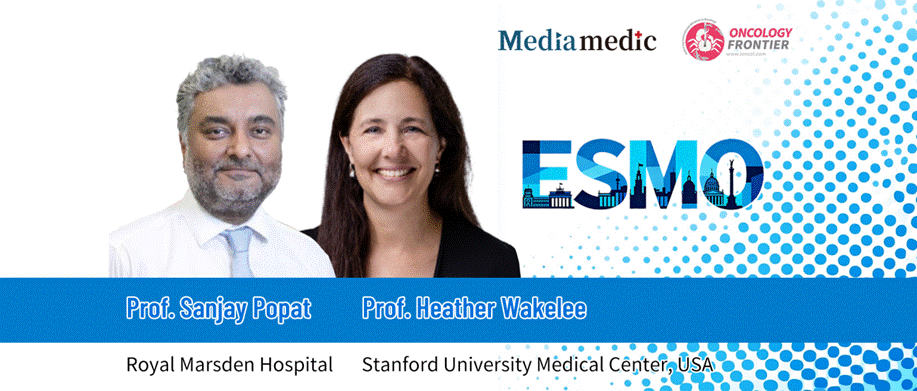
During the ESMO Congress, Oncology Frontier invited Professor Sanjay Popat (The Royal Marsden Hospital, UK) and Professor Heather Wakelee (Stanford University Medical Center, USA) to interpret the OptiTROP-Lung04 data, discuss the clinical prospects of sacituzumab tirumotecan, and share insights into the latest NSCLC treatment advances presented at ESMO.
Part 1
Compelling Efficacy Signals: Sacituzumab Tirumotecan May Redefine Global Treatment Paradigms**
Oncology Frontier:
The OptiTROP-Lung04 study evaluating the Chinese TROP2 ADC sacituzumab tirumotecan was selected for the Presidential Session at ESMO. How do you assess its results and clinical value? How might it reshape post-line treatment for EGFR-mutant advanced NSCLC?
Professor Sanjay Popat
We have been following the development of sacituzumab tirumotecan for some time and have already observed its antitumor activity in EGFR-mutant NSCLC. Previous phase II studies of TROP2 ADCs, including Dato-DXd, suggested promising efficacy in this population. Importantly, sacituzumab tirumotecan had already demonstrated significant PFS and OS advantages over docetaxel chemotherapy in earlier studies (notably OptiTROP-Lung03).
Therefore, seeing the OptiTROP-Lung04 results in the Presidential Session was genuinely exciting. The PFS benefit is clearly clinically meaningful, and we now eagerly await further maturation of the survival data to fully understand the magnitude of OS benefit.
From a Chinese clinical perspective, this study is particularly important because it was conducted entirely within China. The key question moving forward is whether the magnitude of benefit and safety profile can be replicated in Western populations. Ongoing international studies will be critical, and I very much look forward to seeing those results.
Professor Heather Wakelee
The efficacy data for sacituzumab tirumotecan are indeed impressive. The objective response rate exceeds 60%, with a median duration of response of 8.3 months, alongside robust PFS and OS outcomes.
Historically, after first-line EGFR-TKI failure, we often continued targeting the EGFR pathway using alternative agents. However, in OptiTROP-Lung04, sacituzumab tirumotecan demonstrated a striking advantage over platinum-based doublet chemotherapy—although the chemotherapy arm performed slightly below expectations.
Other TROP2 ADCs have also shown unexpectedly high response rates in EGFR-mutant NSCLC, exceeding those seen in unselected NSCLC populations. Given this consistent pattern, it becomes increasingly convincing that TROP2 ADCs are particularly effective in EGFR-mutant disease. Based on ORR and other efficacy endpoints, sacituzumab tirumotecan appears to be the most compelling agent in its class.
That said, future challenges relate primarily to toxicity management. Ocular toxicity appears less pronounced compared with similar agents, and most adverse events are manageable. However, alopecia may affect quality of life for some patients, and oral mucositis/stomatitis could be a significant concern. Optimizing supportive care strategies will be essential as this drug moves into broader clinical use.
Oncology Frontier:
What post-line therapies have you historically favored for EGFR-mutant advanced NSCLC? Which patient subgroups or biomarkers might be most suitable for TROP2 ADCs?
Professor Sanjay Popat
For patients progressing after third-generation EGFR-TKIs such as osimertinib, platinum-based chemotherapy has traditionally been the standard. However, first-line treatment paradigms are evolving rapidly. Many patients now receive FLAURA2 (osimertinib plus chemotherapy) or MARIPOSA (amivantamab plus lazertinib), both of which have demonstrated significant OS benefits.
Upon progression, platinum-based chemotherapy remains a standard option—either pemetrexed plus platinum, or chemotherapy combined with osimertinib, supported by positive results from the UK-based COMPEL study. Additionally, the ABCP regimen (atezolizumab, bevacizumab, paclitaxel, carboplatin) is widely used, despite relatively small registration datasets.
Sacituzumab tirumotecan is an exciting addition, but key questions remain—particularly whether it benefits all patient subsets and whether it provides intracranial activity in Western populations.
Regarding biomarkers, identifying predictive markers for ADC efficacy remains challenging. For Dato-DXd, digital pathology–based assessment of TROP2 expression has shown some promise. Whether similar biomarkers will guide sacituzumab tirumotecan use remains to be determined. If efficacy is confirmed in Western populations, I believe this agent has the potential to replace chemotherapy as the standard post-TKI treatment.
**Part 2
Continued Innovation in the Perioperative Setting: ADCs May Move Earlier**
Oncology Frontier:
At ESMO, you presented 5-year follow-up results from the KEYNOTE-671 study of perioperative pembrolizumab in early-stage NSCLC. Based on available long-term data, how would you individualize perioperative immunotherapy strategies?
Professor Heather Wakelee
The 5-year follow-up data from KEYNOTE-671 remain highly encouraging. Both event-free survival (EFS) and OS benefits are sustained, with hazard ratios remaining stable over time. Importantly, pembrolizumab clearly improves OS, and unlike some studies, PD-L1–negative patients also derived significant EFS benefit.
The perioperative immunotherapy landscape in NSCLC is now crowded. Both perioperative pembrolizumab and atezolizumab demonstrate similar OS benefits, so selection may largely depend on regional drug availability. Neoadjuvant-only approaches such as CheckMate-816 also show OS benefit but do not appear to benefit PD-L1–negative patients.
Further work is needed to identify which patients require full perioperative immunotherapy (neoadjuvant plus adjuvant) versus neoadjuvant therapy alone, and whether treatment decisions can be made upfront or must depend on postoperative pathological response (e.g., pCR). Despite clear OS benefits, many patients still relapse, highlighting the need for continued drug development and biomarker research—particularly in minimal residual disease (MRD) monitoring.
Oncology Frontier:
With positive phase III perioperative ADC data emerging in breast cancer, do you foresee similar breakthroughs in perioperative NSCLC?
Professor Heather Wakelee
ADCs already play a role in advanced NSCLC, but they have not yet been as transformative as in breast cancer. We are still defining their optimal positioning. Naturally, any therapy showing promise in metastatic disease will be explored in earlier stages, and such studies are worthwhile.
However, it is too early to conclude that ADCs will revolutionize perioperative NSCLC treatment. Cautious optimism is appropriate.
Part 3
Lessons from Other Fields: Advances in HER2-Targeted Therapy for Rare NSCLC Subtypes**
Oncology Frontier:
You presented the Beamion LUNG-1 study evaluating zongertinib as first-line therapy in HER2-mutant NSCLC. How might this influence treatment paradigms?
Professor Sanjay Popat
I presented data from cohort 2 of the phase I Beamion LUNG-1 study, which enrolled 74 treatment-naïve patients with unresectable or metastatic NSCLC harboring HER2 tyrosine kinase domain mutations. Patients received zongertinib 120 mg once daily.
The objective response rate reached 77%, with a disease control rate of 94%. All patients demonstrated some degree of tumor shrinkage, regardless of whether they carried the HER2 YVMA mutation. Median duration of response and PFS had not yet been reached at median follow-ups of 9.7 and 11.1 months, respectively. Safety was favorable, with predominantly grade 1–2 treatment-related adverse events and no grade 4/5 toxicities.
Given its high efficacy and manageable toxicity, zongertinib has the potential to redefine first-line treatment for HER2-mutant NSCLC. The ongoing phase III Beamion LUNG-2 trial will further clarify its role compared with chemotherapy.
Oncology Frontier:
What are the main challenges in treating rare mutations such as HER2 in NSCLC, and what advice would you share with Chinese colleagues?
Professor Sanjay Popat
HER2 mutations occur in approximately 4% of NSCLC cases and can be found in both smokers and never-smokers. In Beamion LUNG-1, 30% of patients were smokers, underscoring that smoking history is not a reliable predictor of HER2 mutation status.
Although 4% may seem small, NSCLC is a common cancer, meaning the absolute number of HER2-mutant patients is substantial. The key message for clinicians—particularly in China—is the importance of comprehensive genomic profiling. High-quality molecular testing should be standard at diagnosis to identify HER2 mutations and enable patients to benefit from targeted therapies.

Sanjay Popat, MD, PhD

Heather Wakelee, MD