
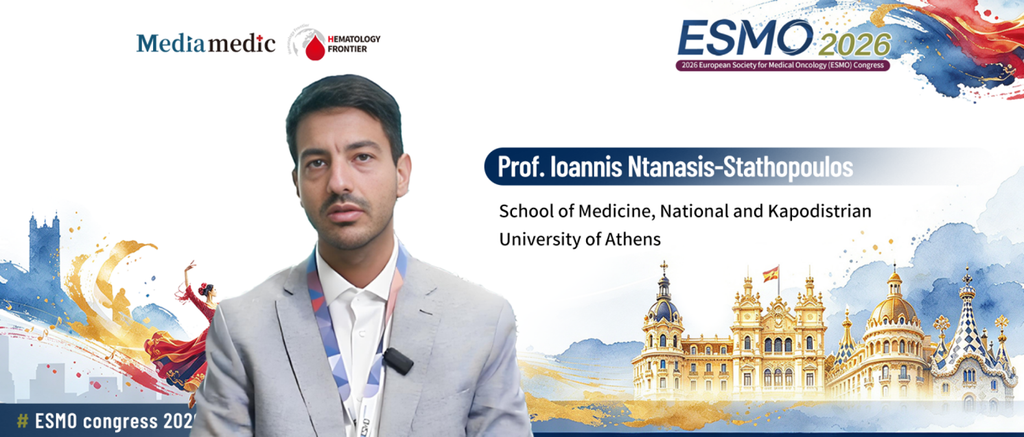
At the 2026 European Society for Medical Oncology (ESMO) Congress, advances in the treatment of multiple myeloma (MM) attracted considerable attention. For patients with transplant-ineligible newly diagnosed multiple myeloma (TI-NDMM), the combination of belantamab mafodotin with lenalidomide and dexamethasone (BelaRd) demonstrated deep responses and a favorable safety profile. During the Congress, Oncology Frontier – Hematology Frontier invited Professor Ioannis Ntanasis-Stathopoulos of the School of Medicine, National and Kapodistrian University of Athens, Greece, for an in-depth academic discussion. Topics included the long-term follow-up data for BelaRd, the clinical value of the Vision-Related Anamnestic (VRA) tool in managing ocular adverse events (OAEs), and the potential future role of this regimen in real-world practice.01
Deep Responses and Rapid Onset of Action: An Analysis of Long-Term BelaRd Data
Oncology Frontier – Hematology Frontier: In the BelaRd clinical study, belantamab mafodotin combined with lenalidomide/dexamethasone (Rd) demonstrated deep responses in patients with transplant-ineligible newly diagnosed multiple myeloma (TI-NDMM). In the long-term follow-up, what data are available regarding the durability of response and minimal residual disease (MRD) negativity rates with this regimen?
Professor Ioannis Ntanasis-Stathopoulos: In our updated results from the BelaRd Phase I/II study, the overall response rate (ORR) in this cohort was nearly 100%, and approximately half of the patients achieved MRD negativity. Although this is currently only a Phase I/II clinical study, these results are very promising from a clinical translation perspective.
It is important to emphasize that all enrolled patients had newly diagnosed MM, and most had symptomatic disease. Two-thirds of the patients already had bone disease at diagnosis. For this particular high-risk subgroup, achieving a deep and durable response is crucial to improving long-term outcomes.
In addition, the median time to first response (TTR) was only one month, demonstrating a notably rapid onset of action. MRD negativity is an emerging endpoint in clinical trials and is also closely relevant to real-world clinical practice. Such a high MRD negativity rate suggests that this regimen may ultimately translate into a meaningful prolongation of median progression-free survival (PFS) with longer follow-up.
02
Empowering Clinical Practice: Optimizing Ocular Adverse Event Management With the VRA Tool
Oncology Frontier – Hematology Frontier: The study included Group A, guided by ophthalmologists, and Group B, in which hematologists used the Vision-Related Anamnestic (VRA) tool. In your practice, has the use of the VRA tool effectively reduced the incidence of ocular adverse events (OAEs) and the discontinuation rate of belantamab mafodotin?
Professor Ioannis Ntanasis-Stathopoulos: One of the main objectives of our study was to determine whether the mandatory monthly ophthalmological examinations currently required for administering belantamab mafodotin could be replaced by a simpler VRA tool. This tool involves standardized questions administered by an oncologist or hematologist, and we wanted to assess the degree of agreement between VRA assessments and specialist ophthalmological examinations.
Our data showed that the vast majority of patients could receive treatment without having to wait for real-time feedback from an ophthalmologist. More importantly, every treatment administration based on VRA assessment was highly consistent with the final assessment by the ophthalmologist.
Overall, among patients considered eligible to receive belantamab mafodotin based on their VRA results, subsequent ophthalmological examinations did not reveal severe OAEs.
We have also observed in real-world clinical practice that, compared with an approach relying exclusively on specialist ophthalmological assessments, this strategy significantly reduces treatment delays (dose holds) caused by waiting for assessments. This VRA-based treatment management approach makes therapy more convenient and accessible while substantially optimizing clinical workflows.
03
Reshaping the First-Line Treatment Landscape: The Real-World Positioning of BelaRd and Optimization of Treatment Sequencing
Oncology Frontier – Hematology Frontier: For frail or intermediate-fit patients with multiple myeloma who are ineligible for transplantation, how does the BelaRd regimen balance efficacy and tolerability? How do you envision its future positioning in real-world clinical practice?
Professor Ioannis Ntanasis-Stathopoulos: According to current domestic and international clinical guidelines, the standard of care (SOC) for patients with newly diagnosed MM who are ineligible for transplantation consists of triplet or quadruplet regimens incorporating an anti-CD38 monoclonal antibody in combination with lenalidomide and dexamethasone, such as Dara-Rd.
The BelaRd regimen has already demonstrated highly promising efficacy and safety in a Phase I/II study. A registration-directed Phase III head-to-head clinical trial comparing the efficacy of the standard regimen, Dara-Rd, with BelaRd is currently ongoing. We look forward to its results, which we hope will provide high-level evidence to inform clinical decision-making.
If BelaRd or other belantamab mafodotin-containing combinations become additional treatment options alongside Dara-Rd, this would substantially expand clinicians’ ability to select individualized regimens for different patients.
More importantly, from the broader perspective of optimizing treatment sequencing, if daratumumab (Dara) or another anti-CD38 monoclonal antibody is reserved for later lines of therapy, we could use highly promising salvage combinations at first relapse, such as teclistamab plus daratumumab, particularly for frail patients. This could help maximize survival benefits throughout the patient’s treatment journey.
Expert Profile

School of Medicine, National and Kapodistrian University of Athens, Greece
Professor Ioannis Ntanasis-Stathopoulos is a hematology specialist at the School of Medicine, National and Kapodistrian University of Athens, Greece. He works in the Department of Hematology and Myeloma Research Group at Alexandra General Hospital in Athens, Greece.
His main research interests include the clinical management and translational research of multiple myeloma. He has long been involved in numerous international multicenter clinical trials investigating novel immunotherapies, including antibody-drug conjugates (ADCs) and bispecific antibodies, and has published multiple academic papers in leading international journals such as Blood and Leukemia.
- Active member of the European Hematology Association (EHA) and the American Society of Hematology (ASH).
- Core member of the Greek Myeloma Study Group.
- Principal investigator (PI) or key investigator at Greek study centers in multiple international clinical trials for multiple myeloma, including the BelaRd and DREAMM series of studies.