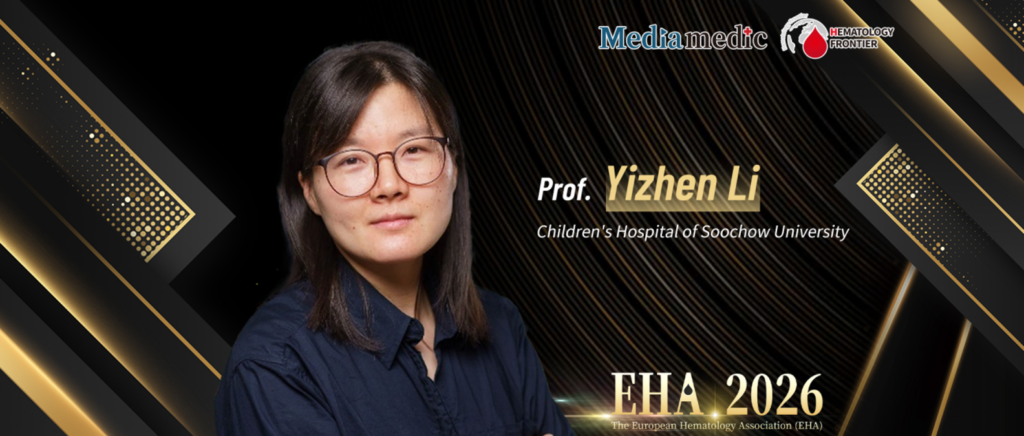
At the highly anticipated Plenary Session of the 2026 European Hematology Association (EHA) Congress, Professor Yizhen Li from the Children's Hospital of Soochow University presented his team’s original research findings.The study demonstrated for the first time that targeting CD5 can serve as a universal enhancement strategy to significantly improve the antitumor activity of T-cell engagers (TCEs). Unlike previous studies that primarily focused on tumor-cell intrinsic mechanisms, this research investigated the intrinsic regulatory machinery of T cells, highlighting the translational potential of CD5 as a platform-wide combinatorial target in the bispecific antibody field.
At the meeting, Oncology Frontier – Hematology Frontier interviewed Professor Li to discuss the mechanistic role of CD5 in T-cell receptor (TCR) signaling, the advantages of CD5 as a therapeutic target, and future clinical development strategies. The findings offer a new perspective for improving TCE efficacy and overcoming therapeutic resistance.
Understanding TCE Resistance Through T-Cell Biology
Oncology Frontier – Hematology Frontier:
Most studies investigating variability in T-cell engager (TCE) efficacy and resistance mechanisms have focused primarily on tumor-cell intrinsic factors. Your team is the first to identify CD5 as a key negative regulator from the perspective of intrinsic T-cell regulation. What insights does this discovery provide regarding determinants of TCE efficacy and resistance?
Professor Yizhen Li:
Our initial studies on TCE efficacy primarily focused on tumor-cell biology, and we have previously published related findings. However, the ultimate elimination of tumor cells depends fundamentally on the activation status of T cells.
Based on this understanding, we shifted our research perspective and began investigating factors on the T-cell side that may influence TCE efficacy. Through rapid genome-wide screening approaches, we successfully identified CD5 as a critical target.
The significance of this discovery lies in its broad applicability. Research targeting tumor-cell biology is often limited to specific diseases or tumor types. In contrast, strategies that regulate T-cell function possess much wider applicability and can potentially enhance the efficacy of TCE therapies directed against different targets and across multiple diseases.
Why CD5 Matters in T-Cell Activation
Oncology Frontier – Hematology Frontier:
Your study showed that CD5 limits T-cell activation by regulating proximal TCR signaling, and that CD5 inhibition significantly enhances cytotoxicity, proliferation, and effector function. From a mechanistic perspective, where does CD5 sit within the T-cell activation network, and what makes it an attractive therapeutic target?
Professor Yizhen Li:
First, regarding its position within the T-cell activation network, we found that CD5 interacts with components of the TCR complex. This suggests that CD5 plays an inhibitory role during the early stages of TCR signaling and TCR complex assembly.
Second, CD5 possesses several unique advantages as a therapeutic target.
On one hand, CD5 is a membrane protein specifically expressed on T cells. Because membrane proteins are readily accessible on the cell surface, they are particularly amenable to therapeutic intervention. In our study, antibody binding to CD5 induced its internalization and degradation, thereby reducing overall CD5 expression and releasing its inhibitory effects on T-cell activation.
On the other hand, numerous targeting approaches can be developed against membrane proteins. For example, current research is increasingly exploring nanoparticle-based antibody delivery systems. Such carriers can substantially enhance CD5 internalization and degradation and may achieve stronger effects than conventional antibodies alone.
Toward a Platform-Wide Combination Target
Oncology Frontier – Hematology Frontier:
CD5 inhibition not only enhanced the efficacy of blinatumomab but also demonstrated broad activity across CD20-, BCMA-, and GPRC5D-directed bispecific antibody models. Do you believe CD5 could become a platform-wide combination target in the future of bispecific antibody therapy? What key steps remain before clinical application?
Professor Yizhen Li:
I believe CD5 has strong potential to become a platform-level combination target for future bispecific antibody therapies.
We evaluated this concept across multiple TCE platforms and consistently found that both genetic deletion of CD5 and treatment with CD5-targeting antibodies significantly enhanced antitumor activity. These findings strongly support the broad applicability of this strategy.
However, an important safety issue must be addressed before clinical translation.
Our current approach relies on antibodies binding to CD5 expressed on T cells. This raises the possibility of antibody-dependent cellular cytotoxicity (ADCC) mediated by natural killer (NK) cells or complement-dependent cytotoxicity (CDC), potentially resulting in unintended T-cell depletion.
Therefore, future CD5 antibody development will require Fc engineering to minimize ADCC and CDC activity as much as possible. Through such optimization, we aim to enhance T-cell activation while simultaneously reducing the risk of T-cell destruction by other immune effector mechanisms, thereby achieving a favorable balance between efficacy and safety.
Expert Profile
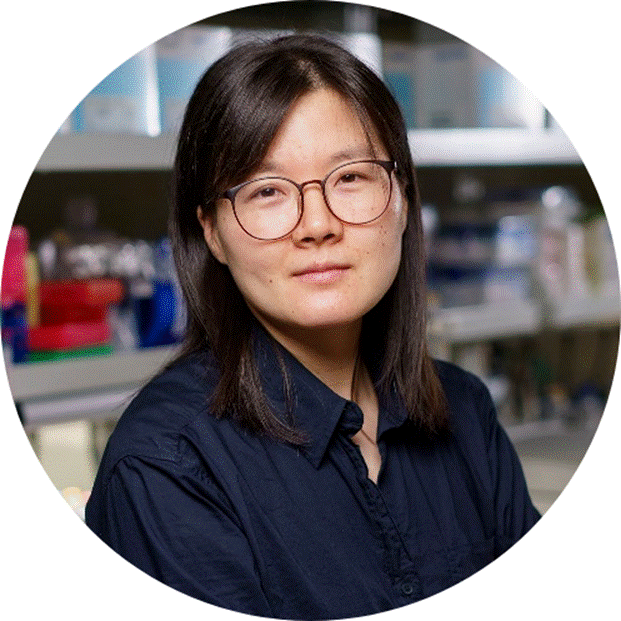
Professor Yizhen Li
Children’s Hospital of Soochow University
Distinguished Professor, Children’s Hospital of Soochow University
National High-Level Talent Program Recipient
Director, Jiangsu Key Laboratory of Pediatric Hematology and Oncology
Jiangsu Distinguished Young Scholar
Leader, Jiangsu Innovation and Entrepreneurship Team
Jiangsu Innovation and Entrepreneurship Talent
Expert Committee Member, Leukemia Group, National Childhood Cancer Surveillance Center Data Application Committee
Committee Member, Pediatric Hematology Group, Chinese Association of Physiological Sciences
Research Interests
Professor Li focuses on translational research in acute leukemia, including both acute myeloid leukemia (AML) and acute lymphoblastic leukemia (ALL).
His research integrates gene editing, high-throughput mutagenesis libraries, in vitro and in vivo leukemia modeling, large-scale CRISPR screening, and pharmacodynamic studies to investigate mechanisms underlying leukemia development, drug resistance, and therapeutic optimization from both genomic and immunological perspectives.
His work has been published in leading journals including Cancer Cell, Blood, Journal of Clinical Investigation, and Science Advances. He is also the principal investigator of multiple National Natural Science Foundation of China grants.