
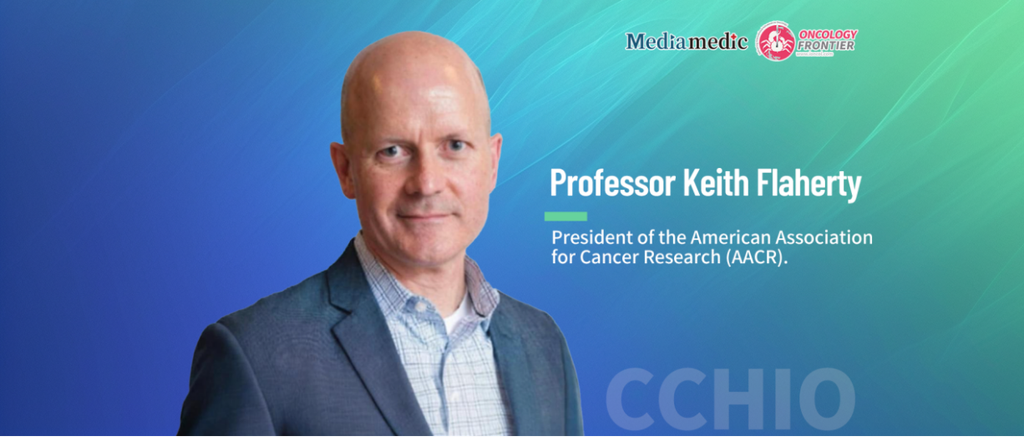
From November 11 to 15, 2026, the 2026 China Congress of Holistic Integrative Oncology (CCHIO) was held in Changsha, Hunan. Hosted by the Chinese Anti-Cancer Association (CACA), co-organized by the International Society of Holistic Integrative Medicine, the World Society of Holistic Integrative Oncology and the Hunan Provincial Anti-Cancer Association, the congress was organized by Hunan Cancer Hospital.As precision oncology continues to advance, combination therapy has become a key approach to breaking the efficacy ceiling of single-agent treatments and addressing tumor heterogeneity. Yet many challenges for the field remain unsolved regarding the design logic of combination regimens and their clinical translation pathways. During the congress, Oncology Frontier conducted an exclusive interview with Professor Keith Flaherty, President of the American Association for Cancer Research (AACR). He shared his in-depth thoughts on the development of cancer combination therapy across four dimensions: technological progress, regimen design, R&D strategy and international collaboration.
Oncology Frontier: Professor Flaherty, your presentation is titled “Accelerating the Development of Rational Combination Therapies for Cancer”. As cancer treatment enters the era of precision medicine, what new opportunities and challenges does combination therapy face?
Professor Keith Flaherty: The greatest opportunity driving combination therapy forward comes from the rapid advances in tumor molecular characterization technologies over the past 5 to 10 years. For a long time, we built the framework of first-generation precision oncology based on detected gene mutations or genetic alterations, but the complexity of tumors extends far beyond what can be uncovered at the genetic level.
Take cancer immunotherapy, which has been a standard of care for over a decade, as an example. To deliver it more precisely, we cannot match patients based on a single molecular feature of their tumor alone; a more comprehensive understanding of tumor biology is required. Only by moving beyond standalone DNA mutation sequencing and expanding the use of multi-dimensional molecular detection technologies can we fully unlock the combined potential of existing treatments, and lay the groundwork for deploying next-generation innovative therapies in combination.
Oncology Frontier: When designing rational combination therapy regimens, how can we identify which combinations will truly benefit patients? How can we identify the factors that guide these decisions?
Professor Keith Flaherty: A clear limitation today is that molecular detection relying on a single technical platform can rarely identify suitable combination regimens for most patients. For instance, mutation detection alone can point to a two-drug combination for only 2% to 3% of patients with cancer. For this reason, we must adopt a multimodal approach to molecular characterization.
RNA expression analysis has served as a research method for more than two decades, yet it has not been fully translated into a routine analytical tool for precision medicine practice. A large body of published evidence indicates that the transcriptomic information of tumor cells can guide not only single-agent use but also the selection of combination regimens more effectively. Going further, AI-powered digital pathology image analysis can capture even more tumor biological features than DNA and RNA sequencing, and will be an essential tool for realizing precise delivery of combination therapy in the future.
Oncology Frontier: With a growing number of innovative drugs coming onto the scene, the possible combinations of treatment regimens have multiplied. From early-phase trials to confirmatory studies, what key issues must be resolved to accelerate the development of rational combination therapies?
Professor Keith Flaherty: The first barrier to break through is the limitation of static molecular detection. Current molecular diagnostic tools essentially capture only a snapshot of tumor cell status at a single time point, which is insufficient to fully reflect the true therapeutic sensitivity of tumors. Ex vivo functional testing of live tumor cells can test drug sensitivity outside the patient body and complement static molecular testing. However, this field is still immature; both its research methodologies and clinical application are in the early stages, requiring greater investment of resources and effort to verify its practical value.
Beyond that, tumor heterogeneity and complexity pose another major challenge. We need to adjust our research strategy and test therapeutic regimens at an earlier stage of tumor evolution. Blood-based detection technologies, particularly circulating tumor DNA assays, open up this possibility. We can identify patients who have received definitive local therapy such as surgery or radiotherapy, with no lesions visible on radiographic imaging but detectable circulating tumor DNA (molecular residual disease) in the blood. Testing new therapies and even combination regimens in this earlier disease setting, rather than in patients with recurrent metastatic disease who have received multiple lines of prior therapy, will allow us to identify effective new regimens much faster, when the tumor is far less complex.
Oncology Frontier: CACA and AACR have deepened their collaboration in recent years. As the current AACR President, in which areas would you like to see the two organizations strengthen their partnership to jointly advance cancer research and clinical translation?
Professor Keith Flaherty: The complexity of cancer exists not only within an individual patient’s tumor, but also across the cancer spectra of different populations worldwide. Ancestral background, germline genetic variation and population-specific environmental exposures all shape an individual’s cancer risk and the molecular profile of their tumors. At present, we still lack a systematic, foundational understanding of the differences and similarities across populations in this regard.
The American Association for Cancer Research and the Chinese Anti-Cancer Association represent two large, well-established cancer care and research systems, and there is enormous potential for collaboration between them. We can jointly build a research framework to characterize the similarities and differences in cancer populations and their underlying molecular mechanisms, and ultimately translate these insights into the development and delivery of therapeutic regimens. This is ultimately a global challenge, and our partnership can set the stage for a global translational research platform of this kind.