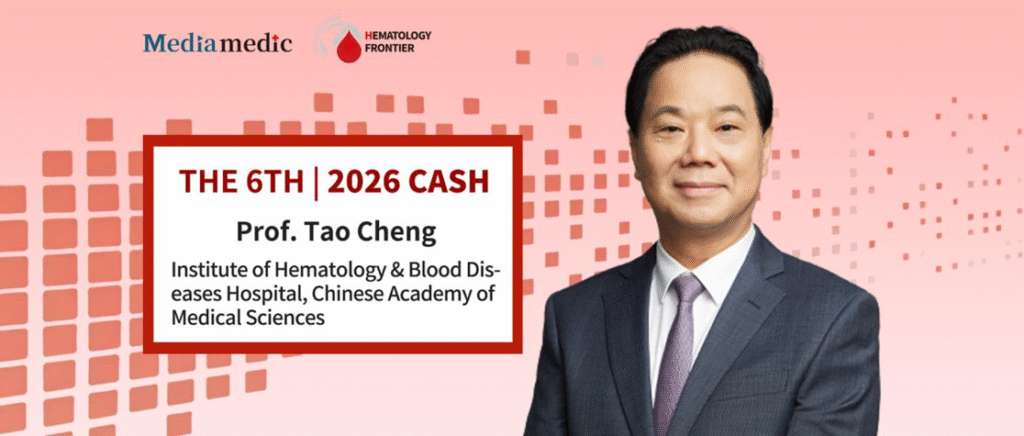
Editor’s Note: From January 9 to 11, 2026, the 6th China Hematology Discipline Development Conference (CASH) was held in Tianjin. Coinciding with the launch of China’s 15th Five-Year Plan, the conference centered on the theme “Tianjin: Renewing Momentum, Intelligence Leading the Future.” With a forward-looking perspective, the meeting focused on the systemic evolution and ecological integration of hematology, exploring high-quality discipline development pathways and innovative models within the broader “Healthy China” framework.During the conference, Academician Tao Cheng, Chair of the meeting and President of the Institute of Hematology and Blood Diseases Hospital, Chinese Academy of Medical Sciences, gave an in-depth media interview. He shared key innovations from this year’s conference, elaborated on the concept of “hematologic ecology,” examined challenges and opportunities in bench-to-bedside translation, and offered strategic insights on innovation capacity building and the future of hematology over the next five years.
As a long-standing Chair of CASH, what are the key highlights and innovations of this year’s conference?
Academician Tao Cheng: Since its launch in 2021, the China Hematology Discipline Development Conference (CASH) has successfully held five editions during the 14th Five-Year Plan period. The 6th CASH, held at the outset of the 15th Five-Year Plan, marks the conference’s entry into a new phase of growth and influence.
Across scientific fields, innovation is now a top priority—and innovation in academic conference design is equally important. Unlike conventional vertically structured academic meetings, CASH has created a horizontally integrated, cross-sector exchange platform, responding to the growing demand for interdisciplinary and interdepartmental collaboration among scientists and clinicians.
This platform brings together stakeholders from government, industry, academia, research, and clinical practice, enabling deep dialogue and cross-pollination of ideas. Such multi-sector engagement is expected to spark new insights, driving innovation in hematology and beyond.
This year’s conference featured over 30 parallel sessions, including both disease-specific specialty forums and cross-disciplinary thematic tracks, such as:
- Clinical Research Forum
- Regulatory Science Forum
- Journal Editors Forum
- Science Communication Forum
- Doctoral Scholars Forum
Additionally, as part of its global outreach, CASH hosted international forums with scholars from multiple countries, reflecting a strong commitment to openness and international collaboration.
Looking ahead to the 15th Five-Year Plan, CASH will continue to expand in scale, academic impact, and innovation capacity, aspiring to become one of the most influential and forward-looking platforms in hematology and related interdisciplinary fields, while also serving as a model for scientific conference organization across disciplines.
You introduced the concept of “hematologic ecology.” What is its core meaning, and how does it reshape research paradigms and clinical translation?
Academician Tao Cheng: When CASH was first launched in 2021, we introduced the concept of “hematologic ecology” in the Chinese Journal of Hematology. This concept has multiple layers of meaning.
At the scientific level, it represents a shift from static, reductionist research models toward a dynamic, interconnected, and systems-based paradigm, marking an important conceptual transformation in biomedical research.
At the innovation level, it reflects a new collaborative model, emphasizing deep multidisciplinary integration and fostering a new research ecosystem in hematology.
At a broader level, hematologic ecology embodies an ecosystem-oriented vision spanning medicine and the national innovation system, highlighting the coordinated linkage of government, industry, academia, research, and clinical application. In medicine, clinical needs must be positioned as a central driver of scientific innovation.
The key lies in building platforms where diverse stakeholders can converge, exchange perspectives, and collaborate deeply—ultimately forming a higher-order innovation ecosystem.
Since its introduction, the concept of hematologic ecology has received wide recognition and growing influence. As cross-disciplinary research accelerates, this ecosystem approach will continue to expand in scope and impact, alongside the parallel development of hematology-related industrial ecosystems.
What are the key challenges in translating basic research into clinical application, and how can CASH promote “medicine–education–research–industry” integration?
Academician Tao Cheng: Hematology is a model discipline for integrating basic research with clinical translation. Historically, many of medicine’s most significant breakthroughs have originated from hematologic research.
Looking ahead, hematology still holds substantial untapped potential for translational advancement. CASH provides a critical platform for interaction between basic scientists and clinicians, enabling idea exchange, problem refinement, and innovation generation.
The deep integration of laboratory science and clinical practice is essential. Rather than pursuing fragmented collaborations, both sides should focus on shared translational objectives:
- Clinicians should identify urgent unmet clinical needs and formulate high-impact scientific questions
- Basic and interdisciplinary researchers should provide robust mechanistic evidence and biologically compelling explanations to support clinical innovation
Meanwhile, hematology has demonstrated exceptional leadership in next-generation innovation, particularly in cell and gene therapies. China has already approved more than 10 cell and gene therapy products, with over half first applied in hematologic diseases.
During the 15th Five-Year Plan, the continued expansion of registrational trials and investigator-initiated studies (IITs) is expected to drive further breakthroughs. Through CASH’s multi-stakeholder integration, the basic–translational–industrial pipeline can be accelerated, strengthening the full innovation chain and fostering globally competitive original discoveries.
At the outset of the 15th Five-Year Plan, how do you envision the next five years of hematology development in China?
Academician Tao Cheng: In recent years, China’s hematology community has achieved remarkable progress, with several areas reaching global leadership—including:
- Regulation of hematopoietic homeostasis
- Translational and clinical research in cell and gene therapies
- Precision diagnosis and treatment of hematologic disorders
However, while these achievements are significant, they do not yet fully meet the demands of future healthcare innovation, and substantial room for growth remains.
Looking forward, we must expand beyond the traditional boundaries of hematologic disease and embrace a broader “Greater Hematology” vision. The core strengths, technologies, and methodologies of hematology should be applied to adjacent and systemic disease areas, including:
- Cardiovascular diseases
- Autoimmune disorders
- Metabolic diseases
- Solid tumors
By extending hematologic expertise into these domains, we can drive interdisciplinary convergence and innovation. Ultimately, hematology’s impact will extend beyond patients with blood disorders, benefiting broader populations and public health at large.
This broader mission represents both a scientific responsibility and a long-term strategic goal for the field.