
Editor's Note: In recent years, antibody-drug conjugates (ADCs) have become a major force reshaping the treatment landscape of advanced breast cancer. However, significant challenges remain in the management of patients with resistance to multiple lines of therapy and those with difficult-to-treat disease, highlighting the urgent need for breakthroughs involving novel therapeutic targets. At the 2026 European Society for Medical Oncology (ESMO) Congress, Professor Hongxia Wang of Fudan University Shanghai Cancer Center presented safety and efficacy data for SYS6043, a B7-H3-targeted ADC, in patients with advanced breast cancer in a Rapid Oral presentation (Abstract No. 5RO). Following the presentation, Oncology Frontier interviewed Professor Hongxia Wang of Fudan University Shanghai Cancer Center at ESMO to discuss the rationale for selecting B7-H3 as a therapeutic target in advanced breast cancer, potential explanations for differences in efficacy across molecular subtypes, and the future positioning and development of B7-H3-targeted ADCs.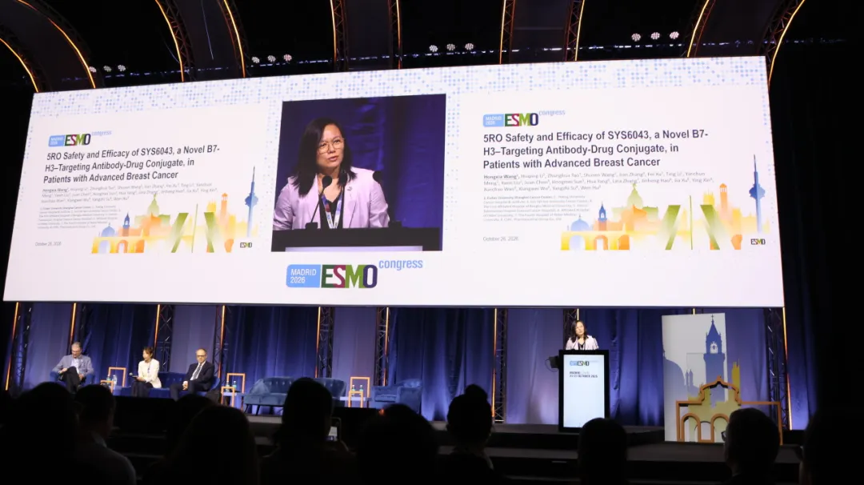
01
Oncology Frontier: SYS6043 is a novel ADC targeting B7-H3, and you presented Phase I/II study data in advanced breast cancer at this year’s ESMO Congress. Could you explain the rationale for selecting B7-H3 as a therapeutic target in patients with advanced breast cancer?
Professor Hongxia Wang: At this year’s ESMO Congress, we presented data from a Phase I/II study of SYS6043, a novel B7-H3-targeted ADC, in advanced breast cancer.
Over the past few years, we have been pleased to see that many solid tumors, including breast cancer, have entered the ADC era. HER2-targeted ADCs such as T-DXd (DS-8201) and TROP2-targeted ADCs such as sacituzumab govitecan (SG) have accumulated substantial clinical evidence in breast cancer. As these drugs have increasingly entered clinical practice, patients with breast cancer have gained more treatment options, with improvements in survival.
Nevertheless, looking at the current treatment landscape of advanced breast cancer, resistance to multiple lines of therapy and the management of patients with difficult-to-treat disease remain major challenges that cannot be avoided in clinical practice. Therefore, from both the perspective of cancer treatment and clinical practice, there is an urgent need to develop ADCs targeting novel antigens.
Looking back at the development of B7-H3 as a therapeutic target, drug development against this target was primarily focused on naked antibodies for a long time. However, the efficacy of antibody monotherapy was not particularly satisfactory. One key reason is that B7-H3 is fundamentally an immunotherapy-related target: it is highly expressed in a range of solid tumors but expressed at very low levels in normal tissues. This makes it a highly attractive target for cancer treatment.
B7-H3 expression is also very high in breast cancer, reaching 70%–80% in triple-negative breast cancer (TNBC). This was the original rationale for selecting B7-H3 as a therapeutic target in advanced breast cancer.
Why have antibody-based drugs shown limited efficacy, whereas ADCs may achieve better synergistic antitumor effects? B7-H3 is both an immune checkpoint molecule and a tumor antigen, with expression concentrated primarily in the tumor microenvironment. By combining target-directed delivery with a cytotoxic payload, ADCs can act on both the tumor microenvironment and tumor cells, producing synergistic effects and potentially stronger antitumor responses.
02
Oncology Frontier: According to the study results, the ORR with SYS6043 was 75.0% in patients with TNBC and 69.6% in those with HER2-positive breast cancer, compared with 53.5% in patients with HR-positive/HER2-negative disease. How should we interpret these differences in efficacy across subtypes? Could they be related to the number of prior lines of treatment, B7-H3 expression levels, or tumor biological characteristics?
Professor Hongxia Wang: This is an excellent question. Based on our analysis of these data, we believe that the differences in efficacy among the TNBC, HER2-positive, and HR-positive/HER2-negative subtypes may primarily be attributable to two factors.
First, patients in the HR-positive/HER2-negative subgroup had received more lines of prior treatment. In this subgroup, 54.8% of patients had received at least three prior lines of therapy, and 66.7% had experienced disease progression after receiving a CDK4/6 inhibitor in an earlier line of treatment. By comparison, the median number of prior treatment lines was two in both the TNBC and HER2-positive subgroups. Therefore, the number of prior treatment lines is a very important factor contributing to differences in clinical benefit. We also know that the more lines of treatment a patient has received, the poorer their response to subsequent therapy tends to be, and the more pronounced cross-resistance may become.
Second, I believe the differences may be related to the molecular biological characteristics and tumor microenvironments of the three subtypes. As mentioned earlier, B7-H3 is, to some extent, an immune checkpoint-related target. The immune microenvironments of patients with TNBC and HER2-positive breast cancer tend to be more active, which may make these patients more likely to benefit from treatment with anti-B7-H3 ADCs.
Of course, we are also conducting related translational research, including biomarker identification and AI-driven analysis of the tumor microenvironment and patient selection. These efforts will help us move beyond the limitations of different molecular subtypes and identify the patients who are most likely to benefit, providing further data and direction for precision diagnosis and treatment in clinical practice.
03
Oncology Frontier: Given the encouraging efficacy and safety signals demonstrated by SYS6043 in advanced breast cancer, what do you see as the potential role of B7-H3-targeted ADCs in the breast cancer treatment landscape? What aspects of dose optimization, combination strategies, and biomarker research warrant further investigation?
Professor Hongxia Wang: My team and I are very confident about the future development of SYS6043 for several reasons. First, B7-H3 is a highly promising therapeutic target. Second, we genuinely believe SYS6043 is an excellent drug. Early studies have already demonstrated good antitumor activity, along with a favorable safety profile across different molecular subtypes of breast cancer. These are the reasons for our confidence in this drug.
Although the incidence of treatment-related adverse events (TRAEs) was relatively high (99.3%), most events were mild and clinically manageable. Overall, patients tolerated treatment well. This is a very important prerequisite. While ensuring antitumor efficacy, safety remains a key consideration for us. A favorable safety and tolerability profile can enable patients to remain on treatment over the long term and receive better comprehensive management throughout their course of care, thereby helping them achieve durable responses.
At the same time, good safety and tolerability also create opportunities to explore new treatment approaches in the future, including combination therapy with other drugs. Regarding molecular biomarkers, as mentioned earlier, we are currently conducting several studies, including research into biomarker-driven precision treatment and AI-guided precision treatment. These will be important directions for future research.