

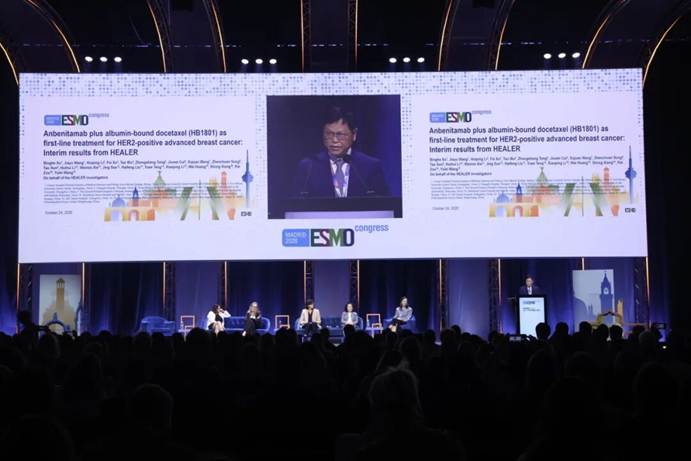
Editor's Note: For many years, trastuzumab combined with pertuzumab and a taxane (the THP regimen) has been the standard first-line treatment for HER2-positive advanced breast cancer. However, approximately half of patients experience disease progression within two years, highlighting the urgent need for more effective treatment options.On the morning of October 24, local time, the Phase III HEALER study, led by Academician Binghe Xu of the National Cancer Center/National Cancer Institute, Cancer Hospital, Chinese Academy of Medical Sciences, was presented as a Late-Breaking Abstract (LBA) at the 2026 ESMO Congress, attracting considerable attention and discussion. The study demonstrated that the HER2-targeted bispecific antibody anetumab (KN026) combined with albumin-bound docetaxel (HB1801) significantly improved first-line progression-free survival (PFS) compared with the standard THP regimen in patients with HER2-positive advanced breast cancer, providing high-quality clinical evidence for this novel combination therapy. The HEALER study was also published simultaneously as an original research article in The New England Journal of Medicine (NEJM), marking the first NEJM original research publication in the field of breast cancer from China.
Study Overview
Background
Approximately 20% of patients with breast cancer in China have advanced disease at initial diagnosis, while around 10% of patients with early-stage HER2-positive breast cancer experience recurrence or metastasis within three years after curative surgery. Over the past decade, the THP regimen has remained one of the preferred first-line treatment options for HER2-positive advanced breast cancer, both in China and internationally, owing to its excellent efficacy. Nevertheless, approximately 50% of patients still experience disease progression within two years, underscoring the urgent need to further improve clinical outcomes in this population.
Anetumab is a HER2-targeted bispecific antibody that recognizes two non-overlapping epitopes of HER2. It simultaneously binds to domains II and IV of the HER2 receptor and achieves more potent signal blockade by enhancing receptor clustering, antibody-dependent cellular cytotoxicity (ADCC), and HER2 receptor internalization.
HB1801 is an albumin-bound formulation of docetaxel. It contains neither polysorbate (Tween-80) solubilizer nor ethanol solvent and can be rapidly infused at high concentrations without corticosteroid premedication.
The HEALER study was designed to compare the efficacy and safety of anetumab plus HB1801 with those of the THP regimen as first-line treatment for HER2-positive advanced breast cancer.
Study Methods
HEALER was a randomized, open-label, Phase III clinical trial initiated by Shanghai Jinmante Biotechnology Co., Ltd., an affiliate of CSPC Pharmaceutical Group, and led by Academician Binghe Xu. The study was conducted at 76 centers across China.
A total of 885 patients with HER2-positive advanced breast cancer who had not received chemotherapy or anti-HER2 targeted therapy in the advanced-disease setting were enrolled and randomly assigned in a 1:1 ratio to receive either anetumab plus HB1801 or the THP regimen. The primary endpoint was PFS assessed by a blinded independent review committee (BIRC) according to RECIST v1.1.
The interim analysis results presented at the 2026 ESMO Congress showed that median PFS (mPFS) assessed by BIRC was significantly better in the anetumab plus HB1801 group than in the THP group. The 24-month PFS rates were 58.5% versus 34.4%, respectively, representing a 54% reduction in the risk of disease progression or death (HR, 0.46; 95% CI, 0.37–0.56; P=6.37×10⁻¹⁵).
This benefit was consistent across all prespecified subgroups, including patients who had previously received trastuzumab (HR, 0.47) and those with visceral metastases (HR, 0.47).
For secondary endpoints, investigator-assessed PFS showed a consistent trend favoring the combination regimen (HR, 0.52). The BIRC-assessed objective response rate (ORR) was 87.6% in the anetumab plus HB1801 group, significantly higher than the 73.4% observed in the THP group. Median duration of response (mDoR) had not been reached in the anetumab plus HB1801 group, compared with 16.6 months in the THP group. These findings indicate a higher response rate and more durable responses with anetumab plus HB1801 than with the THP regimen.
Manageable Safety Profile With No New Safety Signals
Regarding safety, the incidence of grade ≥3 adverse events was 45.9% in the anetumab plus HB1801 group and 34.4% in the THP group. The most common grade ≥3 adverse events were predominantly hematologic toxicities, including neutropenia (13.1% vs. 8.4%) and leukopenia (9.7% vs. 5.5%).
The incidence of treatment discontinuation due to treatment-emergent adverse events (TEAEs) was low (5.2% vs. 3.4%), indicating good treatment tolerability. Notably, although the overall incidence of diarrhea was slightly higher in the anetumab plus HB1801 group than in the THP group, grade ≥3 diarrhea occurred in only 2.3% of patients, and no participants discontinued treatment because of diarrhea.
With regard to cardiac toxicity, the incidences of left ventricular dysfunction and decreased ejection fraction were 2.9% and 8.1%, respectively. Grade ≥3 events occurred in 0.5% and 1.8% of patients, respectively. These findings were consistent with the known safety characteristics of conventional anti-HER2 targeted therapies.
Study Conclusions
The above findings indicate that anetumab combined with HB1801 has the potential to become a new first-line treatment option for patients with HER2-positive advanced breast cancer.
Investigator Commentary
Anetumab Plus HB1801 Has the Potential to Change Clinical Practice
Anetumab is a HER2-targeted bispecific antibody that has been approved in China for the treatment of HER2-positive gastric cancer in the second-line setting and beyond. HB1801 is a novel albumin-bound docetaxel formulation independently developed by CSPC. Compared with conventional docetaxel injection, it has demonstrated improved antitumor efficacy.
Previously, the Phase III Neo-Healer study showed that neoadjuvant treatment with anetumab plus HB1801, with or without carboplatin, achieved a significantly higher total pathological complete response (tpCR) rate than the THP regimen with or without carboplatin in patients with HER2-positive breast cancer. These findings were presented as an LBA oral presentation at the 2026 ASCO Annual Meeting.
The positive findings from the HEALER study were likewise presented as an LBA oral presentation at this year’s ESMO Congress and published simultaneously in NEJM. This represents an important step for China’s innovative medicines on the international stage and demonstrates the strength of pharmaceutical innovation in China.
Based on the significant PFS benefit and favorable safety data demonstrated by anetumab plus HB1801 as first-line treatment for advanced HER2-positive breast cancer, the combination received Breakthrough Therapy Designation from China’s National Medical Products Administration (NMPA). Applications for marketing authorization of this combination in both the neoadjuvant setting for HER2-positive breast cancer and the first-line advanced-disease setting have been accepted by the NMPA and included in the priority review process.
Advantages of the New Treatment Approach: Efficacy, Safety, and Convenience
Prolonging PFS and OS remains a primary goal in the treatment of HER2-positive advanced breast cancer. Compared with the current standard THP regimen, anetumab plus HB1801 can significantly extend the time patients remain free from disease progression, demonstrating improved efficacy.
Anetumab is a HER2-targeted bispecific antibody that does not contain a cytotoxic payload. It has very low incidences of ILD and cardiac toxicity and offers a more favorable safety profile than many approved anti-HER2 ADCs. This may make it more suitable for long-term treatment, particularly during the maintenance phase after completion of combination chemotherapy, when its safety advantages may be especially relevant.
Anetumab also requires a shorter infusion time than sequential administration of trastuzumab and pertuzumab, making treatment more convenient. HB1801 can be rapidly infused at high concentrations without corticosteroid premedication, offering greater convenience than conventional docetaxel treatment.
Future Perspectives
In summary, the clinical development strategy for the novel combination of anetumab plus HB1801 now spans neoadjuvant, adjuvant, and first-line advanced breast cancer treatment, directly positioning it against the standard regimen of trastuzumab, pertuzumab, and chemotherapy.
As further clinical data become available, this regimen may offer patients with HER2-positive breast cancer a new treatment option combining potent efficacy with a favorable safety profile, with the potential to prolong survival and improve quality of life.