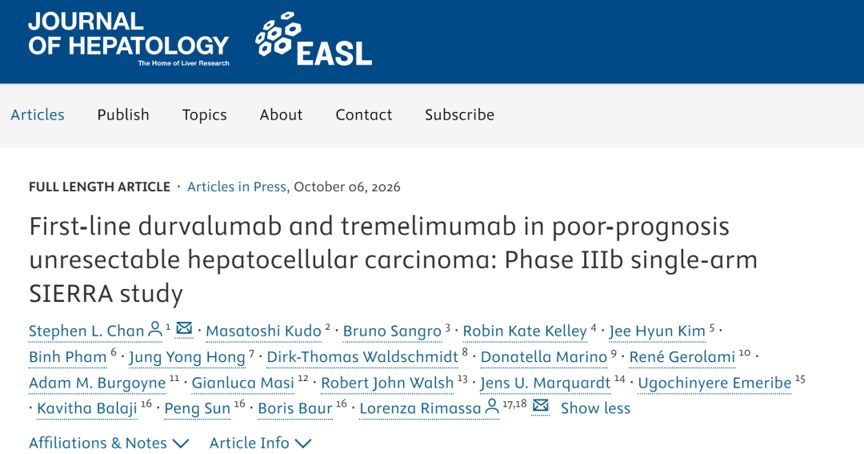
Hepatocellular carcinoma (HCC) represents a major global health burden, with unresectable HCC (uHCC) accounting for a substantial proportion of cases and carrying a poor prognosis. Pivotal phase III clinical trials in uHCC have generally excluded patients with poor prognostic factors, including impaired liver function (e.g., Child-Pugh class B/C), poor performance status (ECOG performance status [PS] >1), or main trunk portal vein tumor thrombosis (Vp4). In clinical practice, these patients account for as much as 65% of the uHCC population. In recent years, combination immunotherapy has become a standard first-line treatment approach for uHCC. The HIMALAYA study established the first-line value of the STRIDE regimen, comprising a single priming dose of tremelimumab followed by maintenance durvalumab. However, HIMALAYA likewise enrolled only patients with Child-Pugh class A liver function, ECOG PS 0–1, and no Vp4 involvement. Because patients with these poor prognostic factors have been underrepresented in global phase III trials, high-level evidence to guide treatment decisions remains limited, making clinical management particularly challenging.To address this unmet need, the phase IIIb SIERRA study (NCT05883644) evaluated the efficacy and safety of first-line STRIDE in patients with uHCC and specific poor prognostic factors. Previously published preliminary safety data from SIERRA indicated that STRIDE had a manageable safety profile. Recently, the primary analysis of SIERRA, reporting safety and efficacy outcomes, was published online in the leading hepatology journal Journal of Hepatology. The findings showed that, in this population with substantial unmet medical needs, the STRIDE regimen had a favorable risk–benefit profile, with a 19.8% incidence of grade 3/4 potentially treatment-related adverse events (PRAEs) within six months and an overall objective response rate (ORR) of 14.4%. As the first prospective interventional study in this setting, SIERRA provides evidence on the safety and efficacy of STRIDE in patients with poor-prognosis uHCC who have historically been underrepresented or excluded from other phase III trials.
Key Study Findings at a Glance
- The incidence of grade 3/4 PRAEs within six months was 19.8% in the overall population, compared with 18.2% in the Child-Pugh B7/B8 cohort, 19.1% in the ECOG PS 2 cohort, and 25.0% in the Vp4 cohort.
- The overall ORR was 14.4%, compared with 6.8% in the Child-Pugh B7/B8 cohort, 21.3% in the ECOG PS 2 cohort, and 15.0% in the Vp4 cohort.
- These findings suggest that first-line STRIDE has a favorable risk–benefit profile in patients with uHCC and poor prognostic factors, particularly those with Child-Pugh B7/B8 liver function, ECOG PS 2, or Vp4 involvement.
Study Design
SIERRA was a single-arm, multicenter, phase IIIb study enrolling adults with histologically confirmed uHCC who met at least one of the following criteria: Child-Pugh B7/B8 liver function (Child-Pugh B7/B8 cohort), ECOG PS of 2 (ECOG PS 2 cohort), or Vp4 portal vein tumor thrombosis (Vp4 cohort).
All patients received the STRIDE regimen: a single dose of tremelimumab 300 mg combined with durvalumab 1,500 mg, followed by durvalumab 1,500 mg every four weeks. Treatment continued until disease progression, unacceptable toxicity, or withdrawal.
The co-primary endpoints were the incidence of grade 3/4 PRAEs within six months of initiating STRIDE and the confirmed ORR assessed by investigators according to RECIST 1.1. Secondary endpoints included safety, overall survival (OS), progression-free survival (PFS), disease control rate (DCR), duration of response (DoR), and duration of treatment (DoT). The study also reported post hoc exploratory endpoints, including OS according to DCR and changes in mean albumin–bilirubin (ALBI) scores over time.
Study Results
A total of 184 patients were screened, of whom 111 received study treatment: 44 in the Child-Pugh B7/B8 cohort, 47 in the ECOG PS 2 cohort, and 20 in the Vp4 cohort. The median age was 70.0 years, 86.5% of patients were male, 40.5% were from Asia excluding Japan, 7.2% were from Japan, and 52.3% were from other regions worldwide.
The median follow-up was 9.17 months in the overall population and 5.27, 14.95, and 4.90 months in the Child-Pugh B7/B8, ECOG PS 2, and Vp4 cohorts, respectively.
Safety: Overall Toxicity Was Manageable, with More Pronounced Safety Events in the Vp4 Cohort
For the co-primary safety endpoint, the incidence of grade 3/4 PRAEs within six months was 19.8% in the overall population, 18.2% in the Child-Pugh B7/B8 cohort, 19.1% in the ECOG PS 2 cohort, and 25.0% in the Vp4 cohort.
Regarding other safety outcomes, the incidence of any adverse event (AE) was 94.6% in the overall population and 93.2%, 93.6%, and 100% in the Child-Pugh B7/B8, ECOG PS 2, and Vp4 cohorts, respectively. Serious AEs occurred in 36.0% of the overall population, compared with 31.8%, 31.9%, and 55.0% in the three respective cohorts.
AEs leading to discontinuation of any study treatment occurred in 12.6% of the overall population, compared with 11.4%, 10.6%, and 20.0% in the respective cohorts. AEs resulting in death occurred in 11.7% of the overall population and 9.1%, 8.5%, and 25.0% of the three cohorts, respectively.
Immune-mediated AEs occurred in 28.8% of the overall population, with 14.4% of patients receiving high-dose corticosteroids. PRAEs were reported in 70.3% of the overall population. The most common PRAEs, each occurring in at least 5% of the safety analysis population, were pruritus (22.5%), hypothyroidism (11.7%), and diarrhea (10.8%).
Most PRAEs occurred early after treatment initiation. Nineteen events had been reported by month 3, with only four additional events observed between months 3 and 12. This pattern suggests that PRAEs were concentrated in the early treatment period, with relatively few new events emerging subsequently.
Efficacy: Confirmed ORR Reached 14.4% Overall, with Different Efficacy Signals Across Risk Groups
For the co-primary efficacy endpoint, the investigator-assessed confirmed ORR was 14.4% in the overall population, 6.8% in the Child-Pugh B7/B8 cohort, 21.3% in the ECOG PS 2 cohort, and 15.0% in the Vp4 cohort.
In the overall population, 1.8% of patients achieved a complete response (CR), 12.6% achieved a partial response (PR), and 45.9% had stable disease (SD). The median DoR was 9.6 months, the 24-week DCR was 44.1%, the median PFS was 3.8 months, and the median OS was 10.6 months. The OS rates at 12 and 24 months were 45.5% and 35.3%, respectively.
In addition, among participants with available assessments at each visit, mean ALBI scores generally remained stable over time in both the individual cohorts and the overall population. A possible trend toward improvement from ALBI grade 2 to grade 1 was observed in the ECOG PS 2 cohort.
Study Conclusions
The safety and efficacy findings from SIERRA indicate that STRIDE has a favorable risk–benefit profile in this population with substantial unmet medical needs. Further investigation with longer follow-up is warranted, including assessment of outcomes within individual cohorts as additional data become available.
Summary
The SIERRA study prospectively evaluated the first-line safety and efficacy of STRIDE in patients with uHCC and poor prognostic factors, focusing on three groups frequently excluded from phase III trials: patients with Child-Pugh B7/B8 liver function, ECOG PS 2, and Vp4 portal vein tumor thrombosis. This report presents the primary analysis, updating the safety findings and providing the first disclosure of efficacy data. Overall, STRIDE demonstrated manageable toxicity, consistent with previously published preliminary safety results, and showed encouraging signs of antitumor activity.
Safety: The incidence of grade 3/4 PRAEs within six months was 19.8% in the overall population, consistent with the 25.8% incidence of grade 3/4 treatment-related adverse events (TRAEs) reported in the STRIDE arm of the primary HIMALAYA analysis. The incidence of other AEs was similar to or lower than that reported with other combination immunotherapy regimens, suggesting that STRIDE has a manageable safety profile in this poor-prognosis population. However, treatment exposure was relatively short in some cohorts, particularly the Child-Pugh B7/B8 and Vp4 cohorts, potentially limiting the time available to observe toxicity. Cross-trial comparisons with HIMALAYA should therefore be interpreted cautiously.
Efficacy: The confirmed ORR was 14.4% in the overall population, reaching 21.3% in the ECOG PS 2 cohort and 15.0% in the Vp4 cohort. The ORRs in the ECOG PS 2 and Vp4 cohorts were consistent with the 20.1% ORR reported for the STRIDE arm of HIMALAYA and the 23% ORR reported in patients with Vp4 involvement in IMbrave150, respectively. The ORR in the Child-Pugh B7/B8 cohort was within the range reported for this population in real-world studies.
The 24-week DCR of 44.1% further indicates that disease stabilization represents an important component of clinical benefit in this population. At a median follow-up of 9.17 months, OS data remained immature. The median OS was 10.6 months, and the 12- and 24-month OS rates were 45.5% and 35.3%, respectively. These findings suggest that some patients may achieve durable benefit, although the absence of a control arm limits definitive conclusions.
Study limitations include the single-arm, open-label design; moderate sample sizes across cohorts; the small number of patients enrolled in the Vp4 cohort; and the possibility of selection bias introduced by eligibility criteria designed to manage safety. Patients with Child-Pugh B9/C liver function or ECOG PS 3 were also excluded. In addition, the median follow-up was shorter than that of HIMALAYA, and difficulties distinguishing Vp3 from Vp4 portal vein tumor thrombosis may also have affected the results.
In conclusion, STRIDE demonstrated a favorable risk–benefit profile in patients with uHCC and poor prognostic factors, a population with substantial unmet medical needs. Further validation through longer follow-up and analyses of individual cohorts is warranted.