


Gastric cancer is a common malignancy worldwide, with a particularly high incidence in China. Most patients are diagnosed at an unresectable, locally advanced or metastatic stage. Approximately 85% of patients have HER2-negative disease. Although first-line immunotherapy combined with chemotherapy has significantly improved outcomes for patients with advanced HER2-negative gastric cancer, the benefits of this approach are beginning to reach a plateau, highlighting the urgent need for new treatment strategies.Gastric cancer is a common malignancy worldwide, with a particularly high incidence in China. Most patients are diagnosed at an unresectable, locally advanced or metastatic stage. Approximately 85% of patients have HER2-negative disease. Although first-line immunotherapy combined with chemotherapy has significantly improved outcomes for patients with advanced HER2-negative gastric cancer, the benefits of this approach are beginning to reach a plateau, highlighting the urgent need for new treatment strategies.Against this backdrop, the phase III RELIGHT study, led by Professor Lin Shen’s team at Peking University Cancer Hospital, represents a major advance in the field. Rilafugratinib alfa is a domestically developed bispecific antibody fusion protein targeting PD-L1 and TGF-β receptor II (TGF-βRII). By simultaneously inhibiting PD-L1 and TGF-β signaling, it delivers dual blockade with the potential to enhance efficacy while reducing toxicity. The RELIGHT study was designed to evaluate the efficacy and safety of rilafugratinib alfa plus chemotherapy versus placebo plus chemotherapy as first-line treatment for patients with HER2-negative, unresectable, advanced or metastatic gastric or gastroesophageal junction (GEJ) adenocarcinoma.
Based on the positive results of the study, rilafugratinib alfa injection was approved by China’s National Medical Products Administration (NMPA) on January 7, 2026, in combination with a fluoropyrimidine and a platinum-based agent for first-line treatment of patients with PD-L1-positive (combined positive score [CPS] ≥1), HER2-negative, locally advanced unresectable, recurrent, or metastatic gastric or GEJ adenocarcinoma, as determined by a validated assay. In addition, the rilafugratinib alfa plus chemotherapy regimen has been included as a Level I recommendation in the 2026 edition of the Chinese Society of Clinical Oncology (CSCO) Guidelines for Gastric Cancer.
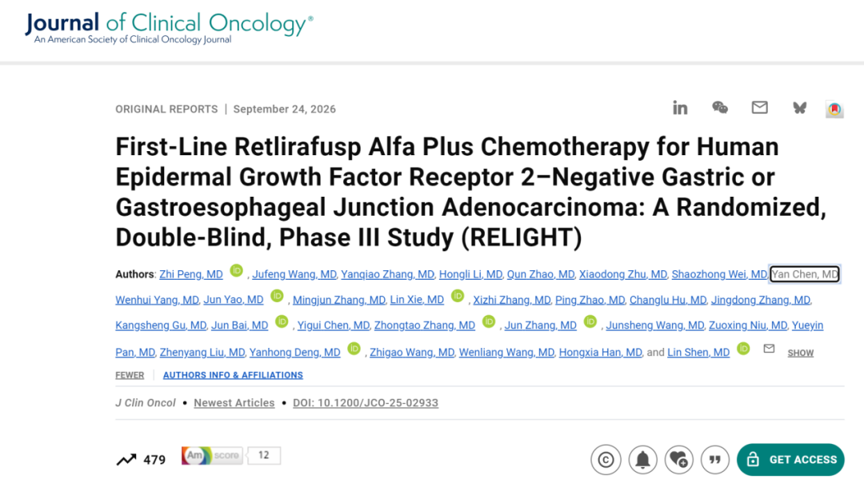
Recently, the full results of the RELIGHT study were published online in the leading international medical journal Journal of Clinical Oncology (JCO). As the first phase III study of a dual PD-L1/TGF-β-targeting agent to formally report positive results in a peer-reviewed publication, RELIGHT further strengthens the evidence supporting rilafugratinib alfa plus chemotherapy as first-line treatment for HER2-negative advanced gastric cancer. The findings also provide strong support for the clinical translation and broader adoption of the dual PD-L1/TGF-β-targeting strategy.
Study Methods
RELIGHT was a randomized, double-blind, phase III clinical trial conducted at 64 centers in China (NCT04950322). A total of 731 patients with previously untreated, unresectable, locally advanced or metastatic gastric or GEJ adenocarcinoma were enrolled and randomly assigned in a 1:1 ratio to receive either rilafugratinib alfa plus chemotherapy or placebo plus chemotherapy.
Stratification factors included PD-L1 expression status (CPS ≥5 vs. CPS <5), performance status (Eastern Cooperative Oncology Group [ECOG] performance status [PS] score of 0 vs. 1), and peritoneal metastasis status (present vs. absent).
The primary endpoints were overall survival (OS) in patients with PD-L1 CPS ≥5 and in the intention-to-treat (ITT) population. Secondary endpoints included progression-free survival (PFS), objective response rate (ORR), disease control rate (DCR), duration of response (DoR), and safety, as assessed by blinded independent central review (BICR) and investigators in both the PD-L1 CPS ≥5 and ITT populations.
Study Results
Between March 11, 2022, and January 13, 2024, 731 patients were randomly assigned to receive rilafugratinib alfa plus CAPOX (N=365) or placebo plus CAPOX (N=366). Baseline characteristics were generally balanced between the two groups.
In the ITT population, the median ages in the rilafugratinib alfa plus chemotherapy and placebo plus chemotherapy groups were 63 and 62 years, respectively. The proportions of patients with an ECOG PS score of 1 were 75.6% and 75.1%, respectively; the proportions with liver metastases were 47.9% and 48.1%; and the proportions with peritoneal metastases were 34.0% and 33.6%. The proportions of patients with tumor PD-L1 CPS ≥5 were 67.4% and 67.8%, respectively. At the data cutoff date of May 20, 2024, the median follow-up was 13.6 months.
Efficacy Analysis: Rilafugratinib Alfa Plus Chemotherapy Significantly Prolonged OS and PFS
OS: In the PD-L1 CPS ≥5 population, rilafugratinib alfa plus chemotherapy significantly prolonged OS compared with placebo plus chemotherapy, reducing the risk of death by 47%. Median OS was 16.8 months versus 10.4 months (hazard ratio [HR], 0.53; 95% confidence interval [CI], 0.40–0.68; P<0.0001).
A significant OS benefit was also observed in the ITT population. Median OS was 15.8 months with rilafugratinib alfa plus chemotherapy versus 11.2 months with placebo plus chemotherapy (HR, 0.66; 95% CI, 0.53–0.81; P<0.0001).
Across most prespecified subgroups, rilafugratinib alfa plus chemotherapy showed a more favorable OS outcome than placebo plus chemotherapy in both the PD-L1 CPS ≥5 and ITT populations. Among patients with PD-L1 CPS ≥1 and <5, median OS was also numerically longer with rilafugratinib alfa plus chemotherapy than with placebo plus chemotherapy (16.4 months vs. 10.3 months; HR, 0.69).
PFS: In the PD-L1 CPS ≥5 population, median PFS assessed by BICR was 7.6 months with rilafugratinib alfa plus chemotherapy and 5.5 months with placebo plus chemotherapy (HR, 0.52). In the ITT population, median PFS was 7.0 months and 5.5 months, respectively (HR, 0.57) (Figure 1).
PFS benefits with rilafugratinib alfa plus chemotherapy were observed in nearly all prespecified subgroups. Among patients with PD-L1 CPS ≥1 and <5, median PFS was 7.0 months with rilafugratinib alfa plus chemotherapy versus 5.6 months with placebo plus chemotherapy (HR, 0.50).
ORR and DoR: In the PD-L1 CPS ≥5 population, the confirmed ORR assessed by BICR was 56.5% with rilafugratinib alfa plus chemotherapy and 32.7% with placebo plus chemotherapy. In the ITT population, the corresponding BICR-confirmed ORRs were 53.4% and 32.8%, respectively.
In the PD-L1 CPS ≥5 population, median DoR assessed by BICR was 10.2 months with rilafugratinib alfa plus chemotherapy versus 5.1 months with placebo plus chemotherapy. In the ITT population, median DoR was 8.5 months and 5.3 months, respectively.
Safety Analysis: Manageable Overall Toxicity, with No New Safety Signals Identified
The incidence of grade ≥3 treatment-related adverse events (TRAEs) was broadly comparable between the rilafugratinib alfa plus chemotherapy and placebo plus chemotherapy groups (62.6% vs. 59.0%). The most common events included decreased platelet counts (19.0% vs. 28.1%), decreased neutrophil counts (12.1% vs. 16.4%), and anemia (19.8% vs. 12.6%).
The incidence of TRAEs leading to discontinuation of any study drug was 10.4% in the rilafugratinib alfa plus chemotherapy group and 3.0% in the placebo plus chemotherapy group. Serious TRAEs occurred in 34.9% and 24.0% of patients, respectively, while treatment-related deaths occurred in 1.9% and 1.1%, respectively.
Study Conclusions
The RELIGHT study demonstrated that, in previously untreated patients with unresectable, locally advanced or metastatic HER2-negative gastric or GEJ adenocarcinoma, rilafugratinib alfa plus CAPOX provided a statistically significant and clinically meaningful OS benefit compared with placebo plus CAPOX, while also improving PFS and tumor response.
The combination demonstrated manageable toxicity, with no new safety signals identified. These findings support rilafugratinib alfa plus CAPOX as a new first-line treatment option for this patient population.
An important limitation, however, is that the study used chemotherapy alone as the control arm. The study protocol had been finalized before immunotherapy plus chemotherapy became an approved standard of care in China.
Summary
The RELIGHT study provides high-level clinical evidence supporting first-line treatment for HER2-negative advanced gastric or GEJ adenocarcinoma. Previously reported data showed that, among patients with PD-L1 CPS ≥1, rilafugratinib alfa plus chemotherapy significantly improved survival compared with the control regimen (median OS, 16.7 months vs. 10.3 months; HR, 0.57).
The newly published data further demonstrate the benefits of this regimen across the overall population and multiple subgroups. Both the PD-L1 CPS ≥5 and ITT populations experienced comprehensive improvements in OS, PFS, ORR, and DoR with rilafugratinib alfa plus chemotherapy.
In terms of safety, the overall toxicity of the combination was manageable, with no new safety signals identified. The regimen may also reduce chemotherapy-related myelosuppression.
Supported by the robust evidence from RELIGHT, rilafugratinib alfa plus chemotherapy has received NMPA approval and has been included as a Level I recommendation in the 2026 edition of the CSCO Guidelines for Gastric Cancer, establishing it as one of the standard first-line treatment options.
Overall, publication of the RELIGHT results in Journal of Clinical Oncology further reinforces the important role of rilafugratinib alfa plus chemotherapy in the first-line treatment of HER2-negative advanced gastric or GEJ adenocarcinoma. The findings provide strong support for the clinical translation and broader application of this dual-targeting strategy in HER2-negative advanced gastric cancer.