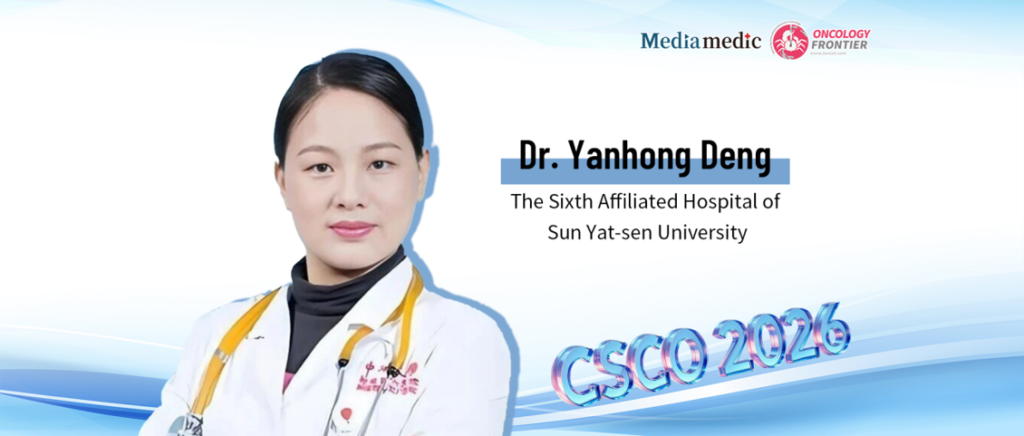
Editor's Note: The 29th Chinese Society of Clinical Oncology (CSCO) Academic Annual Meeting was held in Jinan from September 16 to 19, 2026. Under the theme “Upholding Standards and Advancing Digital and Intelligent Innovation,” the meeting showcased China's achievements in oncology innovation, reflecting the country's transition from following global advances to keeping pace with—and increasingly leading—the field. In the treatment of RAS wild-type metastatic colorectal cancer (mCRC), the introduction of China's domestically developed, fully human anti-EGFR antibody panitumumab N01 is significantly reshaping the anti-EGFR treatment landscape. During the meeting, Professor Yanhong Deng of the Sixth Affiliated Hospital of Sun Yat-sen University spoke with Oncology Frontier about the evolution of first-line treatment for advanced RAS wild-type colorectal cancer, the clinical value of panitumumab N01, and the future of China's innovative medicines.1. Looking Back: The Evolution of First-Line Treatment for Advanced RAS Wild-Type CRC and the Role of Anti-EGFR Antibodies
Oncology Frontier: China sees approximately 562,000 new cases of colorectal cancer (CRC) annually, making it the third most common malignancy in the country. RAS wild-type disease represents one of the major molecular subtypes. To begin, could you review the evolution of first-line treatment for advanced RAS wild-type CRC and explain the role of anti-EGFR antibodies?
Professor Yanhong Deng: The incidence of colorectal cancer continues to rise, and the figure of 562,000 new cases actually comes from data collected several years ago.
Over the past 20 years, RAS has arguably been the first molecular target to attract significant attention in precision treatment for colorectal cancer. One of the earliest clinical studies to examine RAS mutation status was the CRYSTAL study, which was also the first study of anti-EGFR therapy in colorectal cancer. The overall results were negative. At that time, median overall survival (OS) in advanced colorectal cancer was approximately 13–19 months.
Following the CRYSTAL study, further analyses identified differences between patients with RAS mutations and those with RAS wild-type disease. Researchers subsequently found that patients with RAS wild-type tumors could benefit from anti-EGFR therapy, with OS extending to 24.9 months.
As our understanding of anti-EGFR therapy deepened and data from additional clinical studies accumulated, we further discovered that patients with left-sided RAS wild-type colorectal cancer benefited more than those with right-sided disease. In the latest studies, OS among patients with left-sided RAS wild-type colorectal cancer receiving anti-EGFR therapy has approached 40 months. These advances demonstrate how precision treatment can make colorectal cancer therapy more effective, substantially prolong survival, and significantly improve patients’ quality of life.
Overall, anti-EGFR therapy is a standard treatment for patients with RAS wild-type mCRC, particularly those with microsatellite-stable (MSS) tumors that are wild-type for both RAS and BRAF. Anti-EGFR therapy is especially important for these patients and may be more critical than some other chemotherapy options.
For a long time, cetuximab was the only anti-EGFR treatment available in China. We are therefore very pleased to see that panitumumab N01, a fully human antibody independently developed in China, entered the market in 2025, ushering in an era of greater choice in anti-EGFR treatment.
2. Guideline Changes: How the Approval of Panitumumab N01 Is Affecting First-Line Treatment of RAS Wild-Type mCRC
Oncology Frontier: In December 2025, the first domestically developed panitumumab N01 was approved, filling the gap in China’s availability of fully human anti-EGFR antibodies. It was also rapidly incorporated into the 2026 CSCO Guidelines for Colorectal Cancer. What changes has this brought to first-line treatment for RAS wild-type mCRC?
Professor Yanhong Deng: The CSCO Guidelines for Colorectal Cancer continue to evolve with the latest evidence. The updated guidelines recommend an anti-EGFR antibody combined with chemotherapy as first-line treatment for patients with RAS wild-type left-sided colon cancer who are suitable for intensive treatment, with particular emphasis on those with left-sided disease.
The most significant update is that, whereas cetuximab was previously the only available option, there are now more choices: cetuximab, cetuximab beta, cetuximab N01, and panitumumab N01. As a result, the CSCO guidelines have replaced the previous specific recommendation for cetuximab with a broader recommendation for the anti-EGFR antibody class.
Panitumumab N01 entered the guidelines less than six months after its market approval, reflecting its recognition by clinicians and CSCO. Its approval was supported by a multicenter, randomized controlled clinical trial involving more than 600 patients, who were assigned in a 2:1 ratio to combination therapy or chemotherapy alone.
The results showed PFS improvement consistent with previous anti-EGFR studies, increasing from 8.3 months to 11 months. OS increased from 24.5 months to 27.3 months. These findings were generated in a Chinese patient population and were comparable to those reported for other anti-EGFR antibodies, earning broad recognition from the clinical community.
As the world’s first biosimilar of panitumumab, panitumumab N01 fills the gap in the availability of fully human anti-EGFR antibodies in China. It is a fully human IgG2 antibody, which is expected to have lower immunogenicity than chimeric human-mouse IgG1 antibodies. Consequently, infusion reactions, rash, and other adverse events may be less frequent, potentially improving treatment adherence.
From clinical trial evidence to guideline recommendations, panitumumab N01 has made the transition from demonstrating evidence-based benefit to becoming part of standard treatment recommendations, providing clinicians with another option.
3. Clinical Benefits: The Practical Value of Panitumumab N01 for Patients in China
Oncology Frontier: As the original anti-EGFR antibody approaches its 20th anniversary, panitumumab N01 has become the first domestically developed EGFR antibody to receive approval in China. What value do you believe this will bring to clinical practice in China?
Professor Yanhong Deng: In the treatment of mCRC with anti-EGFR therapy, we have long faced limited drug choices and high treatment costs. Panitumumab was not previously available in China, leaving us with relatively few options for an extended period.
Panitumumab N01 took only 12 days to move from approval to clinical availability and entered the guidelines within approximately six months. This reflects the efficiency of China’s healthcare and drug development systems and represents an important step toward addressing an unmet need. It also fills the gap in the domestic availability of fully human anti-EGFR antibodies.
As a biosimilar of panitumumab, panitumumab N01 has highly comparable molecular structure, pharmacological properties, efficacy, and safety to the reference product. The domestic QL1203-003 study also demonstrated that its efficacy was superior to chemotherapy alone. Compared with international studies of similar treatments, the PFS and OS results were very close.
Regarding safety, fewer infusion reactions have been observed, and the drug has a favorable half-life profile. It can be administered every two to three weeks, reducing the number of hospital visits required. We also hope that it will be included in China’s National Reimbursement Drug List as soon as possible, improving access for more patients.
Improved access to this drug also has broader implications for advancing diagnosis and treatment. Our focus extends beyond patients with RAS/BRAF wild-type disease. There is also considerable potential for its use in long-term combination strategies, including combinations with emerging RAS inhibitors.
4. Looking Ahead: From Catching Up to Keeping Pace—and Ultimately Leading
Oncology Frontier: The approval of panitumumab N01 is also a reflection of the progress China is making toward developing more effective and innovative cancer treatments. As a leading expert in oncology, what are your hopes for the international expansion of China’s innovative medicines?
Professor Yanhong Deng: The rapid approval of this drug and its subsequent inclusion in the guidelines demonstrate the efficiency of China’s system. It is also a microcosm of the broader evolution of China’s anticancer drug development, from following global advances to keeping pace with international leaders.
This year marks the beginning of China’s 15th Five-Year Plan period. At the national level, comprehensive support is being provided throughout the innovation chain for the development of innovative medicines and medical devices. All participants in anticancer drug development—including pharmaceutical companies, clinicians, and Chinese patients—are effectively experiencing this transition from keeping pace with global leaders to moving ahead of them.
We believe that, over the next five to ten years, comprehensive support from China’s policies, talent pool, and research environment will help us make the leap toward global leadership.
At this year’s CSCO Annual Meeting, we saw joint international sessions organized by CSCO, ASCO, and ESMO, providing an excellent platform for international exchange. As one of China’s most important academic organizations in clinical oncology, CSCO is helping bring Chinese clinical evidence and Chinese standards to the world.
I am very confident about the future. I believe that Chinese expertise, Chinese treatment solutions, and China’s innovation capabilities will play an increasingly influential and leading role globally.

Professor Yanhong Deng