Editor's Note: Breast cancer is one of the most common malignancies among women worldwide. Optimizing screening strategies is essential to improving early detection and reducing mortality. The 2026 Lingnan Breast Cancer Academic Forum was recently held in Guangzhou. At the meeting, Professor Wing Cheong Chow, Medical Director of the Comprehensive Breast Care Centre at Hong Kong Yan Hong Medical Centre, delivered a presentation entitled “Controversies of Breast Cancer Screening Strategies in Asia,” examining the challenges that breast characteristics among Asian women pose for mammography and outlining potential screening approaches. Following the presentation, Oncology Frontier invited Professor Chow to discuss current controversies surrounding the choice of breast cancer screening modalities in Asia, as well as how to balance the risks of overdiagnosis and missed diagnoses.01 | Controversies Surrounding Mammography Screening in Asian Women
Oncology Frontier: Asian and Western women differ significantly in breast density and age-specific breast cancer incidence patterns. What controversies does conventional mammography screening face in Asian populations? What are the main differences in screening strategies across Asian countries?
Professor Wing Cheong Chow: First, both the average age at breast cancer diagnosis and the age at which incidence peaks tend to be lower among women in Asian countries than among women in Western countries. This difference directly affects the development of screening strategies.
Second, Asian women generally have higher breast density. Dense glandular tissue appears white on mammograms and can obscure lesions that also appear white, such as masses or microcalcifications, thereby increasing the risk of missed diagnoses.
Third, Asian women often have smaller breasts or more compact glandular tissue. Mammography may therefore be less effective, and patients frequently experience considerable discomfort during the examination. More suitable screening approaches urgently need to be explored.
Given these characteristics, many experts in Asia recommend ultrasound as a supplementary screening modality to mammography, with some advocating ultrasound examinations every six months to address the limitations of mammography. At a previous Asian breast cancer screening symposium, we reached a consensus that mammography alone is insufficient for breast cancer screening. Ultrasound should also be incorporated across different age groups, combining mammography with ultrasound to improve detection and reduce missed diagnoses.
02 | Developing Risk-Stratified and Precision Screening Pathways for Asian Populations
Oncology Frontier: Mammography, ultrasound, and breast magnetic resonance imaging (MRI) each have advantages and limitations. Considering the breast characteristics of Asian women and the distribution of healthcare resources, how should China and other Asian countries develop more refined, risk-stratified screening pathways?
Professor Wing Cheong Chow: Western countries generally rely on mammography as the primary screening modality, whereas screening pathways in China differ according to whether women are at low or high risk.
We recommend that women begin screening at age 40. For women at low risk, mammography every one to two years, supplemented by ultrasound, may be appropriate. For women at high risk, we recommend screening every six months or combining mammography with ultrasound.
For women at particularly high risk, breast MRI may also be considered. MRI can detect small lesions with greater precision and help identify cancer at an earlier stage. It is especially useful when mammographic findings are unclear, as it provides more detailed imaging information. These are all modalities that we actively recommend as part of our screening approach.
03 | Balancing Screening Benefits, Healthcare Resources, and Overdiagnosis
Oncology Frontier: Breast cancer screening has long faced the practical challenge of balancing overdiagnosis against missed diagnoses. Based on your clinical experience, how should Asian countries balance the benefits of screening, healthcare resource allocation, and the risk of overdiagnosis when developing locally adapted breast cancer screening guidelines?
Professor Wing Cheong Chow: This is an excellent question. First, although MRI is more precise than mammography and ultrasound in certain respects, it can still produce false-positive results. Contrast agents are administered during MRI examinations to improve diagnostic accuracy and help reduce false-positive findings.
Second, because Asian women tend to have denser breast tissue, mammography is associated with a relatively higher risk of missed diagnoses. We therefore recommend supplementary ultrasound or MRI, whenever appropriate, for women with dense breasts.
In addition, automated breast ultrasound technology is advancing rapidly. Compared with handheld ultrasound, automated systems can provide more objective results and are easier to integrate with artificial intelligence (AI) for data analysis, potentially further reducing missed diagnoses. In my view, this will be an important direction for future development.
In China, we could gradually introduce more AI technologies and integrate them with mammography screening to optimize screening programs and achieve a better balance between clinical benefits and healthcare resource allocation.
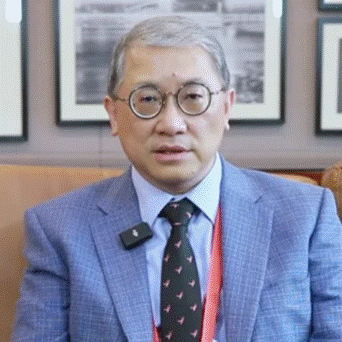
Professor Wing Cheong Chow