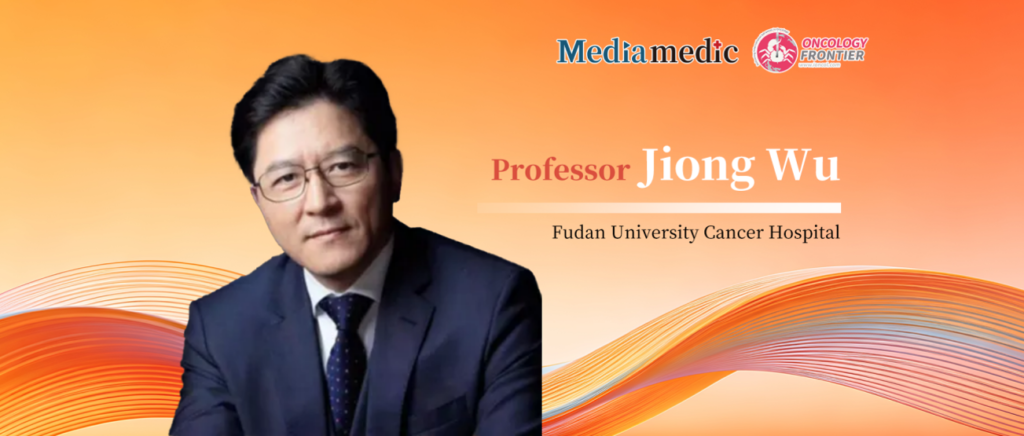
Editor’s Note: The 15th Sino-French Breast Reconstruction Congress and the 13th Sino-French Breast Cancer Academic Conference recently concluded successfully in Chongqing. During the meeting, Professor Jiong Wu from Fudan University Shanghai Cancer Center (FUSCC) delivered a featured presentation on the “FUSCC Model of Autologous Breast Reconstruction,” systematically outlining his center’s distinctive framework and standardized training pathway for autologous tissue breast reconstruction.Oncology Frontier invited Professor Jiong Wu for an interview to discuss the defining features of the “FUSCC Model,” the major challenges encountered when disseminating these techniques to regional and community medical centers, and his team’s experience in building a sustainable multidisciplinary reconstruction program.
01
Oncology Frontier: At the 15th Sino-French Breast Reconstruction Congress, you presented on the “FUSCC Model of Autologous Breast Reconstruction.” Compared with presentations focused purely on surgical techniques such as DIEP (deep inferior epigastric perforator flap), what distinguishes the “FUSCC Model” that you emphasized?
Professor Jiong Wu:
“Compared with implant-based reconstruction, autologous breast reconstruction offers several unique advantages because it utilizes the patient’s own tissue, including skin, subcutaneous tissue, and occasionally a small amount of muscle.
The available reconstructive techniques are also highly diverse, including pedicled flaps, free flaps, flap-implant hybrid approaches, and autologous fat grafting.
These procedures originated in the 1970s and 1980s, initially evolving from pedicled flap techniques into a wide range of free-flap procedures. China adopted and implemented these technologies relatively early. At Fudan University Shanghai Cancer Center, we began exploring autologous breast reconstruction in the early 2000s through collaboration with plastic surgeons and international exchanges with overseas experts.
At that time, access to implants, acellular dermal matrices, tissue expanders, and related materials was still quite limited. As a result, the vast majority of reconstruction patients underwent autologous reconstruction.
Looking back, autologous reconstruction techniques themselves have evolved considerably—from predominantly latissimus dorsi flaps toward abdominal-based flap reconstruction. Today, free abdominal flaps, especially deep inferior epigastric perforator (DIEP) flaps, account for a greater proportion of procedures than latissimus dorsi flaps and have become the dominant approach.
At the same time, flap options have continued to expand. For example, profunda artery perforator (PAP) flaps from the medial thigh and gracilis free flaps are now widely utilized in clinical practice.
In addition, as implant-based reconstruction has become increasingly common, some patients subsequently develop complications, unsatisfactory cosmetic outcomes, or radiation-related deformities after adjuvant treatment. In many of these cases, autologous tissue reconstruction is ultimately required for correction and salvage.
As the scale of breast cancer treatment at FUSCC has continued to expand, the proportion of implant-based versus autologous breast reconstruction among patients undergoing mastectomy has remained relatively stable in recent years at approximately 75% versus 25%, respectively. This means that autologous reconstruction still maintains a substantial clinical volume at our institution.
At the same time, we have established a dedicated training model for breast surgeons in autologous breast reconstruction. In particular, our free-flap training pathway has evolved into a highly structured and standardized process. We also employ increasingly refined strategies for perforator vessel selection.
As a result, physicians who train at our institution generally achieve excellent outcomes, and an increasing proportion are able to independently perform these procedures after returning to their own hospitals. This demonstrates that the ‘FUSCC Model’ is both replicable and scalable.”
02
Oncology Frontier: During the process of disseminating the “FUSCC Model” to regional and community medical centers, what have been the major bottlenecks? To achieve technical standardization and quality control, what key elements beyond surgical skills training should we prioritize in order to enable more breast cancer patients to safely access high-quality autologous reconstruction close to home?
Professor Jiong Wu:
“At present, the major bottleneck is that breast specialists need to recognize that mastering these procedures requires time and systematic accumulation of experience.
Training should ideally occur at high-volume centers with well-established and standardized educational pathways. In addition, physicians may benefit from rotating through different breast centers across China, each with its own unique strengths, in order to gain broader exposure to various reconstruction techniques. This comprehensive experience is extremely valuable for future independent surgical practice.
Currently, China’s standardized residency training system has become quite mature. However, subspecialty training—particularly in breast surgery—still requires further development. We need more advanced demonstration centers, more standardized faculty systems, and clearer training guidelines in order to provide comprehensive and structured educational opportunities for breast specialists nationwide.
Only through these efforts will community and regional hospitals be able to apply these techniques effectively and better serve local patients.”
03
Oncology Frontier: During the live surgery program of the 15th Sino-French Breast Reconstruction Congress, you demonstrated highly complex reconstructive procedures such as free profunda artery perforator flap breast reconstruction. For these technically demanding microsurgical procedures, how does the FUSCC team maintain low complication rates and high aesthetic satisfaction while managing such a high-volume clinical workload?
Professor Jiong Wu:
“First, it is essential to establish a highly targeted, standardized, and comprehensive patient evaluation and treatment system that ensures consistently high-quality surgery.
Although our institution—Fudan University Shanghai Cancer Center—treats a very large number of patients, each patient remains an individual with unique expectations regarding treatment.
Therefore, from the very beginning of the diagnostic process, we formulate detailed surgical plans for each patient. During surgical decision-making, we provide extensive information and conduct thorough discussions so patients fully understand the advantages and disadvantages of different reconstruction approaches following mastectomy.
At the same time, we must carefully assess the biological characteristics of the patient’s tumor and anticipate future treatment needs. We also consider personal factors such as fertility plans, exercise habits, and lifestyle preferences.
This comprehensive evaluation and communication process provides a much stronger foundation for surgical decision-making and also helps reduce the likelihood of postoperative decisional regret.
From the perspective of our surgical team, it is critical to master a broad range of reconstructive techniques and to apply them proficiently according to individual patient needs.
In addition, our nursing team receives specialized training in perioperative rehabilitation guidance and flap monitoring. Over time, these integrated efforts have evolved into a highly systematic program within our institution.
Building upon this framework, we have also established dedicated breast oncoplastic and reconstructive subspecialty services within our breast disease center. This organizational structure allows patients with specific reconstructive needs to receive more targeted and specialized care.”
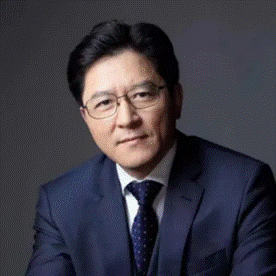
Professor Jiong Wu