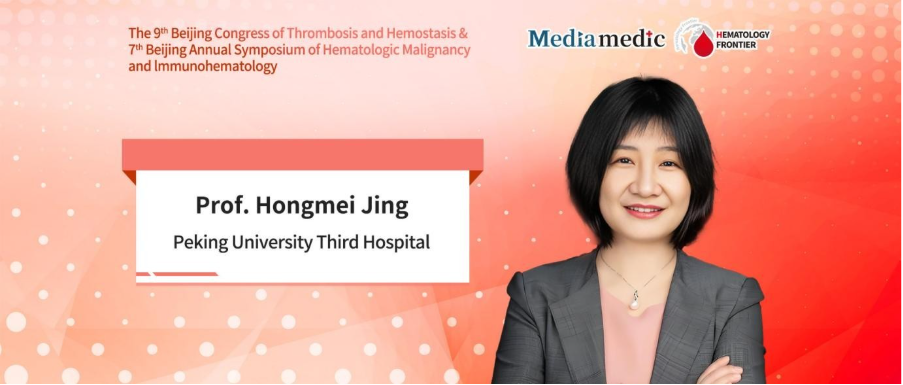
In March, as spring brings renewed vitality to Beijing, the 9th Beijing Conference on Thrombosis and Hemostasis, together with the 7th Beijing Hematologic Oncology and Immunology Summit Forum, was held from March 27 to 28, 2026. Centered on advances in the diagnosis and treatment of thrombotic and hemostatic disorders, as well as hematologic malignancies and immunology, the meeting highlighted cutting-edge developments and evolving clinical strategies. During the conference, Oncology Frontier – Hematology Frontier invited Professor Hongmei Jing from Peking University Third Hospital for an in-depth interview. Focusing on key clinical challenges in lymphoma, she presented her team’s recent findings published in Nature on the cf-EpiTracing liquid biopsy technology. This approach enables disease diagnosis, dynamic treatment monitoring, and minimal residual disease (MRD) assessment using only a small volume of peripheral blood, thereby supporting precise classification and prognostic evaluation. She further elaborated on advances in MRD monitoring and individualized precision therapy, and discussed the potential synergy of this technology with innovative treatments such as bispecific antibodies and CAR-T cell therapy, with the aim of optimizing treatment decisions and improving long-term patient outcomes.
Clinical Value of cf-EpiTracing in Precision Lymphoma Management
Oncology Frontier – Hematology Frontier: Your team recently published the cf-EpiTracing liquid biopsy technology in Nature, which overcomes key limitations of traditional liquid biopsy and enables noninvasive, high-precision lymphoma subtyping and prognostic prediction. Could you elaborate on how this technology addresses current clinical challenges and its future role in advancing precision lymphoma care?
Professor Hongmei Jing: This study was conducted collaboratively by our team and Professor Aibin He from Peking University. The principal advantage of cf-EpiTracing lies in its ability to achieve both disease diagnosis and continuous, real-time monitoring of treatment response using only a minimal volume of peripheral blood, making it highly valuable in clinical practice.
Looking ahead, its applications can be broadly categorized into three areas. First, in the diagnostic setting, it provides an important complementary tool for patients in whom tissue sampling is difficult, thereby facilitating accurate tumor characterization. Second, for treatment response evaluation, it enables dynamic monitoring throughout the entire course of therapy, with observed trends closely correlating with clinical outcomes, thus offering a reliable basis for efficacy assessment. Third, in the context of MRD monitoring, even when patients achieve radiographic remission, this technology allows for deeper molecular-level evaluation to determine whether a more profound remission has been achieved. It is widely recognized that only sufficiently deep remission translates into prolonged progression-free survival and overall survival, ultimately moving patients closer to a curative outcome.
Addressing Key Challenges in Lymphoma: MRD Standardization and Refractory Disease
Oncology Frontier – Hematology Frontier: You have long been engaged in research on molecular diagnostics, MRD monitoring, and immunotherapy in lymphoma, and have led multiple national projects in mantle cell lymphoma and diffuse large B-cell lymphoma. In light of current clinical challenges—such as relapsed/refractory disease and the heterogeneity of lymphoma subtypes—what key breakthroughs has your team achieved?
Professor Hongmei Jing: Two major challenges remain central in current lymphoma management. The first concerns treatment evaluation. Although MRD monitoring and MRD-guided therapeutic strategies are widely emphasized in the literature, achieving accurate detection and standardization of MRD assays remains a critical issue in both clinical practice and research. Our team is actively working to establish standardized protocols for MRD detection, with the goal of making these methods more broadly applicable across different patient populations.
The second challenge lies in relapsed and refractory disease. Despite the growing number of therapeutic options and newly approved agents, a trial-and-error approach is not feasible in real-world clinical practice. Unlike experimental settings, where multiple regimens can be tested in vitro or in model systems, clinical decision-making must be both prospective and precise. Therefore, comprehensive genomic profiling prior to treatment—enabling molecular classification and guiding individualized targeted therapy—has become an increasingly important direction in the field.
Synergy Between Novel Therapies and Precision Monitoring
Oncology Frontier – Hematology Frontier: In recent years, innovative therapies such as bispecific antibodies and CAR-T cell therapy have emerged in lymphoma, with some agents now included in national reimbursement programs, significantly improving accessibility. Based on your clinical and research experience, how do you view the integration of these therapies with cf-EpiTracing and targeted treatment strategies? Can such synergy further optimize treatment and improve long-term outcomes?
Professor Hongmei Jing: A number of novel agents, including bispecific antibodies and CAR-T therapies, are now available in the lymphoma field. However, the optimal timing for their use remains a subject of ongoing debate. Although these therapies have demonstrated clear benefits and are currently approved בעיקר for second-line and later settings, there is growing interest in whether they should be introduced earlier, particularly for high-risk patients.
In this context, MRD monitoring plays a pivotal role. If a patient achieves both radiographic remission and MRD negativity, it may be reasonable to defer the use of more intensive therapies, thereby sparing the patient from potential adverse effects and financial burden. Conversely, if MRD remains positive despite radiographic remission, early escalation to more effective treatment strategies should be considered.
Thus, MRD monitoring provides critical guidance for clinical decision-making, enabling a more rational and individualized approach to therapy, and ultimately improving patient outcomes.
Expert Profile

Hongmei Jing, MD, PhD Professor, Chief Physician, Doctoral Supervisor Director, Department of Hematology, Peking University Third Hospital
Professor Jing is a leading expert in lymphoma research and clinical practice. She serves as Vice Chair of the Oncology Expert Committee of the Chinese Women Physicians Association, Vice Chair of the Lymphoma Committee of the Chinese Medical Education Association, and Vice Chair of the Youth Committee of the Hematology Branch of the same association. She is also Chair of the Hematologic Oncology Committee of the Beijing Society of Integrative Medicine, a standing committee member of the Geriatric Oncology Committee of the Chinese Geriatrics Society, and a member of the Diagnostics Group of the Hematology Branch of the Chinese Medical Association.
She has led or participated in multiple national and regional research projects, including grants from the National Natural Science Foundation of China and the Beijing Natural Science Foundation. She has received the Second Prize of the Higher Education Outstanding Scientific Research Achievement Award (Science and Technology Progress) and has published more than 60 academic papers, as well as contributing to several academic monographs.