Home » ASH25 China Voice | Dr. Yishan Ye: Haploidentical Transplantation Shows Superior Outcomes for MRD-Positive AML in CR
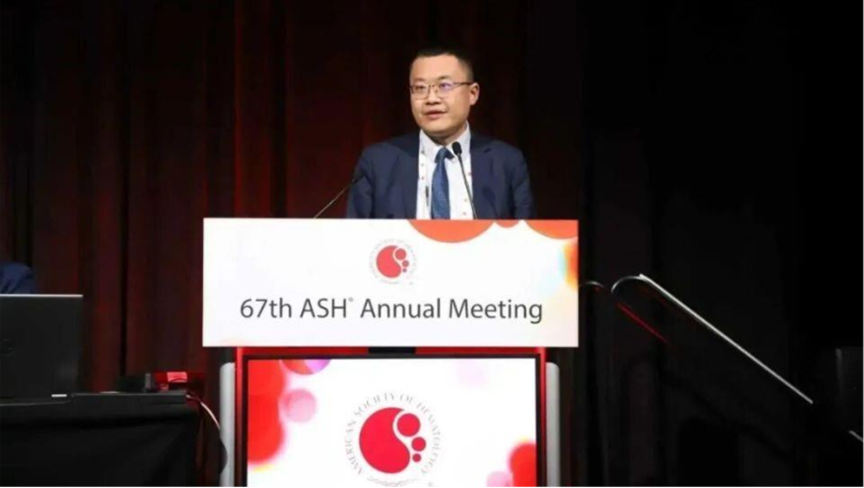
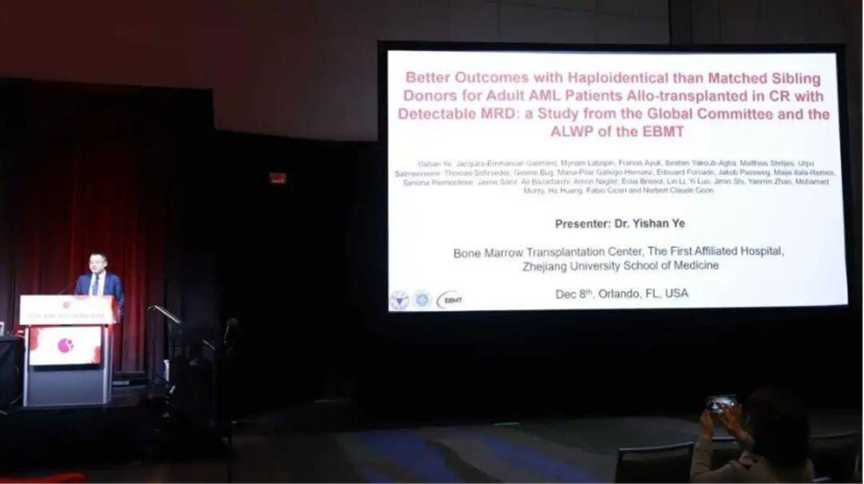
Previous collaborative studies between the European Society for Blood and Marrow Transplantation (EBMT) and Prof. He Huang’s team have demonstrated that haploidentical hematopoietic stem cell transplantation (HAPLO-HSCT) can confer clinical benefit in high-risk acute myeloid leukemia (AML). Building on this foundation, Dr. Yishan Ye from The First Affiliated Hospital, Zhejiang University School of Medicine presented updated results at the 67th Annual Meeting of the American Society of Hematology (ASH 2025), reporting outcomes of adult AML patients in complete remission (CR) with measurable residual disease (MRD) undergoing transplantation (Abstract No. 1059).
To further elucidate the clinical implications of this study, Hematology Frontier invited Dr. Ye for an in-depth on-site discussion, aiming to inform optimization of donor selection strategies in this high-risk population.
Hematology Frontier: Your study focuses on adult AML patients in MRD-positive CR and proposes that haploidentical donors may improve outcomes through a stronger graft-versus-leukemia (GVL) effect. What prior evidence supported this hypothesis, and why is MRD-positive CR a particularly meaningful clinical setting?
Dr. Yishan Ye:
This hypothesis is grounded in multiple prior studies from China, the United States, and Europe. Over the past two years, under the leadership of Prof. He Huang, our team has collaborated closely with the EBMT to investigate donor selection in high-risk AML.
Collectively, these studies suggest that in high-risk or relapsed/refractory AML, haploidentical transplantation may reduce relapse through a more potent GVL effect, ultimately translating into survival benefit. The current study represents a continuation and refinement of this research trajectory.
MRD-positive CR is a clinically critical state: patients are in morphologic remission but retain a biologically measurable relapse risk, making this group ideal for evaluating the impact of donor-driven anti-leukemic effects.
Hematology Frontier: In your cohort, a higher proportion of patients in the HAPLO group underwent transplantation in CR2 (22%) compared with the matched sibling donor (MSD) group (15%). Despite CR2 being a known high-risk factor, HAPLO transplantation still showed superior outcomes. Does this suggest donor type may outweigh disease status at transplant? Should donor selection differ between MRD-positive CR1 and CR2 patients?
Dr. Yishan Ye:
Indeed, a larger proportion of CR2 patients were transplanted in the haploidentical group. Nevertheless, haploidentical transplantation consistently demonstrated superiority in relapse prevention and survival outcomes.
These findings further support the notion that, compared with HLA-matched related or unrelated donors, haploidentical donors may provide a unique and stronger GVL effect. However, whether these data should directly change clinical decision-making requires confirmation through prospective, randomized studies with larger cohorts.
Hematology Frontier: Your study concludes that for MRD-positive AML patients in CR, haploidentical transplantation offers better relapse control, leading to improved LFS and GRFS. How should this influence current donor selection strategies, and what are your priorities for future research?
Dr. Yishan Ye:
From a practical standpoint, for high-risk AML patients, particularly those who are MRD-positive prior to transplant, in CR2, or with relapsed disease, haploidentical transplantation may be preferentially considered.
Looking ahead, our focus is to further mine these large-scale registry data and, critically, to design prospective randomized controlled trials to validate these observations. Only through such efforts can we establish robust evidence to guide individualized donor selection.
Ultimately, optimizing donor choice and transplant strategies remains a complex and evolving field, requiring close collaboration among national and international centers.
Abstract Summary
Abstract 1059Title:Haploidentical versus matched sibling donors for adult AML patients transplanted in complete remission with measurable residual disease: an EBMT ALWP study
Key Findings
3,385 adult AML patients transplanted in CR1 or CR2 with detectable MRD (2015–2022, 269 EBMT centers)
All haploidentical transplants used post-transplant cyclophosphamide (PTCy)
Multivariable analysis showed:
MSD transplantation was associated with higher relapse risk compared with HAPLO (HR = 1.55)
Inferior leukemia-free survival (LFS) and GVHD-free/relapse-free survival (GRFS) in MSD vs HAPLO
Matched unrelated donors had higher relapse rates but similar overall survival
CR2 status, advanced age, and poor performance status adversely impacted outcomes
Myeloablative conditioning was associated with reduced relapse and improved survival
Conclusion
For AML patients transplanted in MRD-positive CR, haploidentical transplantation provides superior long-term LFS and GRFS compared with matched sibling donors, largely driven by enhanced relapse prevention.
Expert Profile
Dr. Yishan Ye The First Affiliated Hospital, Zhejiang University School of Medicine
Associate Research Professor; Master’s Supervisor
National and provincial high-level talent awardee
Principal investigator of national and international collaborative grants
10 first/corresponding-author papers in Blood, STTT, JHO, Am J Hematol, Cell Discovery
Editorial Board Member, Bone Marrow Transplantation
Invited speaker and oral presenter at ASH (4 oral presentations) and EBMT
EBMT China Office Research Coordinator; IACH Young Ambassador